Review of Downfall (2004) by Joe A — 19 Sep 2009
"If the war is lost, it is immaterial if the German people survive. I will shed not one tear for them.".
The words uttered by Adolf Hitler in response to pleas by his advisers, generals and remaining followers in the Fuhrer bunker to end the war before more destruction is brought upon Germany by the vengeful Red Army. The statement epitomises delusion and self destruction by a man who wanted aggressive expansion and the promotion of the perverse "Aryan" ideology on an unsuspecting world. The very people who had supported him in the 1930s during the time of the Great Depression, had rebuilt the country, restored its industrial, military and sporting pride now had to suffer. The hubris of Nazi Germany in 1939 culminated in nemesis from the Red Army and Soviet Union.
Even with Red Army soldiers approaching his bunker and any venture outside the bunker is risking exposure to artillery shells, aerial bombardment and machine guns, Hitler has immersed himself in a world of self delusion. With the architect Albert Speer, he dreams of restoring Berlin to the plans he and Speer designed. He fumes and rants at the perceived incompetence of his generals who are unable to carry out his increasingly unattainable gains. He points at boundaries on maps which have altered and directs armies which have been obliterated or cannot meet his orders. The Wehrmacht has suffocated from Hiler's stranglehold over command decisions since the Winter offensive by the Soviets in 1941. Hitler genuinely believes that he knows better than his generals. He despises the Prussian military school, proclaiming himself the "greatest military genius" and the victor of the West in 1940. His generals speak of revolt behind his back but do not enforce the "coup." Why? They say it is Prussian code, a matter of honour and their oath of allegiance to the Fuhrer. Could it be lack of balls? They probably remember the bomb plot in 1944 and cannot stomach the consequences of betrayal, capture, trial and execution.
Even at the final stages of the war in Europe, Hitler is surrounded by his sycophants, Joseph Goebbels, Magda Goebbels, his partner Eva Braun and the fanatical members of the SS. Goebbels is as pitiless as Hitler in his view of the German people. He is as firm in his conviction that they must give everything for the Fatherland or they have failed their Fuhrer. His wife Magda cannot bear the prospect of living with her children in a world without National Socialism and in the film's most shocking and chilling scenes she calmly, methodically and without a trace of emotion, poisons her children while they are sleeping. She is convinced that she is doing the right thing for her children. The Goebbels were Hitler's most loyal supporters and are taken aback and in tears at the prospect of being separated by their Fuhrer. They resemble loyal dogs clinging to their master and need his leash to have any direction and order in life.
The macabre, eerie atmosphere in the bunker is brilliantly captured. The weird world of its inmates - drunken revelry alongside talk of the best method of suicide - is marvellously evoked. But what was happening outside is not forgotten. The grim scenes of death and destruction above ground, the last horrific stages of a war still raging in the streets of Berlin while the absurd grand guignol is played out below, provide a stark reminder.
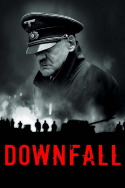
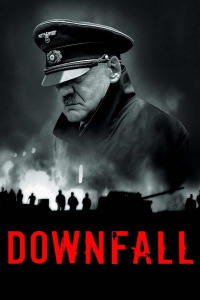
Bruno Ganz is impressive as Hitler. Everything about his portrayal as an old, sick, delusional, paranoid individual is conveyed in his hunchback stature, his left hand shaking uncontrollably and haggard features. He captures his volatile nature, Hitler was known to be kind and considerate to his female staff members while at an instant delivering profanities on Jews and berating his generals. What he projects out of his performance is the violence of his temper, that is the only emotion that is witnessed by us in his portrayal. He may be shown as human but he's as utterly degraded a human being as has ever been shown on the screen, a man whose every impulse leads to annihilation. We do not understand what motivates Hitler and there is no glimpse into his thoughts even at the moment of his suicide. Even sixty years after his death and countless studies he still remains an enigma.
In spite of this I do not believe that any film can explain the nature of Adolf Hitler, the Nazi party and Germany in bringing about the most destructive war on European and the most far reaching in terms of the long term impact on the politics and morality of Europe. Hitler was the most unimpressive of all leaders. He was a notorious slob who struggled to wake up in the morning. He was never involved in the day to day affairs of the state and he only took an active interest in military decisions and foreign policy, especially after 1941. He was, however, a charmer and manipulator who understood the mood in Germany in the 1930s: the humiliation of Versailles, defeat in 1918, unemployment, hatred towards the Jews and other minorities. He knew that others shared his vision of a strong Germany dominating the world. His role was to encourage others to join his campaign and convinced them through his "charismatic leadership" that victory was possible.
Sir Ian Kershaw has argued that in Nazi Germany, officials of both the German state and Party bureaucracy usually took the initiative in beginning policy to meet Hitler's perceived wishes, or alternatively attempted to turn into policy Hitler's often loosely and indistinctly phrased wishes. Kershaw demonstrated both Hitler's central role in the "Final Solution" and why there was no need for any order from Hitler for the Holocaust, as the progress that led to the Shoah were "worked out" toward the Fuhrer by almost everyone in Germany. It is hard to imagine that a technologically, culturally and industrially advanced nation like Germany could have embraced Aryan ideology and a Nazi government which seeked to subjugate Europe according to racial purity and condemn Eastern Europe to helot like servitude. We will never have a clear grasp as to why so many intelligent individuals in positions of authority were prepared to put his wishes in practice.
What the film indicates, however, that certain elements of Germany which are represented by the SS, the so called "pure Aryans" and the master race, shared Hitler's racial and nationalist ideas. It was they who wished to continue fighting, hoping to die for their Fuhrer, they were the ones who carried out the ethnic cleansing in Eastern Europe, and who organised and directed the Final Solution. These fighting, fanatical soldiers, were held in special distaste by the Red Army and even elements of the German Wehrmacht. They shared his beliefs and it does not bode well for the present that elements of society still support and champion the Nazis. Human nature does not change.
This review of Downfall (2004) was written by Joe A on 19 Sep 2009.
Downfall has generally received very positive reviews.
Was this review helpful?