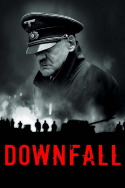
Review of Downfall (2004) by Parker M — 13 Feb 2011
4 Stars out of 4.
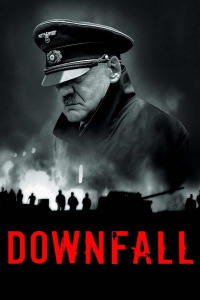
Downfall is not just Hitler's story or about his accomplices either. This is a story that has characters' lives weaving through each other's in order to understand the vast number of people, mostly German, Hitler collaborated with, coerced, and ultimately betrayed. Downfall is written by Bernd Eichinger, and I think this would have been a challenging script to write. He has to integrate Fest's novel Inside Hitler's Bunker; memoirs of Traudl Junge - Hitler's secretary; parts of Albert Speer's Inside The Third Reich; and several more eye witness accounts and memoirs. Unless you can't tell, this is a fascinating film.
Our first glimpse of Adolf Hitler (Bruno Ganz - utterly brilliant) is at a fort in East Prussia, where he meets Traudl Junge (Alexandra Maria Lara). She's young, naive, and obedient. Her character remains much like this for the film - but the difference is she does so out of fear and pseudo-patriotics. She considers Hitler to be an innocuous, calm man. But his left hand always trembled, suggesting there was an earthquake of anger erupting within.
Fast-forward to April 1945 and the Red Army of Russia is invading Berlin. Hitler is in a state of ruthless and pointless toiling, but is also in stasis in his bunker. He yells, dictates, ponders while his Reichswehrs even start to notice Hitler's madness. The arrival and subjugation of the Russians are inevitable. Everyone knows it, and those who persist put on a facade and are infected with denial. Hitler affirms he will fight to the death (which involves several tirades on his men) and then blow his brains out. Footnote: He and his wife Eva Braun (Juliane Köhler) would commit suicide on April 30, 1945 - a little over a week till the ceasefire.
The war got to the point when the potential of an Aryan Race was futile. We cannot understand it, but for the Nazis there was no other option. Aryan hegemony was the only route Germany could go. If not, it was to hand itself to absolute destruction. Hitler is beseeched by his officers to allow the citizens to evacuate, but Hitler believes "in war, there are no civilians ... they have chosen their fate." No: he has chosen it for them. The thing is HItler had no compassion for others, that is the people. He admitted he did not agree in sympathizing with the "weak" - any one demarcated from the Nazis. Hitler knew "compassion", he just did not use it.
Without giving credit to Ganz's performance would be a hate crime. Every twitch, murmur, accentuation, and salivating bawl is delivered with the tenacity of a mad man. But Ganz also embodies the human art of genius. Because Hitler was a political virtuoso who seized a great portion of Europe and expanded Mussolini's fascist policies to malignant levels. Yet Ganz plays the role with such fire and heart that we empathize with Hitler how we do with a rabid dog.
As for the other characters, they are really the audience of Hitler's equanimous decline. His efforts for a supreme race and the solidarity of his lebensraum ("living space") was his baby or, I would call, his Frankenstein. This is a man who fought in the Battle of Somme, Passchendaele, and the First Battle of Ypres in World War One. He endures the storms of mustard gas and squalid trenches. If he had been one of the ten million deaths in that war, we may have avoided 60 million more death from 1939-1945. It's a sick thought, but think about it: kill one evil man, save multi-millions of lives.
World War Two, I would argue, was the bloodiest and perhaps the most surmountable war. The Western World appeased Hitler to the point that he had marched into Rhineland, Sudetenland (when he was forbidden), and eventually Poland. The fault of this calamity is shared equally to us - North America. When we watch Downfall, we watch an immoral man do terrible things, but we sympathize bitterly because sympathy is, as moral, submerged in our subconscious. Director Oliver Hirschbiegel, a German filmmaker, never dares to make us pity the Nazis, but he does question if we should bother considering it.
I do not know exactly if I had offered my utmost solace to these nefarious people. Some of them were not necessarily bad, but just wanted to stay alive... or die with dignity. The type of dignity that had been indoctrinated into them. Hitler believed if you were loyal you should be indefatigable, irrational, and on a death trip. The ones who betrayed him were not vermin and cowards (as Hitler claimed), they were smart.
The Russians had penetrated the city of Berlin and it was just a matter of time. To tell the story right, Hirschbiegel magnificently incorporates the material as a moving nexus. This is not just from Junge's point of view, as the focalization of femininity at the fall of the Third Reich would be a complete bore. Instead, Hirschbiegel interjects all the stories like a promenade through a blitzkrieg. We see the passive feminine angle observe the active higher ranks of the Third Reich and then jump to the helpless and cornered Hitler youth. This is a genius method to imply the fragmentation and relentless hegemony of Nazi Germany.
Downfall is a masterpiece. I have studied World War Two since grade school and continue to marvel in it today. Most films I have seen, such as Schindler's List or Sophie's Choice, have been great films about the subaltern. It looks in through the middle voice and antagonizes the Nazis viciously because, well, they were vicious. In Downfall, the bias belongs to the Rottweiler's of politics - Nazis. It challenges our sympathies, animosity, and our perspective. This is through the eyes of mad men. Ones who pulled the trigger and by 1945, turned that gun on themselves. You cannot feel pain, only an acerbic taste of relief and shock.
A film close to Downfall's tenacity is Letters To Iwo Jima, about the Japanese soldiers who fought against the onslaught of American troops on only a tiny, encircled island. Downfall handles its character slightly better I think, because it leaves no mush. Letters To Iwo Jima was directed by Clint Eastwood, who left behind traces of mushiness in his film (as he habitually does). Downfall approaches its characters like a garden of withering flowers, smothered by a layer of bricks. It's impossible to appreciate any beauty and to only contemplate the putridity.
After seeing Downfall 4 times, it haunts me and rivets me. I revel the film because it takes no prisoners and never sugar codes itself or its characters, when most films of this scale and contentiousness would. I wish now to watch the famous propaganda film Leni Riefenstahl's Triumph of the Will. It's apparently a masterpiece because, as filmmaking, it is astonishing. But it also convinced millions of its absurd idealism. Would it convince me?
Downfall is one of the best films of the past decade.
This review of Downfall (2004) was written by Parker M on 13 Feb 2011.
Downfall has generally received very positive reviews.
Was this review helpful?