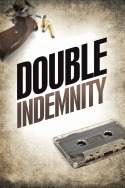
Review of Double Indemnity (1973) by Jake R — 16 Jun 2009
As America slowly realised the Second World War was actually pretty nasty and as a result this very grey mood seeped into every corner of popular culture. After the excessively heady year of 1939 movies that were spun out of fluffy, wafer thin entertainment were passed over in favour of a moodier, more mature return to the grittier style of the early 1930s. But now that the industry had more money and more room to be creative, the cheap sets and cookie-cutter method of previous years gave way to a more arty, distinctly European brand of style.
Noir mixes the Expressionist trappings of German Silent cinema with the pulp stories of the original gangster cycle, so now movies could be visually striking as well as throwaway. While 'Double Indemnity' is responsible for the true establishment of the Noir genre it also characteristically shares a cheap and melodramatic quality.
Co-scribe Raymond Chandler was a master of sophisticated crime fiction with a tough, vivid style that comes to the fore here. He was also the master of pulp stories you could pick up for a nickel and read by the end of the day. Adapting a similarly lurid novel, what comes out is an old-fashioned melodrama, of which, unfortunately, very few from the era have dated well.
Told in a self-conscious narration, littered with poetic but bland dialogue and suffering from an excess of subplots the faults are easier to spot after 65 years, and to an average movie-goer unclouded with rose-tinted spectacles of swooning nostalgia. It's not that there is a problem with the central story, it's that the focus is too skewed. When we want to see the simmering heat between Neff and Dietrichson we get largely pointless scenes between Neff and Lola, or Neff and Keyes, though that one does have ulterior motives. Stuff that could be described in the rambling, languid voiceover is shown at monotonous length, drawing out scenes for no apparent reason or showing character insight when it's really not necessary.
Then there's the cast. With the sole exceptions of Stanwyck and Robinson the entire set of players is a tiresome drawl of no-name no-hopers as wooden as an age-old shed, with the biggest fault lying at 'Neff' himself. It's not hard to see why 99.99% of people on Earth will never have heard of Fred MacMurray and his performance here is a big piece of evidence as to why. Maybe he's emulating the emotionless drab-fests that these detectives are supposed to be; yet no one criticises Bogart for doing the same thing a million times every year back then. There's nothing attractive about MacMurray mumbling his way through lines at 100 mph with a physicality so stiff if he didn't blink he'd be dead. To be fair, it doesn't help his character is a spineless, sexist jerk; leads tend to be more likeable these days. He also makes for the most unconvincing 'insurance salesman' ever, not just because he's built like a brick outhouse but seems to find the switch from clerk to murderer about as emotionally conflicting as deciding what to have for dinner that night. Even 'Mike Hammer' in borefest 'Kiss Me Deadly' had at least a weird voice to keep him interesting.
No, the real plaudits go to Stanwyck as Dietrichson and Robinson as Keyes. Eddie is true professional, polishing his role with a real sense of justice and friendship, and he also gets the best lines and jokes, particularly his standout monologue on suicide statistics. Stanwyck is arguably Noir's hottest femme fatale, exuding a sleazy, guilty-pleasure persona that drips with sex, curling her dialogue with her Brooklyn brogue into something quite pornographic. Her character is also not the stereotypical 'evil woman' either; she's a much stronger will than Neff, more level-headed and, despite her 'confession', more loyal - it's in Stanwyck's bravura honesty in the role.
Then of course there's the pretty lighting, what you can see of it, but admiring a Noir for its cinematography seems pretty pointless and trivial.
The whole thing could really pass unnoticed to today's world if not for some unexpected post-modern interpretations. One reason why Neff spends not nearly enough time with Dietrichson as he, and we, should is because of his unabashedly homosexual relationship with Keyes. Giveaway things include Keyes saying he knows Neff 'intimately' and Neff telling him, twice, that he loves him, but there's also the fact that they share almost half of the film's total scenes together, usually alone in deserted places, and that they never stop lighting each other's cigarettes. Perhaps that's what explains Neff's wussy relationship with Dietrichson, how he avoids seeing or talking to her, because he's already got a boyfriend.
With that new angle to ponder and an enjoyable performance from Robinson and a cold shower-inducing one from Stanwyck the film can stand on its own, just. Far from being a classic movie in its own right.
This review of Double Indemnity (1973) was written by Jake R on 16 Jun 2009.
Double Indemnity has generally received positive reviews.
Was this review helpful?