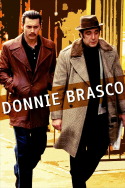
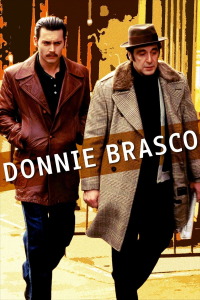
Review of Donnie Brasco (1997) by Moviemastereddy — 06 Apr 2016
Mob life receives one of its least glamorous screen portraits in "Donnie Brasco," which concentrates on the human toll of an enormously successful real-life FBI infiltration of the New York Mafia. The psychological dimensions of the story remain underrealized, but the loaded central premise and intimate focus the film sustains combine for a very involving and dramatic piece of crime lore that should generate solid late winter biz.
In a substantial step down in the gangland pecking order from his roles in the “Godfather” films and “Scarface,” Al Pacino here plays Lefty Ruggiero, a two-bit wiseguy who, as of the tale’s start in 1978, has worked as a loyal foot soldier for 30 years, has done 26 hits by his count but is basically broke and destined not to ascend any higher in the ranks. Brash as he can be, Lefty is intimidated by his boss, Sonny Red (Robert Miano), and lives such an unrewarding home life with his obedient wife and junkie son that it’s no wonder he prefers to spend most of his time with the boys.
At his barroom hangout, Lefty meets a young man, Donnie Brasco (Johnny Depp), who quickly impresses him with his knowledge of jewels and his tough-guy prowess. Smart and unafraid to stand his ground, Donnie inspires nothing but confidence as the older man shows him the ropes, giving him, as well as the audience, an irresistibly intriguing guided tour of mob life from the inside. Donnie meets Lefty’s guardedly accepting cohorts, who most importantly include the hulking, explosively temperamental Sonny Black (Michael Madsen), the suspicious Paulie (James Russo) and the more voluble Nicky (Bruno Kirby), and is told that, under Lefty’s sponsorship, he could be on the road to one day becoming a Made Guy in the family.
What Lefty never knows, however, is that his streetwise willing student is actually FBI agent Joseph Pistone, who is taping hours of revealing talk and, as he is welcomed further into the mob hierarchy, accumulates mountains of evidence on their illegal activities. The question becomes, how long can Pistone’s successful impersonation last before some slip puts him and the entire operation in jeopardy?
The answer is, far too long for Pistone’s wife Maggie, who is forced to endure long months without seeing her husband and is not even able to ask him what he’s doing on the rare occasions he does return to see her and their three daughters. The strain on the marriage becomes almost unendurable, and one can only conclude that such a job is not one for a family man.
But Donnie’s ties to his new family are, by contrast, growing stronger, as his proposal for an expansion into Miami is met with approval by the quickly rising Sonny Black. But when the New York group’s new club is raided by Miami police, the boys smell a rat. A subsequent struggle between Sonny Black and Sonny Red for dominance in Gotham inevitably leads to a bloodbath, whereupon it’s only a matter of time until the FBI pulls Donnie out and puts the hammer down on the mob.
All this would provide more than enough narrative incident for any movie, but screenwriter Paul Attanasio and director Mike Newell to resist wallowing in the alluring trappings of the gangster genre. Downplaying, although not ignoring, the standard violence, suspense and excitement, the filmmakers keep their attention trained on the growing bond between Lefty and Donnie and the looming betrayal that Donnie knows will doom the man who has taken him under his wing.
So Donnie remains an opaque creation. The film does not give him an interior voice, a door into his feelings, so one cannot engage his point of view or even connect with this intriguing and brave man as much as one would like, despite the outward appeal of Depp’s performance.
By contrast, Pacino unlooses an unchecked stream of visible thought and emotion, beautifully delineating the need his small-time neighborhood thug has for a best friend and surrogate son. Although perhaps familiar in its outer trappings, Pacino’s fine work is the key to the film succeeding to the extent that it does.
Although the supporting actors get across the right attitudes, none of them have roles of sufficient depth to permit more than superficial readings. As Pistone’s wife, Anne Heche gets to do little other than suffer and hurl accusations of neglect.
Very proficient in the many scenes with the two main actors, Mike Newell’s direction is a tad soft around the edges and lacks the intense atmospherics normally associated with such fare. Sharp production values accentuate the tacky disco-era look.
This review of Donnie Brasco (1997) was written by Moviemastereddy on 06 Apr 2016.
Donnie Brasco has generally received positive reviews.
Was this review helpful?