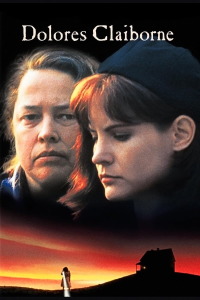
Review of Dolores Claiborne (1995) by Pavan R — 22 Nov 2009
[from The Watermark, 1995/04/01].
OSCAR AFTERGLOW: If you read my Oscar column last issue, you?ll remember I predicted every one of the major winners except for Jessica Lange in Blue Sky who beat out Jodie Foster for Best Actress. Not too bad, though I didn?t think it was too hard to guess. In actuality, the real anticipation this year was not who would win, but who would get nominated. Thankfully, the ceremony was mostly painless and there weren?t too many fashion nightmares. I?m still thrilled over the Best Costume Oscar awarded to gay designer Tim Chappel and his collaborator Lizzy Gardiner for The Adventures of Priscilla, Queen of the Desert. Nobody topped the mini dress worn by Gardiner that was completely made of American Express Gold Cards, though Oprah?s flawless train came very close. Letterman was slightly disappointing, but the hilarious ?You wanna buy a monkey?? segment redeemed him. All in all, it was a night of good old-fashioned Hollywood fun, and when you think of it, the Oscars are probably the only remnant that can be found of the glitzy whitewashed Hollywood of yesteryear.
BACK TO BUSINESS: Speaking of Oscars, Kathy Bates was lucky enough to receive one a couple of years back for her great performance in Stephen King?s Misery. Now that she has proven that this performance was no one-shot deal, she was a natural to play the title role in King?s newest novel-to-screen, Dolores Claiborne. Both King and Bates have a pretty good track record with movies, and seeing the two working together again is a pleasure. The film overall, though, is slightly disappointing, simply for the fact that it is so good in every way until it clumsily falls off track in its finale.
The film (as most of King?s stories) takes place in Maine where Dolores Claiborne (Bates), a nursemaid to a domineering invalid millionairess, is suspected of killing her employer. Bates is being hounded by a detective (Christopher Plummer) who is convinced she is guilty, and her journalist daughter from New York (Jennifer Jason Leigh) returns home to act as Bates? guardian. The reunion of the two women in their old home drudges up many unpleasant memories and forces them to confront the circumstances surrounding the mysterious death of Leigh?s abusive father (David Strathairn), of which Bates is also suspect. As the pieces of the puzzle fall into place for both of the murders, so do the reasons for the estrangement of this mother and daughter.
Bates? subdued performance carries the film as the unremorseful, defiant, and outspoken Dolores, while still working on our sympathies and making us believe she truly cares for her daughter. Leigh is barely believable in her role, only because blank sneers and wooden line delivery goes a long way when portraying the withdrawn and chemically dependent. When she comes out of her shell, her limitations are most noticeable. Plummer is very good, but among the plethora of poor New England accents to be found in the film, his is the worst. Bates also seems to have trouble with her accent, and even though the film is trying to mirror the vernacular as originally written by King, it is a distraction, and the film wouldn?t have suffered with a more standardized dialect.
The film is outstanding in its marriage of screenwriting, acting, lighting, and direction. The story involves two enticing whodunit plots and slowly reveals the truth piece by piece in flashbacks, which build consistently. At times the characters literally wander through their own minds, while the film seamlessly interweaves reality with memory, and present with past. The lighting is particularly noteworthy as it brings us from the cold blue-grays of the present to the splashy Technicolor warmth of the past. The lighting works well with the make-up, too, in making Bates (and Plummer, surprisingly) appear twenty years younger for the flashbacks. All of the elements are tied together with beautiful shots of the Maine shore, and a well composed soundtrack by Danny Elfman (The Nightmare Before Christmas, Batman).
The film also possesses pertinent feminist issues. One scene has Dolores going to withdraw her own money from the bank and finding that her husband did so without the bank asking her permission. The woman who is Dolores? boss drives this theme home with odd quips such as, ?It?s a depressingly masculine world we live in,? and ?Sometimes being a bitch is all a woman has to hold onto.? It is interesting to see Bates adopt the latter saying as her own, and later pass it onto Leigh in an apparently unending chain of bizarre feminist wisdom. The theme isn?t developed to its fullest, but it does help to portray Dolores as a victim of a male dominated society.
Unfortunately, the anti-climactic ending of Dolores Claiborne is puzzling. At Bates? hearing where she has confessed her whole story, Plummer is presenting his evidence to the judge to incriminate her. Leigh comes to her mother?s rescue, making a desperate plea, and the judge is swayed that Bates is innocent. The scene is too lengthy to watch after we have seen rapid fire total eclipses, people falling down stairs, and Bates physically defending herself against her husband?s beatings. Leigh?s weak performance makes the rhetoric unconvincing as she talks in her mother?s defense; a better solution would have been if she possessed some evidence (either tangible or in memory) that could have been revealed to clear her mother of suspicion. Bates remains silent for the whole scene while Leigh does all the talking, completely missing a great moment in which the two women could have started working together to symbolize the mending of their relationship. In a movie with so many twists and surprises, a verbal scene involving people sitting around a desk is too stationary and completely out of place; the scene is a gross oversight.
All in all, despite its flawed ending, Dolores Claiborne is a well-made suspense drama. In all honesty, neither Bates nor the film is likely to see an Oscar nomination next year, but it is still worth seeing for its structural and technical superiority.
This review of Dolores Claiborne (1995) was written by Pavan R on 22 Nov 2009.
Dolores Claiborne has generally received positive reviews.
Was this review helpful?