Review of Dog Day Afternoon (1975) by Blake P — 06 Nov 2015
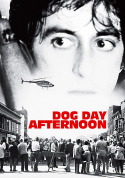
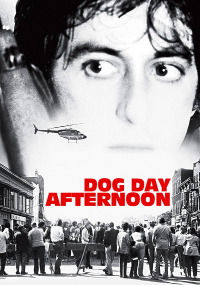
"Come on, now. Who do you think you're dealing with? A fucking idiot here?" Sonny Wortzik (Al Pacino) asks the employees of the bank he's attempting to rob as he scurries about unmasked, without a plan, and with a partner (John Cazale) who thinks Wyoming is a country. If he didn't have such a big gun and wasn't in such a reckless emotional state, then I might, if in the shoes of the head teller, respond with a hard yes. But I'm a nice guy without enough good sense to avoid messing with the slightly unhinged - to sit back and bathe in the pathetic events of this criminal train wreck might be better for my health instead.
As audiences, we have grown accustomed to robbery-based films that glide by with lightweight finesse, the cinematic population consisting of a few too many "Thomas Crown Affairs" and "Italian Jobs" to prove that, in actuality, most crooks are bumbling, not suave. So it's no surprise that "Dog Day Afternoon" is based on real events - in the nonfictional world, slippery Steve McQueens and Michael Caines do not exist. We are, unfortunately, stuck with unbalanced Al Pacinos who leave us ripping out hair out rather than ricocheting back in fear of their sinful prowess.
Sonny is a man acting out of desperation, not rationality, and that's what makes "Dog Day Afternoon" such an enormously involving film; it is more concerned with why the guilty parties are so bent on committing high-attention theft than on the crime itself. Sonny is not a playboy nor a mastermind but a perpetual loser whose life is all work and no play - it is a workout to simply psychologically ready himself to wake up in the morning. He is party to a failed marriage and a party to a dying extramarital affair; but Sonny, it seems, is more driven by the latter, as it acts as his motive for robbing a bank. His lover (Chris Sarandon) is in dire need of money to fund a sex change operation.
It doesn't take long for the robbery to turn into an event, as Sonny isn't much subtle and catches the eye of a group of policemen perched across the street - minutes later is a crowd attracted, the hold-up becoming a major hostage situation. The public loves him: they see him as an anti-hero standing up for the 99% (until his sexuality is revealed and they turn into a body of jeerers). But two dim-witted men cannot hinder the movement of bank tellers for very long - especially considering the FBI soon camps out in front of the building - and Sonny is eventually forced to come to terms with his reality, and how an act of spontaneity is no way to go about changing one's life.
Best about "Dog Day Afternoon" is its cockeyed humor; robbing a bank and threatening to kill a group of vulnerable women is no joke, but it sees the human comedy that forms when society's most prominent outcasts get it through their heads that they can emulate Butch Cassidy and the Sundance Kid without a blueprint in mind. No one in the film actually feels threatened. They are so entertained by the spectacle that surrounds them that even the hostages themselves are having a good time. "My place is with my girls," the head teller replies to a cop who pricks her with the idea of the opportunity to run away from the building in hopes of escape. She sounds heroic, but she likes the attention of the media, and Sonny is not enough of a threat to make her want to discover safety. Similar is a pizza delivery boy who shows up at the front steps of the bank to serve Sonny and company's dinner; "I'm a star!" he shouts after he collects his cash.
I suppose "Dog Day Afternoon" could be looked at as a biting media commentary, but it is more compelling of a film when viewed as a character study. It begins with the tone of a black comedy, but little by little is the sheer tragedy of the situation revealed, particularly when we meet Sonny's lover for the first time. Then and there, we come to understand just how parched Sonny is for some sort of a normal life. Not committing a crime is not a thought that passes through his head. He can only see the end result, which is a crooked view of happiness that even he can't seem to understand will never arrive.
Pacino, at his most formidable in the mid-1970s, gives one of his greatest performances in "Dog Day Afternoon," though his characterization can hardly be called a "performance": he becomes Sonny, not with actor contrivance but with ease encapsulated by a mere twitch of an eyebrow. Charles Durning, as the lead detective who does most of the negotiating, is excellent as a man not concerned enough to take extreme measures but concerned enough to sacrifice his reputation for the safety of Sonny's hostages. Most startling, though, is Sarandon, whose uncanny ability to portray an underlying hurt causes our hearts to ache as he makes up for the judgment Sonny so heartily lacks.
Cinema has changed a lot since the 1970s, and one can only wonder just how much of a success a modern-day film equivalent would be - are present audiences as capable of absorbing a gripping character study that never changes location, that relies solely on a handful of accomplished actors? "Dog Day Afternoon" is an intricate configuration of what Sidney Lumet does best: finding entertainment, consolidation, sympathy, in people.
This review of Dog Day Afternoon (1975) was written by Blake P on 06 Nov 2015.
Dog Day Afternoon has generally received very positive reviews.
Was this review helpful?