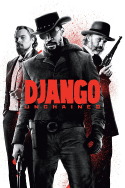
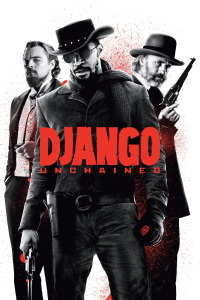
Review of Django Unchained (2012) by Eero V — 27 Jun 2014
I've always had mixed feelings about Quentin Tarantino's films. Reservoir Dogs was amazing, Pulp Fiction, Inglourious Basterds and Jackie Brown great, both of the Kill Bill volumes poorly written and boring, and Death Proof I had to leave unfinished. After two viewings, Django Unchained ranks among his weaker efforts.
The main character is Django Freeman, who has been sold into slavery. He is rescued from the owners by a German dentist-bounty hunter King Schultz, who is looking for the Brittle brothers, the people who captured and sold Django and for whom Schultz is carrying a warrant. He and Django make a deal: Django helps Schultz find and identify the brothers, and Schultz helps Django get his wife back, who has been sold to a sadistic plantation owner, Calvin Candie. And so begins a long journey through wilderness, numerous long conversations and gory gunfights that finds its resolution in Candyland, Candie's plantation.
Django Unchained represents the familiar Tarantino style: plenty of dialogue, violence, memorable characters, some dark humor and a huge amount of references to some of Tarantino's favorite films (of which most of the audience usually hasn't even heard of). Of course there are also references to some classic western films, like the original Django, the Dollars Trilogy and Once Upon A Time in the West.
But to me these references have never been "the thing" in Tarantino's films, as I'm sure it isn't to many others either. I always take the more accessible way: I enjoy what is going on screen and let the dialogue, characters and action sweep me away. Like by any other Tarantino film, you don't have to think much in the course of Django Unchained or look for depth, just settle back and enjoy. This kind of approachability is what made films like Pulp Fiction and Inglorious Basterds terrifically entertaining, and it should work by Django Unchained as well. The film's depiction of slavery and usage of N-word have angered many people (including Spike Lee, Tarantino's eternal enemy), and I have to agree that especially the latter one is ridiculous, but I don't expect political correctness or historical accuracy from Tarantino; I just expect to be entertained.
However, the entertainment value of Django Unchained is reduced by its prominent flaws. The most notable thing is that the dialogue isn't as memorable and energetic as before. Django doesn't have those great one-liners for which films like Pulp Fiction and Reservoir Dogs are famous for. Especially when Candie steps on the screen, the conversations start to lengthen and lengthen. During the longest ones Tarantino simply doesn't seem to notice that his dialogue isn't very interesting; he just assumes that we enjoy everything what these characters are saying. Gone seem to be the days of "Are you gonna bark all day, little doggy, or are you gonna bite?" and "Say what again!!".
What also distracts is the film's uneven structure. The cleverness of Tarantino's films has always been in how they have huge amount of characters with their own storylines and how they're brought together in the most surprising ways. But now since there are two very clear main characters, it feels dumb to watch a western where some 80 percent of the time these people just talk. It makes the film feel humdrum and dragging. Django and Schultz go from one conversation to another, in between there's some shooting and violence, and then they just chatter again. The violence is also highly excessive, and sometimes already visits on the borders of repulsion. Tarantino has always combined many elements of different film genres together, but his films have still remained coherent. But now the wholeness just doesn't stay together, even while the film is probably Tarantino's most linear to date.
What Django Uncained lacks is discipline. This problem isn't evident only because of the structure, but because the film is blatantly overlong. Tarantino seems to have gotten too enthusiastic while writing it, because the end result is nearly three hours long. While his direction is once again very proficient, it's the screenplay that has slipped out of his control. The same problem was already on display in Inglorious Basterds, but that film was saved by Christoph Waltz (whose performance there was one of the best I've ever seen).
Then there's the music. Tarantino recycles some old western themes, which fit perfectly to the film's atmosphere, but sometimes the music is completely out of place. The best/worst example is the fragment of some rap song in one scene, which nothing but baffles. It's no wonder that Ennio Morricone himself criticized the film's soundtrack.
When the film finally starts moving towards its conclusion, it really starts testing the viewer's endurance. Tarantino spends the last 30 minutes of the film just offering one pointless scene after another and growing the already ridiculous body count, and the ending is completely out of place and feels like a slap in the face. Tarantino himself also does his obligatory cameo near the end of the film, delivering yet another staggeringly bad performance as an Australian miner. And yes, he does attempt to speak with an Australian accent. You have been warned.
As usual in Tarantino films, the acting is superb. Jamie Foxx has had an uneven career since his Oscar-winning performance as Ray Charles in "Ray", but now he gives a splendid performance. However, he is constantly overshadowed by Christoph Waltz, who once again gives an excellent performance, not as great as in Basterds, but still. But even Waltz is knocked out when Leonardo DiCaprio and Samuel L. Jackson step on the screen. DiCaprio gives one of the best performances of his career as the vicious and sadistic Candie, totally chewing the scenery and clearly enjoying it. Now even his boyish looks don't bother, since he's been masked to an extraordinarily crippled eyesore. Jackson is hilarious as his trusted house slave and his shared scenes with DiCaprio are some of the film's best. Each of the actors really seem to have fun with Tarantino's dialogue and their work is a pleasure to watch.
In the end, Django Unchained is a bloated and over-indulgent mess that has some memorable individual bits, interesting characters and some good dialogue, but its aimless narrative, horrible length and dreadful violence make it a burdensome experience. Reservoir Dogs is still his best film, because it was Tarantino at his most punchy and succinct, and above all, at his tightest. I hope he makes a film like that - short, sharp and vivid - again someday, but his ambitions seem to keep growing all the time and Django leaves much of them unfulfilled. At least in my opinion the Oscar for best screenplay was highly undeserved. It's a disappointment, but I guess it will still taste to his most sworn fans.
This review of Django Unchained (2012) was written by Eero V on 27 Jun 2014.
Django Unchained has generally received very positive reviews.
Was this review helpful?