Review of Django Unchained (2012) by Jose Luis M — 18 Jan 2015
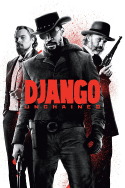
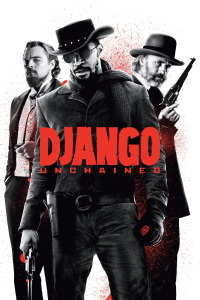
Full of anachronisms and heedless of any form of caution or subtlety regarding its subject, Quentin Tarantino's spaghetti western-stylized, Blaxploitation slavery epic, revenge thriller Django Unchained takes the filmmaker's brazen, over-the-top antics to their extreme; the film blends genres while exciting the plot with dramatic zooms and bloody, stylized shootouts set to music associated with the spaghetti westerns of Italy. The revenge flick follows Django, a slave, freed by a certain Dr. Schultz, as they travel the American south pre-Civil War to kill white men for money as bounty hunters and to track down Django's beloved wife, who is being held as a slave on a famous plantation named Candieland (after the eccentric plantation owner Calvin Candie). In true Tarantino style, the movie is entertaining and visceral - it never bores. But it also, unfortunately, never really transcends the genres that it pays homage too, and doesn't really seem to have all that much to say about either revenge or racism; at times, the film almost flips the racism that it despises on its head, branding almost all white people as horrible villains.
There is a certain honesty, however, to the portrayal of slavery and bigotry in the pre-Civil War south that is admirable amidst all of the pulp; a particularly poignant moment, after Calvin Candie has one of his slaves torn apart by dogs, has Jamie Foxx's Django saying to Candie, after not batting an eye at this violence, that he's too used to America to have this phase him - he's used to seeing people fed to the dogs. Moments such as this, and the brutal whippings throughout, are as harsh a portrait of slavery as has ever been seen in American fiction. This is admirable. But the movie doesn't seem to deal with slavery with much tact as it progresses, and every character comes across as over-the-top, unrealistic, and each has his moments of racism, even the black characters.
Occasionally, the film succeeds at an odd form of slapstick satire, for lack of a better phrase - particularly early sequences involving the first plantation owner that Django and Schultz visit, "Big Daddy" Bennett. Schultz and Django arrive at Bennett's plantation and Schlutz requests that Django be shown around by a slave woman, but that the woman not treat him like a slave - he wanted that made expressly clear - but like the free man that he is; Bennett, a terrible racist having been won over by Schultz's offer of quite a lot of money, asks Schultz to clarify: does he want Django to be treated like a white man? No, heavens no, he didn't say that - only that Django was to be treated as better than the other black people around the plantation, because he is a free man and Schultz's valet, after all, not a common slave.
After violence breaks out in typical over-the-top Tarantino fashion and things settle down, this quirky and tense triangle escalates in hilarious fashion in the following scene, when Bennett is revealed to be the leader of a local branch of the KKK. The galloping of the KKK is a giddy, gothic, glorious moment set to dramatic classical music that sweeps over images of men dressed in white hoods riding across open fields and grasslands - but then the scene stops, and the men assemble and intend to discuss their plans to kill Django and Schultz, but wind up complaining for some time about the hoods that they are wearing and how ridiculous they are, and how some guy's wife on the team didn't do a good enough job cutting out the eye holes, because none of them can see out of them, and then the woman's husband gets upset and rides off, and the KKK members feel kind of bad but admit that the wife could've done a better job cutting out the eyes... the scene goes on like this, and it is a highlight of the film, one of Tarantino's fine, unexpected verbal battles that are often the best parts of his movies.
Unfortunately, though there are moments of inspired dialogue, it feels here more so than ever before to be a little more forced, a little too self-conscious, not as assured as the dialogue and storytelling construction that made his past films so special. In Django Unchained, it sometimes feels like Tarantino is trying too hard. Even more disappointingly, the film lacks the great suspense builds that made Inglourious Basterds so completely gripping - there are no scenes here, really, like the bar scene in that film, or like the great opening conversation between Christoph Waltz's Hans Landa and the Jewish farmer - scenes in Django explode into violence, yes, but with far less of a build, and whereas Landa was a cool, collected villain who broke naturally into devilish sadism, Calvin Candie (played by Leonard DiCaprio) seems to be just purely insane: he snaps and flips out, memorably breaking a glass with his hand (DiCaprio's own blood bled in that scene) but lacks the dark assurance of Landa (as enjoyable and theatrical as Leonardo DiCaprio's performance is). But this is a problem that hits at the core of the main problem with Django: Tarantino has finally gone over the edge with his characters, and they have almost fully become caricatures. And unlike in Inglorious Basterds, they aren't given as much room or space to really come to life and revel in their environments. For some reason that I can't quite pinpoint after a first viewing, I was far more disappointed with his characters here than I have been in the past.
That is not to fault the performances, however. Jamie Foxx gives Django a certain fierceness that is captivating to watch, and he portrays his wounded, enslaved past and violent strength with equal weight. Kerry Washington gives an emotional performance (as emotional as Tarantino gets, at least) as Django's wife, stolen from him by the racist plantation owners who made them slaves. Leonardo DiCaprio's performance is wonderfully over-the-top and colorful (the problem is with his character himself, as stated above). And Samuel L. Jackson gives a wonderful supporting performance as a racist black man who stands by Candie and watches over the plantation.
I found it difficult to accept Christoph Waltz's performance in this film during some moments not because it is a bad performance - quite the contrary - but because the baggage of his previous role in a Tarantino movie carries over to this, and Tarantino seems to be doing little to guide him in a new direction. The performance feels like it has the same nuance of speech and same hints of danger as Waltz's Landa; however, here he is meant to be a dentist turned bounty hunter, not a sadistic Nazi. There isn't any of the dentist here, except for the ridiculous bit of art decoration atop Schultz's stagecoach early on. Just the bounty hunter.
A bit more depth, greater character development, and the addition of more suspense and more subtlety (not Tarantino's strong suit, I know) would have guided Django Unchained in a better direction. As it stands right now, I was entertained from start to finish, but found myself wanting more. It's a good enough bit of cinematic entertainment and a loving ode to genres seemingly forgotten by the masses and by Hollywood today, and Tarantino is still one of cinema's most unique and exciting voices; however, Django Unchained is not, in my opinion, one of his best.
This review of Django Unchained (2012) was written by Jose Luis M on 18 Jan 2015.
Django Unchained has generally received very positive reviews.
Was this review helpful?