Review of Django (1966) by Kenneth L — 21 Jan 2012
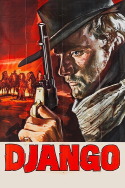
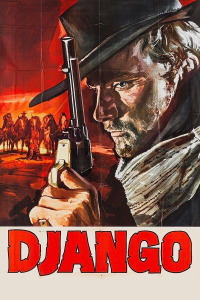
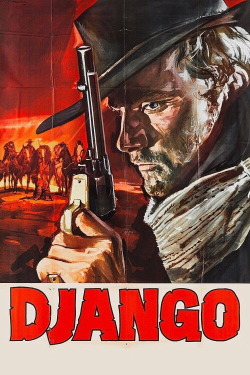
This is one of the other big, influential "spaghetti Westerns" from the 1960s, alongside the films made by Sergio Leone. It was so popular, apparently, that it caused at least 50 other (officially unrelated) films to put the name "Django" in their titles. In fact, that tradition isn't even over with yet, despite the film being 45 years old - Quentin Tarantino's next movie, about a slave seeking revenge on his former master in the pre-Civil-War South, is not coincidentally called "Django Unchained." While it predictably doesn't have as much visceral impact today as it must have at the time, thanks to the decades of action movies that have come in between, you can still appreciate it for the genre classic that it is.
The story is simple and rather similar to the one in A Fistful of Dollars: a mysterious, gun-slinging stranger wanders into town and gets involved in the conflict between two rival gangs competing for control of the town. Unlike Eastwood's character, this man does have a name, and it is Django. For some mysterious reason, he is always dragging a big coffin behind him. What could be in it? Will he outwit and destroy the gangs? And what of the girl he saved from being murdered by the gangs?
I watched the film in the original Italian with English subtitles, because the 1960s-made English dub was just too goofy-sounding for me to handle. The movie was clearly shot silently and only had voices added in later, as was the style for whatever reason in 1960s Italian cinema. I know that all those movies from this era did that, even those of Fellini, but it does annoy me, though no more here than anywhere else. Franco Nero, while admittedly not Clint Eastwood, is still a good center to the movie. The very pretty Loredana Nusciak is fine as the love interest, though her role consists almost entirely of reaction shots.
I guess what made the film so famous at the time was not really the acting or story, but the then-shocking violence and action scenes. This is where contemporary action-movie desensitization starts to set in. The movie clearly comes from an era when the simple sight of a machine-gun shooting or an ear getting cut off was enough to really rile people up. These days, explosions and gunfire are so routine that filmmakers really have to go the extra mile to make them interesting (for example, Guy Richie pulled it off pretty well with those slow-mo bullet impacts and explosions in his recent Sherlock Holmes: A Game of Shadows). But the fact that the last 45 years have made the action sequences ever more elaborate and intense is no fault of Django's, and it is indeed exciting for a movie of its time. The music, which isn't by Ennio Morricone but pretty much sounds like it is, is very enjoyable. Sergio Corbucci's direction is a little less inflected in terms of things like camera angles than Sergio Leone's, but the overall feel of the movie is a bit grittier and tougher. At any rate, it is a good movie, and I look forward to seeing Tarantino rip it off as only he can do.
This review of Django (1966) was written by Kenneth L on 21 Jan 2012.
Django has generally received positive reviews.
Was this review helpful?