Review of Disobedience (2018) by Bertaut1 — 18 Dec 2018
A well-told love-story set against a background of religious orthodoxy.
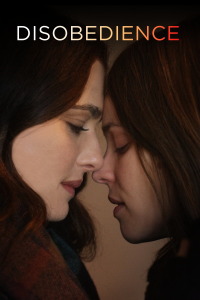
Depicting the problems that can arise when deeply held spiritual beliefs clash with notions of personal freedom, Disobedience is the story of a forbidden love given a second chance. Based on Naomi Alderman's 2006 novel, written for the screen by Sebastián Lelio and Rebecca Lenkiewicz, and directed by Lelio, the film deals with a lesbian relationship within London's relatively insular Modern Orthodox Jewish community. Uninterested in presenting a binary story where faith is the Big Bad, although the film is certainly critical of the strictures that can result from a rigid application of Jewish religious law, the community itself is depicted respectfully.
When Rav Kruschka (Anton Lesser) dies in the midst of a service, his estranged daughter Ronit (Rachel Weisz) returns home from New York, heading to the house of Dovid (a superb Alessandro Nivola), her childhood friend, and Kruska's protégé. Although the community isn't happy to see her, Dovid offers her a spare room. She accepts and is stunned to learn he is married to Esti (Rachel McAdams), another childhood friend. Over the next few days as the community prepare for Krushka's funeral, it becomes clear that Ronit and Esti were once more than friends, and the more time they spend in one another's company, the more their suppressed feelings come to the surface.
Thematically, Disobedience is far more concerned with the clash of views that result from Ronit's return than it is with condemning the beliefs of the community per se. On paper, the story might lend itself to a condemnation of the kind of social suffocation and emotional repression that can result from fundamentalism. Instead, however, the film spends time building a respectful, if not idealised, picture of the community. A key part in this is Dovid himself. In a less nuanced film, he would be a fire-and-brimstone Roger Chillingworth-type, an obstacle to Ronit and Esti's happiness. Instead he is presented as someone who faces a difficult choice - that between his communal position and his faith on the one hand, and his genuine love of Esti and affection for Ronit on the other.
However, for all that, the film never lets you forget that this is a community where married women must wear a sheitel wig in public and where the genders are strictly divided at religious services. As Ronit and Esti discuss their sexuality, Esti points out that she and Dovid have sex every Friday night, "as is expected", and that the reason she was married to him in the first place was that Krushka hoped "marriage would cure" her lesbian desire. In this sense, although respectful of the community, the film certainly challenges its myopic sexism.
Obviously, a major theme is sexuality. There are actually two sex scenes in the film; one between Ronit and Esti, and the other between Esti and Dovid. And although they couldn't be more different, they also couldn't exist without one another, as the abandonment, lust, and sense of pressure being released when Esti is with Ronit contrasts sharply with the detached, formulaic, and passionless scene with Dovid. The scene between Ronit and Esti is the physical manifestation of the characters' long-repressed desire. It's a wholly justified narrative moment, and a necessary beat for the two characters. It's not an aside or a piece of voyeuristic male fantasy, it's the centre of the whole film. Together, the two scenes represent Esti's binary choice - an unbridled and sexually fulfilling, but unstable relationship with Ronit, or a dutiful and dull, but respectful and secure relationship with Dovid.
If I had one major criticism, it would be that although Lelio's direction is subtle, some of his and Lenkiewicz's writing choices are spectacularly on the nose. The opening sermon is a good example - a religious diatribe whose subject is mankind's freedom to choose, the concomitant ability to disobey, and the notion that freedom is impossible without sacrifice, in a film about these very same issues. The worst example of this, however, is found when Ronit and Esti go to Krushka's house and Ronit turns on the radio, which just so happens to be playing The Cure's "Lovesong", a song which perfectly encapsulates their situation.
These issues aside though, this is an excellently crafted film. Once again examining female desire, issues of patriarchal oppression, and profound self-doubt, Lelio delivers a mature and considered meditation on the conflict between faith and sexuality. Equal parts sensual and spiritual, the lethargic pace and absence of any narrative fireworks will probably alienate some, but for the rest of us, this is thoughtful and provocative cinema.
This review of Disobedience (2018) was written by Bertaut1 on 18 Dec 2018.
Disobedience has generally received positive reviews.
Was this review helpful?