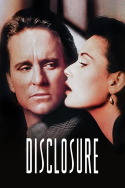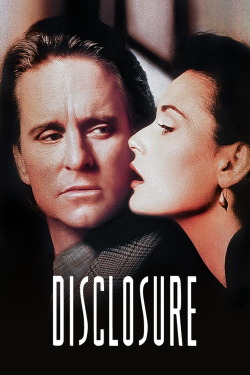
Review of Disclosure (1994) by Harry W — 26 Feb 2014
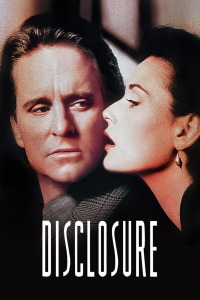
I was only really interesting in Disclosure because it featured Demi Moore in a rather sexual role, and because so far I've been somewhat impressed by Michael Douglas' erotic thrillers such as Basic Instinct and Fatal Attraction.
It's a while before Disclosure kicks into gear as it makes it through the erotic theme of the story, so its pacing is a little slow at the start.
Disclosure hits an interesting takeoff when Roma Maffia's character Catherine Alvarez explains to Michael Douglas' Tom Sanders that whether or not he sues for sexual harassment he has a huge chance of failure. Once the real courtroom drama of the story begins, Disclosure becomes interesting and even somewhat compelling.
In a way, Disclosure borrows themes from To Kill A Mockingbird. To Kill a Mockingbird features a story about a black man being charged with something he is innocent for and cannot win in a society dominated by white men, resulting in him being found guilty despite clear evidence. In Disclosure, protagonist Tom Sanders is faces in the difficult situation of being falsely accused of sexual harassment by a powerful female figure which is believed by a crowd of people who don't believe that sexual harassment can happen to men. This represents a cultural shift which has continued over the course of 20 years where sexual harassment has become cracked down on and females have become favoured for being known as the weaker gender which results in special treatment in case of sexual harassment or assault which has become known as "violence against women". In Disclosure, viewers see the kind of pressure the male community faces because of society's favourable treatment of female figures when it comes to sexual politics, and the story presents a strong female figure who has more power than any other characters who initiates the case. Neither sex is called is weaker in Disclosure, but both come head to head in a situation where the female has more power.
As a person who has experienced discrimination and sexism due to being a male during several events in my life, I could easily connect to Disclosure which made me feel angry. I spent most of my Year 12 suffering at the hands of two sexist female figures at my school and couldn't make a plausible argument against them since my principle told me "You can never win an argument with a woman", and due to that I sat there and had to let myself be struck several times by female students knowing that defending myself would result in serious trouble. Even though Disclosure is 20 years old, its commentary on the strong manipulative role many women play in society is incredibly valid and true, and as a person who supports equality, Disclosure really speaks to me when it deals with sexual politics.
Disclosure's flaw is its technological story element, because the role that the computers play in the story isn't clarified all that well and it all seems like a subplot to the story even though it is key to the premise. But most of it isn't clarified well and so it all seems confusing when the computer flashes lights on screen. And what the actual purpose of the Digicom virtual reality program is aside from being just a fancy way to look into a computer system and a way for the filmmakers to show off the kind of visual effects they are working with. It never seems like such an important story element and there isn't much of a reason clarifying why a company is putting so much effort into building it when it does the same things a computer can but only looks cooler. Essentially, it feels like the only point of the visual effects sequences in Disclosure are for the sake of making the film a more visually thrilling depiction of computer science as to make it a techno thriller from a visual perspective. And while there is no denying that the visuals are good, it just seems unnecessary and doesn't actually change the story much. Really, half of the story in Disclosure is good while the other half is convoluted and lacks explanation, so it succeeds as a courtroom drama but not as a thriller because it misses its reach for that.
The musical score is undeniably effective though, and you could expect nothing less from mastermind composer Ennio Morricone. And thanks to the cast, Disclosure feels genuine.
Michael Douglas gives a performance which is once again ripe a lot of tension and ferocity which he can deliver at will, and so as a lead he never comes up short in Disclosure. He makes Tom Sanders a very easily sympathetic figure and delivers his natural charisma to the role which he has given to many performances, making Disclosure another example of his strength as a lead actor.
If you came into the second half of the film Disclosure and didn't witness the first half of the film, it would be too easy to believe that Meredith Johnson was the character that was really victimised, because Demi Moore's dedicated performance which gets detail to the emotion in her line delivery and the intensity in her facial gestures, so much so that she is able to manipulate so many aspects of the story for her own sake. Her energy is powerful, and her sexual aggression is undeniably strong, so she makes a powerful seductive antagonist in Disclosure with an intense chemistry with Michael Douglas.
Roma Maffia is the other standout in Disclosure because her relentless passion for line delivery which is swift and sharp makes her perfect for the role of a lawyer fighting for the case of Tom Sanders. Once she comes into play, the true interesting elements of the story begin to kick off, so she's a great presence.
Donald Sutherland does a fine job too.
So while it's not director Barry Levinson's greatest work and is semi-flawed, Disclosure is a strong look at sexual politics which benefits from dedicated performances from its cast.
This review of Disclosure (1994) was written by Harry W on 26 Feb 2014.
Disclosure has generally received mixed reviews.
Was this review helpful?