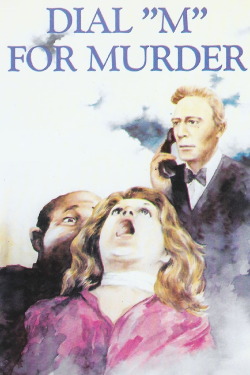
Review of Dial M for Murder (1981) by Skyler W — 28 Jun 2009
Hitchcock may have claimed that 'Dial M for Murder' could have been "phoned in," but Hitchcock was also the man who said style is self-plagiarism, and I think it's in some of the master's most effortless works that one gets a full sense of his artistic facility (see also 'To Catch a Thief' and 'Frenzy'). As with 'Rope', 'Rear Window', 'Torn Curtain', 'Rebecca', et al., Hitchcock here details the always-imperfect process of repressing murder. What makes 'Dial M' unique though is its near-clinical attention to the gritty minutiae of crime. Where the aforementioned films are more concerned with character pyschology re the revelation of murder, 'Dial M' focuses principally on the crime-planning and crime-execution process often assumed in other Hitchcock efforts (its closest relative probably is 'Rope', with the caveat that 'Rope''s attention is split between the crime-repression process and the Nietzschean psychology of the two killers).
Some may fault the film for being less formally ambitious than canonized movies like 'Vertigo' and 'Psycho', but I think it should be said that few directors could breathe cinematic life into what's basically stage material like Hitchcock could. The cramped setting of 'Dial M' is opened up as much as possible by the versatile camerawork, and Hitchcock isn't so stuffy that he can't eschew purely functional cinematography for the occasional expressionistic flourish (Hitch famously reshot the murder scene when he discovered that the scissors weren't "gleaming"). 'Dial M' is as rich and gripping a film as any in Hitchcock's upper-tier works, and I'm hoping its reputation continues growing among those who care to experience the richness of Hitch's entire ouvre -- not just the widely-circulated classics.
This review of Dial M for Murder (1981) was written by Skyler W on 28 Jun 2009.
Dial M for Murder has generally received positive reviews.
Was this review helpful?