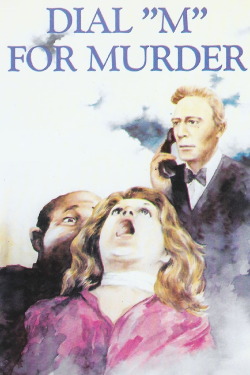
Review of Dial M for Murder (1981) by Josh G — 02 Jun 2009
Unlike many people, I haven't seen many Hitchcock films. I'm certainly missing out on the greats - Psycho, Rear Window, The Birds - which puts me in the awkward position of being the guy who can't criticize Dial M for Murder for not being up to par for Hitchcock. I can't knowingly smile and nod and say, "Yes, but it's one of Hitch's lesser works, wouldn't you say?" I would call him Hitch in this scenario, as having seen the vast majority of his work, I would be able to speak of the man with a certain sense of camaraderie.
Alas! As I have made clear, I haven't seen the majority of Hitch's filmography and so Dial M for Murder was a thoroughly enjoyable and suspenseful thriller for my virgin eyes. Well, not virgin eyes - I have seen North by Northwest, of course. Inexperienced eyes, sure. Eyes that think that this is all moving a little bit too quickly, and, well, I mean, we hardly even know each other. Those sorts of eyes.
But these eyes know what they like, and they liked this movie. It tells the tale of a tennis pro named Tony (Ray Milland) who has hatched a clever scheme to have his wife killed so that he can keep her money. She's fallen out of love with him and he can't ride on his tennis skills forever, especially as he's just recently given up the game. Tony has spent years, in all likelihood, plotting this ingenious plan, which he has choreographed down to the last bit of minutiae.
As Tony's wife's new lover says, though, "In stories things usually turn out the way the author wants them to; and in real life they don't... always." The double meaning of the word always there is just one of the subtle touches from the play that the film is based on. The scheme does not go off as planned, and Tony ends up having to try to keep everything from falling apart on the spur of the moment. He's clever enough to cover his tracks, to tell the lies that will lead to the outcome he wants, to smile at the detectives and play nice. But how long will it last?
As Peter Bogdanovich mentioned in a short about the film included on the DVD (or did somebody else say this?), this is a masterful suspense thriller. It is not a mystery. We know from the beginning who the "bad guy" is, we know all of the facts of the case - for the most part. The real tension in the film is built by wondering when or how the facts that we know will play out. Will the characters gain the knowledge that we have in time to save themselves? It's nail-bitingly exciting.
Of course, if there's one major flaw to point out it is the character of the police inspector played by John Williams. Williams does a fine job in the role, don't misunderstand me, but I think that the character was a little bit too perfect - a little too keen, a little too perceptive - to be real. He felt the most like a character, rather than just a person that we are watching.
And of course, I have to mention it: the 3-D. I wasn't able to view this movie in the 3-D that it was originally intended to be viewed in, sadly, but I would absolutely love to. Hitchcock used the 3-D effect in a way that makes it much more than a gimmick (which is what most people see it as). His intent was to put the play on the screen without changing much of anything, and so he did. He used the 3-D effect to make things in the foreground really seem to be there in front of the viewer, to make the audiene feel as though they were really in the scene with the characters. And the few times when something reached out of the screen - Grace Kelly's hand during the murder scene, for instance - those moments add weight to the scene, not just providing a corny gimmick because it's possible.
Yes, it's possible to enjoy this film without the 3-D effect, as you should be able to with any movie. But I maintain that it is exactly movies like this that show how useful the effect can be. When we move past looking at it as merely a gimmick and begin to see it as a useful tool for providing a new dimension to the action, movies will be a lot better for it. I hate to use this analogy so often, but this movie would have worked just as well in black-and-white as it does in color. Color is just another gimmick that we now consider a useful tool in the movies. Why are people so rabid in their disparagement of 3-D, when masterful works like Dial M for Murder can use the technology in a very effective and artful manner?
Here's the bottom line: Dial M for Murder is a really great movie. I've owned it for a long time, but have avoided watching it. That was a mistake. This is an excellent film.
This review of Dial M for Murder (1981) was written by Josh G on 02 Jun 2009.
Dial M for Murder has generally received positive reviews.
Was this review helpful?