Review of Detour (1992) by Paul Z — 19 Oct 2010
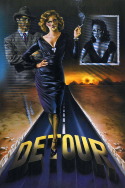
A minimally preserved, 68-minute strip of scratched, seamy celluloid, this movie from Hollywood's destitute rank, shot in six days, to the top with technical errors and blundering sequencing, starring a man who can merely show displeasure and a woman who can merely scorn, should've washed from view soon after it was released. And yet it lives on, evocative, sinister, an incarnation of the shamefaced core of film noir, probably because its story pulls no punches in its refreshingly pagan pessimism, searing a sour chasm in your mind that doesn't immediately heal, as it'll trouble, maybe just slightly, the more insecure recesses of your thoughts. "Fate, for some mysterious force, can put the finger on you or me, for no good reason at all." It tells the story of Al, a petulant loser played by Tom Neal with troubled eyes and a tired mouth, a nightclub pianist who's in love, or says he is, with a singer. Their song, ominously, is I Can't Believe You Fell in Love With Me. He wants to get married, she goes West, he carries on with the piano, but then: "When this drunk gave me a ten spot, I couldn't get very excited. What was it? A piece of paper crawling with germs." The movie was shot on a shoestring with B-minus actors, but it was directed by a cult director who sought creative autonomy from the studios, Edgar G. Ulmer, who was an assistant to the great Murnau, and granted one of the associations between German Expressionism, with its overstated lighting, camera angles and melodrama, and the American film noir, which contributed slang and shame.
The distinction between a crime film and a noir, I think, is that the bad guys in crime movies know they're bad and don't mind it, while a noir hero believes he's a good guy who's been trapped by life. Neal protests to us: "Whichever way you turn, fate sticks out a foot to trip you." Most noir heroes are overcome by the chinks in their armor. Few have had more chinks than Neal. He narrates the movie by candidly addressing the audience, generally in a maudlin drone. He's pleading his case, protesting that life hasn't given him an even leg up.
Most critics, and admirers too, of Detour have taken Al's story in a straightforward manner: He's star-crossed in love, he loses the good girl, is pillaged by the bad girl, he's a blameless onlooker who looks guilty even to himself. Naturally, I read it that way upon first viewing myself. But a more stimulating hypothesis highlights that the narration is not what occurred, but what Al wants us to believe occurred. It's a false yet gratifying telling of the story, because the singer scarcely matches Al's descriptive account of her, that he's less in love than in need of her paycheck, and that his hiding of Haskell's death is a validation for an easy theft, scared and alone on the pitch black night-time roads between his home and his dreams. Al's account exemplifies that upsetting events can be revised into flights of the imagination that are easier to live with.
Perhaps that's why Detour cozies itself up so well, why audiences react so fervently. The story's leaps and discrepancies are nightmare logic. Al's not telling a story, but dashing through the untreated fragments, amassing a defense, like the sequence where Al checks into a motel, goes to sleep, and dreams of the very same events that just happened: It's a flashback alongside with the events it flashes back to, as if his subconscious is doing a speedy modification. You could justify the overbearing amount of voice-over narration with the validation that the whole film's essentially a flashback. The focus is on the action, information and character relations. It's lean on setting details. And it's all frontstory.
Neal makes Al limp, submissive, sappy. That's perfect for the material. Ann Savage's work is special: There's not a single transitory shaving of compassion or mercy in her performance as Vera, as she snaps out her pulp dialogue. These are two pure types: the submissive man, the femme fatale. To be in the moment, an actor needs to be connected to their own feelings. Sometimes, alas, the only feeling an actor honestly has is anxiety, but that's perfect for this film. And the idiosyncrasies of the two leads come off fittingly.
The movie's low budget is clear. During one early scene, Ulmer artfully employs thick fog to function as New York streets. He shoots as many scenes as possible in the front seats of cars, with poorly maintained process shots. Flashing back, Ulmer just zooms in on Neal's face, cuts the lights in the background, and shines a light in his eyes. It results in a shrewdly economic way of furnishing an insatiably expressionistic noir, truer to form than many of the breed, but occasionally you can see him really reaching to get by, such as when Al calls long-distance to the singer. Ulmer fleshes out his running time by inserting stock footage of telephone wires and switchboard operators, yet can't manage any footage of the singer speaking into the phone.
Do these confines and indiscretions mar the film? No. They distinguish it. Like good punk rock, Ulmer's radical film gains its natural, edgy verve from its actual roughness. Detour is a case of material finding the suitable format by, inadvertently or not, going outside the norm. Two scavengers from the mire of pulp reel through the literal shadows of low-budget noir and are caught panting in Ulmer's web. Detour's one of the most audacious, utterly wicked works ever to come out of studio-era Hollywood, and its succinct, negative vision of the arbitrary futility of the world is still all the rage today.
This review of Detour (1992) was written by Paul Z on 19 Oct 2010.
Detour has generally received positive reviews.
Was this review helpful?