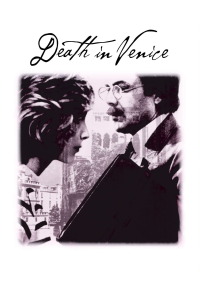
Review of Death in Venice (1971) by Daniel A — 14 Jan 2015
-Spoiler Warning-.
The film, "Death in Venice" (1971) by Luchino Visconti, presents themes of same-sex attraction, disguise, growing up, platonic beauty or perhaps pedophilia. All of these themes can be linked to the overall concept of androgyny as a means to promote an underlying attraction to danger and mystery through its inherent ambiguity. Visconti relates same-sex attraction to androgyny by demonstrating that the use of androgyny to hint at a heterosexual relationship between the film's main characters disguises its queer themes. Additionally, the association of same-sex attraction with androgyny helps the viewer identify the androgynous character's age through their gender portrayal. The film's main character, Gustav von Aschenbach is attracted to an Adonis named Tadzio in an unspecified manner, which suggests that it may or may not be platonic. The entire film is intentionally ambiguous, and it's to this ambiguity that Gustav is ultimately infatuated with, platonically or not.
Androgynous people are not often encountered in the world, and when they are, their appearances often induce a curiosity in others around them over what their true gender may be. Thus when an androgynous character is intentionally cast, their unclear gender may be presented as a form of costume or disguise meant to conceal their identity and inspire interest. Thomas Waugh writes, "The element of costume has several resonances. First, it is obviously a disguise, a basic term of homosexuals' survival as an invisible, stigmatized minority. Second, it operates to desexualize the subject within an erotophobic regime in which nudity articulates sexual desireability" (Waugh, 17). Tadzio's androgynous appearance coupled with his youth may be a means to desexualize his character, but contrary to Waugh's statement, the disguise may also be a method of drawing attention to the costume as a distraction away from queer love rather than a method of ensuring its invisibility. Tadzio's cross gender persona emphasizes a disguise that both arouses Gustav and mystifies the film's viewer.
Tadzio's androgynous disguise is fortified by his lack of a voice throughout the film, especially when around Gustav. Without a voice it becomes difficult to assess his interests and consequently the type of gender his personality portrays according to cultural norms. Tadzio first speaks at 42'30'' when Gustav is not present, and throughout the entire film, only speaks in two instances where his voice is actually heard by the viewer. Thomas Waugh mentions, "In many cases, the look of the gay subject is activated by or signified by his voice, namely through the mechanism of disembodied voice-over narration" (Waugh, 19). Tadzio's voice however, is rarely heard and so his look is rarely "activated" or determined to be masculine or feminine.
The voice is not the only hidden signifier of gender in the film. From his upper-class ballroom dress attire to his one-piece swimwear that cleverly conceals his junk, the clothes that Tadzio wears are nearly always androgynous in nature. In a particular scene at 67'17'', while Gustav watches Tadzio walking a long the beach, Tadzio is adorned in a white towel clasped around his body and over one shoulder in a style worn by ancient Greek royalty, a style of dress that was also androgynous. This dress may be a reference to the Greek figures often referred to when alluding to attractive male youth, such as an ephebe or an Adonis. Waugh mentions, "The cross-dressed ephebe may also have functioned as an alibi for that homosexuality that dared not fully assume the dimensions of same-sex desire, a reassurance for the masculine-gendered body and identity of a discreet spectator" (Waugh, 15). Waugh's statement suggests that rather than portray homosexual desires; the presence of the ephebe drains the queer essence out of the scene by replacing Gustav's sexual attraction with an admiration for beauty.
At 74'30'', Gustav attempts to visit a female prostitute to take his mind off of Tadzio. Even though the woman glows with beauty and skillfully plays the piano, two traits that Gustav should be interested in given his profession as a musician, Gustav rejects her before they even have a chance to get sexually physical. Robert Schwartzwald mentions, "the concept of the false feminine 'allows [us] to distinguish a natural and real love from another that is false and, when all is said and done, contrary to the positive and creative forces of nature'" (Schwartzwald, 29). In this instance, Gustav turns down the beautiful woman who represents natural and real love and opts for a love that according to Schwartzwald, is contrary to the positive and creative forces of nature; the love of a young boy. It isn't unnatural that Gustav loves a male, but that Tadzio is likely an underage male.
Tadzio's androgynous appearance is presented as a means to distinguish his age based on the gender that he is portraying. The significance of his age lies in the type of relationship that Gustav hopes to forge with him, whether it is one of admiration for beauty or one of pedophilia. It may be bold to assume that certain actions are associated with certain genders in the present, but doing so was a cultural norm not so long ago. Visconti creates a pattern that associates characteristics of the male gender with youthfulness. The same pattern ties characteristics of the female gender with growing up and maturity. Tadzio's male and female traits are depicted through his actions and occasionally through the way that the camera frames him. The connection between masculinity and youth occurs when Tadzio first speaks at 42'29'' and is revealed to have a young adolescent male voice. In this scene he is in the process of building a sandcastle with his friends, which is often regarded as a children's activity. Furthermore, at 60'04'' and again at 120'05'', he is depicted play wrestling with his male friends where play wrestling is symbolic of young age and masculinity. Thomas Waugh discusses "the decline of the ephebe, [situated] in the late 1950s, before which there was a clear dichotomy between adolescent object and 'dirty old john over thirty'" (Waugh, 20). Seeing Tadzio as an ephebe might allow the viewer to effortlessly differentiate his age from Gustav's, the "dirty old john over thirty", which would present a clear age gap between the two characters. On the other hand, Tadzio's female persona mildly closes that age gap as Tadzio is occasionally introduced as an older and more mature character when displaying female qualities.
When both the viewer and Gustav first see Tadzio in the film at 24'30'', he is sitting in a fancy hotel dining room grouped quietly with several young girls and women. Given his androgynous appearance and clothes, he may be seen as a girl too. The implication that he is older comes from the way that he is sitting quietly with his hands together. He is behaving very maturely in contrast to the later scenes where he and his friends are wrestling while yelling at the top of their lungs. At 43'24'' the camera pans through different sets of adults having conversations, reading newspapers, trying on jewelry, and then onto Tadzio, having his back caressed by another boy and then receiving a kiss as they walk together slowly. Here the camera creates the theme of adulthood by panning through other mature activities. Given that flirting is an action linked with growing up and that in the 1900s the female gender was often regarded as more submissive than the male gender, Tadzio portrays traits of an adult female as he yields to the kiss of his male friend.
The difference between the ages that Tadzio portrays is significant depending on whether Gustav's attraction to him is one of admiration of beauty or of sexual deviance. If Gustav's attraction is through sexual deviance, it might be related to his passion for excitement through the mysterious and abnormal. Pedophilia presents Gustav with a means to travel a dangerous path that may appear exciting to him because of how wrong it is. Waugh mentions, "The decline of the ephebe stems perhaps from the tightening taboos on pedophilia within sociological-juridical discourse, but no doubt more fundamentally from changing conceptions of economic role and sexual identity of the child, and the emergence of youth culture with its (post-) pubescent subject" (Waugh, 18). While pedophilic themes are rarely present in films nowadays, Waugh all but confirms that given that the book was written in the early 1900s; "Death in Venice" may very well revolve entirely around pedophilic love.
Through androgyny, same-sex attraction indirectly relates to many themes in Death in Venice such as growing up and sexual deviance. Visconti's use of androgyny as a distraction cleverly masks the film's queer themes while intriguing the viewer with curiosity over Tadzio's gender portrayal, perhaps as a means to appeal to public sexual norms in the 1900s or at least to stimulate the viewer's interest. Tadzio doesn't just look androgynous. He also acts androgynous. It's through the ways he acts that the viewer can also distinguish his age, and with that, the type of relationship that Gustav fantasizes about with him.
Bibliography.
Schwarzwald, Robert. "'Symbolic Homosexuality', 'False Feminine', and the Problematics of Identity in Quebec". Fear of Queer Planet: Queer Politics and Social Theory. Warner, Michael. 1993. 264-299. Rpt. in FMST 393: Queer Cinema I Coursepack. Comp. M. Hays. Montreal, QC: Concordia University Bookstore, 2014. 15-23. Print.
Waugh, Thomas. "The Third Body: Patterns in the Construction of the Subject in Gay Male Narrative Film". Queer Looks: Perspectives on Lesbian and Gay Film and Video. New York and London: Routledge, 1993. 141-161. Rpt. in FMST 393: Queer Cinema I Coursepack. Comp. M. Hays. Montreal, QC: Concordia University Bookstore, 2014. 25-42. Print.
This review of Death in Venice (1971) was written by Daniel A on 14 Jan 2015.
Death in Venice has generally received very positive reviews.
Was this review helpful?