Review of Days of Heaven (1978) by Jennifer A — 21 Apr 2008
Cinema's reigning poet, Terrence Malick is at the very least one of the most visionary directors of all time. He's a stylist very much at odds with Hollywood's conventional mode of film-making. He's a recluse, an enigma and an artist that is likely to divide both critics and his audience. Those who dislike his work usually brand him as pretentious and self-indulgent. Regardless of where you stand on Malick, it's hard to deny his impact after just four films in 30+ years.
After selling a couple of screenplays, Malick made his directorial debut with 1973's Badlands.
[b]Badlands (1973) - 9.1/10[/b].
Director - Terrence Malick.
Starring - Martin Sheen, Sissy Spacek, Warren Oates, Alan Vint, Ramon Bieri.
Widely considered to be Malick's best film, an opinion I happen to agree with, [i]Badlands[/i] is based on the 1950's Starkweather-Fugate murders. 25 year old Kit (Martin Sheen) is a garbageman with a James Dean sense of coolness. 15 year old Holly (Sissy Spacek) falls for the much older Kit, despite the objections of her father (Warren Oates). The pair becomes fugitives on the run after shooting Holly's father which leads to a multi-state killing spree and an intensive manhunt.
Filmed on a limited budget, [i]Badlands [/i]isn't as strikingly beautiful to look at as Malick's later films. That said the camerawrok is still very impressive and like his later films the landscape becomes another character, enhancing the mood and moving the story along. We are also introduced to another Malick trademark, his use of voice-over narration. Contemplative and poetic, it's not used to merely move the story along, it's purpose is to invoke thought or create a certain mood. It's quite effective in this film helping [i]Badlands[/i] avoid feeling like a pale imitation of[i] Bonnie and Clyde, [/i]another film I happen to admire.
So why is this my favorite Malick film? Is it because it's Malick's most conventional film? Although that may be the case, that's not the reason I admire Badlands more than his other films. I think it's Malick's most cohesive film. I wonder if this is because of budgetary constraints. All of the elements of his later films are present, just more restrained. No the reason I think this is Malick's best film is because Martin Sheen and Sissy Spacek are such a commanding presence. Their performances are so strong, so believable that they are not overshadowed by Malick's poetic or visual mastery. Nope they are his equal here. No actors have been used better since, with the possible exception of Q'orianka Kilcher in [i]The New World[/i].
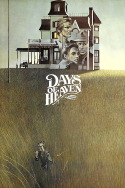
Five years later Malick would return with his highly anticipated follow-up, 1978's [i]Days of Heaven[/i].
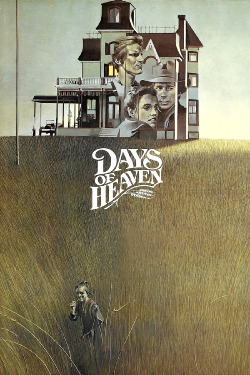
[b]Days of Heaven (1978) - 6.3/10[/b].
Director - Terrence Malick.
Starring - Richard Gere, Brooke Adams, Sam Shepard, Linda Manz, Robert J. Wilke.
Richard Gere stars as Bill, a Chicago steelworker who flees to the Texas panhandle with girlfriend Abby (Brooke Adams) and younger sister Linda (Linda Manz) after a fatal confrontation with his boss. Broke and in need of work, they work the harvest for a wealthy farmer (Sam Shepard) who only has a year to live. The farmer falls in love with Abby, believing her to be Bill's sister, not his girlfriend. The opportunistic Bill and Abby decide to go along, hoping to reap the rewards of his imminent death. However after Abby weds the farmer, he seems to make a miraculous recovery, dappening the plan an creating a dangerous triangle of love. The voice-over narration is handled by the observant and candid young Linda.
[i]Days of Heaven[/i] is easily Malick's most visually arresting film. Mostly filmed just before sunset, it's simply gorgeous to look at. Stunningly beautiful shot after shot. This may be the best cinematography I've ever seen, or certainly close. With [i]Days of Heaven [/i]Malick's reputation as a visual artist is forever cemented. The film's visuals are so meticulously detailed that they remain in your memory long after the credits role. Unfortunately that is where most of my praise ends for this film.
Obviously this is the film where Malick became a visual artist, and a poet, so much so that it completely overwhelms the story. Make no mistake a great story is buried here somewhere, but upon repeated viewings it's never fully realized and I'll try to pinpoint why. Some detractors will immediatly question the use of the young girl as the film's narrator, but for the most part I think that worked well. Linda appears to be wise beyond her years yet still seems innocent enough so that her candid observations still resonate with the audience. However there are a few moments in the film where her voiceovers can't piece together a very complicated triangle. Nope the biggest problem here is my lack of emotional investment in the two leads, Bill and Abby. Unlike [i]Badlands [/i]the pair become little more than background fodder, only necessary to move the basic plot along. It's not that the film needed to be dialogue intensive, it didn't, but the lack of depth in these characters (especially Abby) makes any connection rather difficult. In a film that's so visually emotional, I found the lack of emotional connection to the characters to be rather disarming. And the ultimate confrontaion between Bill and the Farmer was an anti-climatic disappointment. As detailed as Malick can be you would have thought he could have come up with something better. You would think a film centered on a romantic triangle would be, well, more romantic, but only the landscape is romanticized here.
Ultimately I cannot totally dismiss this film because the totally innovative and beautiful imagery. The film is a favorite among Malick afficienados and was a critical success overall. However audiences were not as kind as it didn't do very well at the box-office. Obviously this is the film Malick was meant to make and perhaps he was so disappointed by it's lack of success that he disappeared for twenty years.
In 1998 Malick finally returns to filmmaking with his epic war drama [i]The Thin[/i] [i]Red Line[/i]. I reviewed and rated this film a couple of years ago but I'll go ahead and add some more thoughts here.
[b]The Thin Red Line (1998) - 8.0/10[/b].
Director - Terrence Malick.
Starring - James Caviezel, Sean Penn, Nick Nolte, John Cusack, Ben Chaplin, Woody Harrelson, Elias Koteas, John Savage, John Travolta, George Clooney, Adrien Brody, John C. Reilly, Jared Leto, Tim Blake Nelson, Dash Mihok.
Malick returns after a 20 year sabbatical with the much anticipated war drama [i]The Thin Red Line[/i]. Featuring a rather impressive (and quite large) ensemble cast, the film is set in the South Pacific, the site of the Battle of Guadalcanal. James Caviezel stars as Private Witt, a deserter living peacefully among the natives. Witt is soon returned to his unit, debriefed by his sergeant Welsh (Sean Penn) as he and his unit prepare for battle. We see war through the eyes of many soldiers, learn about their hopes, fears and motivations although Private Witt serves as the film's heart and soul and primary narrator. I've already gone through the basic story/plot in an earlier review so I'll just skip to my thoughts of the film.
Released the same year as Steven Spielberg's [i]Saving Private Ryan[/i], Malick's visionary tale of war couldn't be more contrasting. Speilberg's film is most notable for it's opening battle sequence which is quite harrowing. What followed was a much more conventional war film where Spielberg seemed so concerned about being respectful to vets that he missed an opportunity to make a real statement other than war is hell, which has been done countless times before. Malick's film on the other hand knows that war is hell and focuses instead on the duality of war. It's a philosphical film that uses war as a backdrop for many underlying themes. Man's inhumanity towards man and towards nature. The nature of our very being. It's all weighty stuff and for the casual viewer expecting a typical action/war film a bit too much to grasp. They may argue if war is hell why do you have to get so lyrical and poetic? Perhaps to help grasp the insanity of the war? For whatever reason I found this film to be much more profound than [i]Saving Private Ryan. [/i]I think it's also a film where Malick found a creative balance between his visual mastery (his 2nd best looking film) and storytelling. Where he seemed to dismiss his actors in [i]Days of Heaven [/i]as necessary props, he embodies the chracters here. With the exception of a couple of star-studded cameos (Clooney and Travolta come to mind) each character seems to add something important to the mix. Malick once gain relies heavily on voice-overs but they are very effective in guiding the film and it's many messages. At first glance it may appear to be only an Anti-War film, but that just scratches the surface. It doesn't quite acheive greatness, but it does mark the return of an important filmmaker and ranks among the best war films I've seen.
Malick would wait seven more years before making his ambitious fourth film, [i]The New World[/i].
[b]The New World (2005) - 8.0/10[/b].
Director - Terrence Malick.
Starring - Colin Farrell, Q'orianka Kilcher, Christian Bale, Christopher Plummer, August Schellenberg, Jonathan Pryce, John Savage.
Malick's epic story begins in 1607 as three British ships land on new soils, beginning a new settlement known as Jamestown. John Smith (Colin Farrell) is shackled below, due to be hung for rebellious acts once the ships dock. With only a 100 settlers, Captain Newport (Christopher Plummer) decides to pardon Smith knowing he will useful with further exploration. The colonists soon discover they are not alone as they soon meet the local Native American tribe. At first the two groups view each other curiously, but distrust surfaces. One day Smith, exploring the new land, is captured by the natives. The chief's daughter Pocahantes (Q'orianka Kilcher) is fascinated by Smith and her interest saves his life. Smith lives with the natives and soon falls in love with Pocahantes, much to the chagrin of her father. Sent back to his colony, he can't help thinking about her. Meanwhile the Chief Powhatan (August Schellenberg) assumes the colonists will return to Britian in the spring. Ill-equipped to survive the winter, the colonists suffer dearly. Pocahantes brings food and her support further alienates herself from her tribe. Soon sent away, she winds up at Jamestown where she is slowly "civilized". However her love John Smith is sent back to England by Captain Newport and she is alone in her "New World". A few months later she is told that Smith has died. As she mourns, Pocahantes is fancied by plantation owner John Rolfe (Christian Bale). He is kind and patient and tells Pocahantes she will learn to love him. She agrees to marriage but is torn when Smith returns.
Initially [i]The New World[/i] didn't really impress me. I wrongly dismissed it as another [i]Days of Heaven[/i] type effort, much more concerned about style than substance. However repeated viewings have been much kinder to [i]The New[/i] [i]World[/i] than [i]Days of Heaven [/i]and I can honestly say I admire and enjoy this film. So why the change of heart? In many ways it's structered similarly to [i]Days of Heaven[/i] just on a grander scale. Like [i]Days of Heaven [/i]it's a visual masterpiece full of poetic musings and sparse dialogue. And like [i]Days of[/i] [i]Heaven[/i] it features a love triangle. So why is one a beautiful mess and the other a beautiful success? Quite simply Malick found the perfect centerpiece for this film in young actress Q'orianka Kilcher. It's not a dialogue driven role, it's an emotionally driven role. To capture the beautiful essence of this "New World" Malick needed an actress that he could feature as prominently as the landscape. She embodies the spirit of the new land not in words, but in movement, beauty and gestures. He wasn't able to do this with Brooke Adams (or the other actors) in [i]Days of Heaven [/i]but he does so here. We yearn for her happiness, feel her sadness and sincerely care about her journey. It's a remarkable performance, one that's as vivid and poetic as anything Malick has captured on film. In fact the film suffers without her presence. Colin Farrell and Christian Bale compliment her much better than Richard Gere and Sam Shephard did in [i]Days of Heaven[/i]. Not being a fan of Farrell, he was at his best in scenes with Kilcher. Bale as always does a fine job in the "lesser" role.
Of the four Malick films, [i]The New World[/i] was the one critics disliked the most. Many called it pretentious, self-indulgent, slow, or worse. It's not a film that immediatly grabbed me either. However once you get past the vivid imagery you will find an emotionally rich, beautifully told story. Malick may not be everyone's cup of tea but you have to admire a man who steadfastly refuses to compromise his own vision in a time when Hollywood continues to manufacture and remanufacture pre-marketed garbage.
Next up for Malick? [i]Tree of Life [/i]which is set to star Sean Penn and Brad Pitt.
This review of Days of Heaven (1978) was written by Jennifer A on 21 Apr 2008.
Days of Heaven has generally received very positive reviews.
Was this review helpful?