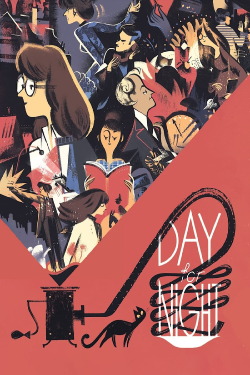
Review of Day for Night (1973) by Edith N — 24 Jun 2009
Inside the Shallow, Vapid Lives of Film People.
Fans of [i]MST3K[/i] are very familiar with the process which gives the film both its English and French titles. (In French, [i]La nuit américaine[/i]). Fans of older movies just in general, really. The term, as we are told early in the picture, refers to the use of filters and camera tricks to make sequences shot in broad daylight look like they were filmed at night. This happens with varying degrees of success, as you may have noticed; we never see the level of success achieved in our picture-within-a-picture. Indeed, we see very little of it at all. Truffaut is content to let us fill in the story and imagery in our own heads. He wants us to compare the confidence these people seem to have onscreen with the . . . interesting lives they lead. And by "interesting," I mean "crazy.".
Ferrand (François Truffaut himself) is making a film about a woman who, upon being introduced to her new father-in-law, falls in love with him. The woman is American actress Julie Baker (Jacqueline Bisset). The father-in-law is French actor Alexandre (the actors do not reliably get credited with last names in the film; at any rate, the character is played by Jean-Pierre Aumont). The young husband is Alphonse (Jean-Pierre Léaud). His mother is Severine (Valentina Cortese). The only character within the inner film whose name I can remember is Julie's Pamela, and that because the film is named after her. At any rate, Julie has just gotten married to a much older man, Dr. Nelson (David Markham). Alphonse is having a wild and inadvisable affair with Liliane (Dani), who holds some amorphous position on the crew and who is not remotely as interested in him as he is in her. Severine's son has cancer, apparently, and is dying. Alexandre is talking of adopting a young man, and I suspect it's not just for the given reason of having someone to carry on his name when he dies.
Alphonse gets referred to by about half the cast, not least Liliane, as a child, and he really is. His actions almost destroy the film single-handedly. Probably he knows they will, too. But he must be the center of attention, the more so because Liliane has finally gotten tired of him--and shown, honestly, that she's not much more mature than he is. She's just immature in a different way. Really, few of the people involved in making the movie are terribly mature, which may have been Truffaut's point in the first place. He says, at one point, that he always starts a film hoping to make a fine one and ends happy to make one at all. We are shown four stars of the film, four actors in it at all, and every single one of them derails filming in some way (though, at the last, not intentionally on the part of one of them). Severine is suffering genuine emotional trauma and should not be there in the first place. I do not dispute this. However, as she has made the decision to be there, she should work to do the very best she can, and she doesn't. She screws up lines and which door is the exit and which is the closet, because she is [i]very[/i] drunk. Which doesn't help anyone anyway. Julie makes a mistake with good intentions. And there is Alphonse, who is, again, a child. Alexandre is professional throughout, but in the end, it is he who makes things worst of all.
One thing Truffaut seems to be trying to show us is how much work a film really is. Julie, at one point, admits to working as many as fourteen hours a day. These people are away from their families for weeks on end, pretending to be people in intense emotional situations they themselves will probably never experience; that is, after all, what acting is. Ferrand is running around trying to keep everyone's individual insanity separate from the production so that he can actually make his film. New pages of script are handed out pretty much every evening. The wardrobes and the technical bits are a constant pressure--at one point, they have to go to the airport because there's something wrong (I didn't catch what) with the costumes. At one point, the composer calls in to play some of the music he's written for a scene that, as I recall, never ends up getting shot in the first place.
If one watches most films about the making of movies, it sparks a belief that one can just jump in. Someone will discover you and everything will work out well for you. Teh actual filming will be bright and full of happy, hard-working people. Your life may be difficult, but you'll overcome it and shine at the end. On the other hand, there are films like this one, which show that things may not be as happy as you think. This one is probably more realistic. It's interesting, really, when the great directors take on things so close to their hearts. Fellini gave us [i]8 1/2[/i], and that's about the hazards of being, well, a director in a Fellini film. But Truffaut, who has also acted, seems to be more interested in what goes on during filming, not the director's search for inspiration. Truffaut knew film from several perspectives, and the movie here seems determined to show us all of them.
This review of Day for Night (1973) was written by Edith N on 24 Jun 2009.
Day for Night has generally received very positive reviews.
Was this review helpful?