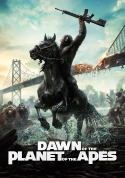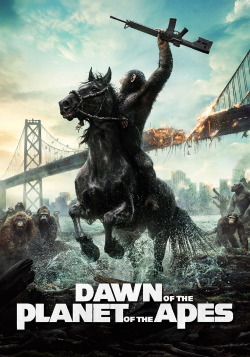
Review of Dawn of the Planet of the Apes (2014) by Moviemastereddy — 07 Apr 2016
‘Dawn of the Planet of the Apes’ Continues the Saga.
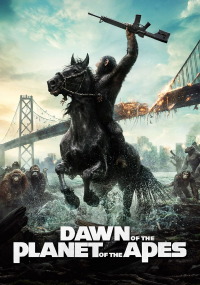
A quick montage at the beginning of “Dawn of the Planet of the Apes” fills us in on what has happened since “Rise of the Planet of the Apes.” Three years have gone by for us in the audience, and about a decade for the assorted primates on the screen. James Franco and millions of other people are dead, victims of a lethal virus and the usual apocalypse-causing disease of hubris. After a period of violence and chaos, the survivors have cobbled together a reasonably stable society in the ruins of San Francisco, with Gary Oldman in charge.
But this is not “Dusk of the Planet of the Humans.” The spectacle of yet another desperate population, huddled together in the wake of catastrophe to await the next zombie, alien, robot or monster attack, would be unlikely to inspire much excitement. The real interest lies across the battered Golden Gate Bridge, in Marin County, where our evolutionary cousins, under the benevolent guidance of an upright-walking chimpanzee named Caesar, have built their own civilization. In contrast to the bedraggled human colony, the ape encampment is a thriving city-state with distinctive wooden architecture, domesticated horses, a sophisticated (mostly signed) language and an educational system overseen by Maurice, the gentle, copper-furred orangutan who gave the first movie an extra fillip of soul.
The sylvan, simian Athens in the Muir Woods is a remarkable achievement and an important part of what makes “Dawn of the Planet of the Apes,” directed by Matt Reeves from a script by Rick Jaffa, Amanda Silver and Mark Bomback, the best of this summer’s large-scale, big-studio franchise movies. Granted, this isn’t a very high bar to clear: “better than ‘Transformers 4’ ” barely counts as praise, even with an exclamation mark. But unlike that toy-smashing extravaganza — and unlike 2014’s visitations from the “Spider-Man,” “X-Men” and “Godzilla” money trains — “Dawn” is more than a bunch of occasionally thrilling action sequences, emotional gut punches and throwaway jokes arranged in predictable sequence. It is technically impressive and viscerally exciting, for sure, but it also gives you a lot to think, and even to care, about.
Starting with the apes themselves. In the final credits, Andy Serkis receives top billing for his performance as Caesar, a role that continues to redefine screen acting in the digital age. His facial expressions and body language are so evocatively and precisely rendered that it is impossible to say where his art ends and the exquisite artifice of Weta Digital, the special-effects company, begins. The same is true of the other main ape performers: Karin Konoval (Maurice); Nick Thurston (Caesar’s son Blue Eyes); Judy Greer (Caesar’s wife, Cornelia); and especially Toby Kebbell as Koba, Caesar’s lieutenant and eventual nemesis.
Koba, a survivor of scientific experiments, bears the physical and moral scars of human cruelty. When the apes encounter a scouting party from the city (led by Jason Clarke and Keri Russell), Koba is quick to sound the alarm. The humans, about to run out of fuel, want to restore an abandoned hydroelectric station in ape territory, and they ask Caesar for help. Koba warns that people are a violent, duplicitous, predatory species that should be fought if it can’t be avoided.
Caesar, who saw the generous, tender side of humanity when he was hanging out with Mr. Franco and Freida Pinto, is willing to give our kind the benefit of the doubt. There is plenty of evidence — both in the movie and beyond it — to support Koba’s view, but the film comes down squarely, and maybe a little too squishily, on the side of tolerance and cooperation. The ape and human societies are parallel primitive patriarchies (women nurture and worry, while men lead and fight, a disappointing but hardly surprising failure of imagination on the filmmakers’ part), and they are threatened by symmetrical schisms. As Koba opposes Caesar, so does Malcolm (Mr. Clarke’s character) find himself increasingly at odds with Dreyfus (Mr. Oldman), who sees the apes as a mortal threat to be confronted with maximum brutality.
And while “Rise” found room for exuberance in the shadow of catastrophe — partly because it seemed so justifiably excited by its own ingenuity — “Dawn,” its title notwithstanding, paints a darker, scarier picture of the future. It also has a grave, brooding beauty, intensified by Michael Giacchino’s wild and subtle score and by the deep, verdant shadows of Michael Seresin’s cinematography. Mr. Reeves has a fine sense of visual detail and also of the eloquence of nonverbal exchanges between characters, digitally enhanced and otherwise. (Ms. Russell and Kodi Smit-McPhee, as her adolescent son, do especially graceful work in limited roles.) The film is full of small, memorable moments and crowded with distinctive personalities on both sides of the ape-human divide.
This review of Dawn of the Planet of the Apes (2014) was written by Moviemastereddy on 07 Apr 2016.
Dawn of the Planet of the Apes has generally received very positive reviews.
Was this review helpful?