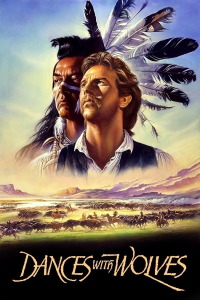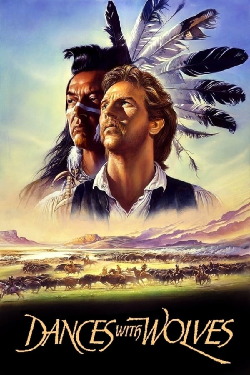
Review of Dances with Wolves (1990) by Kylie P — 22 Dec 2009
The appeal of Dances with Wolves stems from Costner's thoroughly sensitive and sympathetic treatment of the Sioux. Is it overly simplistic? Perhaps, but remember that Costner was filming one of the first examples of film in which Indians were not the aggressors, begging to be out-gunned and defeated by white settlers trying to set up their piece of the so-called American dream. For such a subject to attain a connection to the audience, generalizing and oversimplifying a culture may have been necessary, and Dances with Wolves works because such a connection to the viewer is provided. The film does not focus exclusively on the Dunbar character; there are scenes in which the tribal leaders confer amongst themselves about the meaning of Dunbar's presence and the possibilities it may symbolize, and the film isn't exactly meant to be a documentary.
Maybe Costner just begs for the criticism. After all, he'sl an awkward actor; he has a certain everyman demeanor that gives him some credibility and suspension of disbelief in the characters he chooses to play, but his faults and limits become painfully obvious in roles that challenge him to seek three dimensions. His performance (which is the fulcrum of the film, since it is told from his point of view and through his sporadic narration) is strongest when he focuses on Dunbar's feelings and fosters connection from Dunbar to the other characters, because it as if Costner is connecting to them and connecting them to the viewer. His performance is weakest in moments of subtlety, whether that subtlety stems from irony, sarcasm, or quiet moments when the Dunbar character must appreciate or observe something around or before him. Costner may never be a strong actor, but his limitations are not as jarring in Dances with Wolves, quite possibly because the man sees something of himself in the character, and the man as the director had passion in his subject.
The film is beautiful, and anyone who says different is lying to be contrary. The photography is absolutely stunning, and the use of natural light and focus on the contours of the wilderness truly add texture to a film that is already complexly layered. The score is beautiful and epic, tells so much story, and sounds so much like what is being depicted visually, or, perhaps evokes that reaction so heartily; Barry did such great work in creating a score that is essentially synonymous with the visual elements of the film.
Also, the supporting performances were wonderful, including all of the actors who portrayed the various members of the tribe. Even if the treatment of the Sioux in this film was overly simplistic, the Indian actors' devotion to the material was real, and their performances natural. Mary McDonnell also offered a fine performance, even if her character's memory of the English language strained credibility (considering that the younger version of the character seemed barely able to use the English language to start). All in all, the production values of Dancing with Wolves are outstanding, and Costner really is not so annoying (no matter what the naysayers say).
This review of Dances with Wolves (1990) was written by Kylie P on 22 Dec 2009.
Dances with Wolves has generally received very positive reviews.
Was this review helpful?