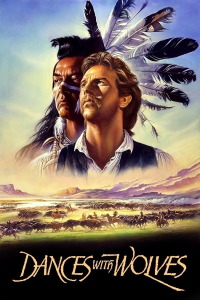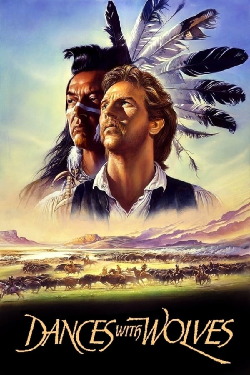
Review of Dances with Wolves (1990) by Valentin A — 16 Aug 2014
In an occasional series I look back at films I have loved (to death) and muse on why with the vain hope that some of you will dust them off again and plunge right in all over again. They need to be re-watched. They're worth it.
This time; Dances with Wolves, brought to us by a very wise and brilliant young actor (at that time) called Kevin Costner (you've probably heard of him!).
NB: This was what turned Kevin Costner into gold dust for a few years (remember Robin Hood: Prince of Thieves). Costner was King Midas basically until his sparkly, shiny star reached its apogee with his untimely filmic demise in the utterly ridiculous and overblown (and over-budget) Waterworld. (Holds head in hands; Kevin what were you thinking!).
I fell in love with Dances With Wolves in 1990 and then recently again when I tried to force my 13 and 15 year old to watch it. Their response was the inauspicious; "It's a bit boring dad," as they vacated the sofa 32 minutes in. But I contend here Calum and Adam that you're just not quite ready for it yet and don't be surprised if it cycles round again sneakily one Friday Family Film Night soon.
Dances With Wolves is genius, a slim novel of 1988 vintage written by Michael Blake with his eyes on a possible screenplay prize, it was bought hook, line and sinker by Costner who yummed it up so much he starred, directed and drummed up the finance for it over the next few years. It became Costner's labour of love and at the same time he re-invented the Western form for Hollywood so they could fall in love with it again in a post-modern way with a whole lot less stubble and a whole lot more human heart.
Dances With Wolves has Oscar written all over it and I fell head over in heels in love with it when I was a (still extremely naive and immature) twenty-two year old. Where to start then on this gorgeous-fest of love, hope, humanity and sheer cinematographical brilliance?
Is it with Timmons the hapless mule-train driver who first takes the naive and idealistic John Dunbar (the solider fresh from the horrors of the Civil War) that Costner plays out to the Frontier, a sea of prairie where so-called civilisation hasn't reached yet? (Poor Timmons dies brutally - and brilliantly - the victim of some Pawnee Indians tracking back to their home-lands after a patrol. His scalping is so visceral we can almost hear (at an appropriate distance) the skin unzipping from the skull!).
Or perhaps we should start with Kicking Bird (played by Graham Greene) the thoughtful and wise young brave who first visits the decimated Fort Sedgwick after John Dunbar first arrives.
Or perhaps it is simply the vast, swaying grasslands of the mid-west, an ocean of Buffalo for mile upon mile? A landscape the sky was invented for, a landscape to put us in our mortal place.
Or perhaps it's the sweeping John Barry soundtrack or incredible long, lugubrious shoots of the Dakota Badlands and the in-your-face wildernesss of a country as yet untamed.
At root the reason why so many of us love this film is the production values for the whole project, from cinematography through to the language coaching the Native American actors underwent so they spoke Lakota convincingly. Everything on this movie is sumptuous (except perhaps the budget, note to self Mr Costner) and it is strong and powerful theme of the story, revisited endlessly in mini-echoes throughout its three hour duration, that brings home such a resounding narrative success. Dances With Wolves works because the story is simple and straight as a Pawnee arrow and it strikes right to our hearts. It is about what we truly are, as individuals and as a species. It is about heart and head, family, connections and the wisdom of living together with tolerance and in harmony with our world. It is about the wind in our hair and the sun on our backs, it is about simply being as opposed to being something.
The story is a back-to-nature tale of John Dunbar's gradual re-education about the so-called Savages the great White Man is expunging from America's heartland. It is an Alice Through The Looking Glass narrative where Dunbar very soon realises, whilst amongst the metaphorical wolves of the title, it is his own kind, White Man, who are the savages. The story of this film was totally ripped off in Avatar, same idea, just with eleven foot smurf aliens and some eye-popping CGI. What Dances With Wolves has in spades which its newer and bluer rip off didn't (and I totally loved Avatar too) is that it helped reinforce a revisionist tack on the Great American West, actually much more like genocide than a heap of swaggering John Wayne gunslingers ever let on.
Of course the Native American life-style is romanticized in this film, the wars between tribes, the pointless politics and the diseases and famines of a neolithic society are all glossed over, but we can forgive all that. It's ultimately an extended apology for all the Cowboy and Indians nonsense that went gone before. The Wild in West was the White Man's rapacious and violent land-grab and in Dances With Wolves we get to see that barbarism from the other end of the telescope. Not pretty or pleasant, but a truer account than most Westerns.
Go on, buy it again and re-watch it. It deepens our humanity and succeeds in upsetting me deeply every single time I watch it.
***** (Five Stars).
This review of Dances with Wolves (1990) was written by Valentin A on 16 Aug 2014.
Dances with Wolves has generally received very positive reviews.
Was this review helpful?