Review of Daisy Kenyon (1947) by Blake P — 17 Jul 2013
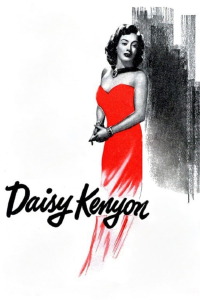
Joan Crawford continued her winning streak with "Daisy Kenyon," following the massive successes of two delicious women's pictures, "Mildred Pierce" and "Humoresque." It's not one of her most gloriously over-the-top performances, but "Daisy Kenyon" works well because it's a low-key romance film and is much more classy than most Hollywood melodramas. Otto Preminger has made many better films than this one, but it shows a more commercial side of him that's better than most.
Daisy Kenyon (Crawford) is a New York based artist that is stuck in the middle of a stressful love-triangle: she's torn between Dan (Dana Andrews), a powerful attorney that is unhappily married with two children, and Peter (Henry Fonda), a WWII veteran that is dissatisfied with life after the war. Though most would follow their moral compass and go with Peter, Daisy cannot decide easily. Even when she eventually marries one of the men.
Crawford was groundbreaking for her time because she was one of the few actresses who could still be sexy and independent after 40. But even more mesmerizing was the fact that she became a draw once again AT 40, after she was labeled "box-office poison" in the late '30s. Even today this is a remarkable achievement. But during that period, Crawford starred in some of the best women's pictures and film noirs of all time, this being one of them.
Daisy normally would be played by an actress in her 20s, but Crawford makes it work. You can see why men like her: she's smart, pretty, and quick-witted. Crawford manages to keep her status as Queen of the Melodramas, even though she gives up her normally sudsy acting for a more subtle performance. Her chemistry with Andrews and Fonda is magnetic, and the love-triangle is interesting and believable.
The film as a whole is very ahead of its time. Having a romance with two different men was already scandalous in the '40s, but that isn't what is so modern in its thinking. Andrews' character is cheating on his wife, so in response, she takes out her sexual frustration and misery on her children. At the time, cheating husbands' wives in movies were written mean or cloying, so then it would therefore make it okay for the leading lady to have a relationship with the man in question. But here, it's a realistic characterization. In the meantime, Andrews' character is a lawyer that is defending a Japanese man who has lost his property, without racism. That in itself is a triumph, considering the racism at the time.
Is "Daisy Kenyon" a film noir? It has all the right aspects. It has slithery cinematography, the characters live within a gritty world that always looks down but not up, and of course, it's directed by Preminger, one of the finest noir directors. But "Daisy Kenyon" is much to A-picture-esque and three-dimensional to be called so. It's instead a great Crawford vehicle.
This review of Daisy Kenyon (1947) was written by Blake P on 17 Jul 2013.
Daisy Kenyon has generally received positive reviews.
Was this review helpful?