Review of Cry Freedom (1987) by Edith N — 29 Jan 2008
Actually, the reason I'd planned to do a double review here was that they both started with the word "cry." If the library had had [i]Cry-Baby[/i], I would've been all over it. I thought, briefly, about throwing in [i]The Crying Game[/i]--which I own! But then, I actually looked at the [i]plots[/i] of both these movies. I'd put them on my hold list without having bothered to look at the plots, you see, because they were both movies that sounded vaguely familiar. That's been the case with a lot of the films we've gone through, actually. If I've heard of it from somewhere, it generally goes on the list, unless what I'd heard of it was, "My, that's a bad movie." And sometimes even then, hence Creature-o-rama.
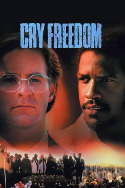
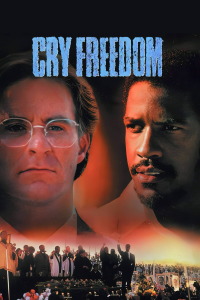
But [i]Cry Freedom[/i] is about . . . well, realistically, it's about Donald Woods, a white liberal newspaper editor who ended up fleeing South Africa with his family. However, the thing that shaped his life to the point where he had to flee was his friendship with black activist Steven Biko. More on this anon. Likewise, [i]Cry, the Beloved Country[/i] is about two families, one white and one black, and how they interact in 1946 South Africa. It is very, very difficult for those of us who remember Apartheid to envision a story set in South Africa that [i]wasn't[/i] about the interactions between black and white people; I suppose you could make a movie about paleontologists or something, but I'm not sure it would work even then.
The problem a lot of people have with [i]Cry Freedom[/i], as I alluded to, is that it's not really the story of Steven Biko (Denzel Washington), who is arguably a more significant influence on the blacks of South Africa, and therefore--since the blacks are a majority--the country as a whole. Certainly it's true that it is the story of Donald Woods (Kevin Kline), and Steven Biko is not so much the star as the supporting role. However, I think that it is an equally important story to see the journey one man makes from going along with the status quo to risking his life--after a friend of his was beaten to death in prison, mind--in order to continue his fight against an oppressive regime. Let's face it, Steven Biko's death wouldn't've helped galvanize opposition to Apartheid if no one outside the country knew about it. Part of what ended Apartheid was pressure from other nations, and Donald Woods helped build that pressure. In the name, naturally, of his good friend, Steven Biko. Who is the [i]protagonist[/i] in the sense that the story would not move forward without him.
[i]Cry, the Beloved Country[/i] gives us a stronger focus on the black man, here James Earl Jones. However, in this case, I think a large part of the story [i]should[/i] focus instead on Richard Harris's James Jarvis, as it is his son that has been killed. However, we focus on Rev. Stephen Kumalo, the father of the killer, instead. Now, it is true that the point of the story is that Absolom Kumalo (Eric Miyeni) is guilty of perhaps manslaughter, and he should not have been executed for the crime, and that the reason he was has to do with the unjust system. That, it is true, is an awfully important story. However, James Jarvis has lost a son, and it changes him completely. I guess either story could go either way, really.
Now, I wouldn't be me if I didn't point out that Absolom is a clear Biblical reference, though probably--all things considered--not a Faulkner one. (And thank Gods, because I hated that book.) Abs[i]a[/i]lom was a son of King David, most famous for having been killed, and for the mourning of his father. Both fathers here have lost sons; both fathers here mourn. Both fathers are angry, as King David was angry, about what brought them all to this pass. It is this anger and this grief that allows the fathers to overcome what has separated them, even though one father might well be even angrier at the other.
Actually, Steven Biko and Donald Woods came together because Woods called Biko a racist in one of his columns. (Yes, boys and girls, it [i]is[/i] possible for a black person to be racist. Anyone who dislikes anyone else for the colour of their skin is a racist, no matter what colour whose skin is.) Biko denied the claim, I think rightly, and offered to show Woods the South Africa he did not know. So I guess the moral of today's stories is that friendship can come from unusual places, and what's important is to do good with it. Or something.
Weighty stuff, I know. And I'm sure we'll get into lighter, happier stuff soon; I've got some Al Franken in at the library, for example. And we've got the Cocteau [i]Beauty and the Beast[/i], and so forth. But in the library's catalog, as in life, we must take the serious with the joyful.
This review of Cry Freedom (1987) was written by Edith N on 29 Jan 2008.
Cry Freedom has generally received positive reviews.
Was this review helpful?