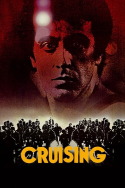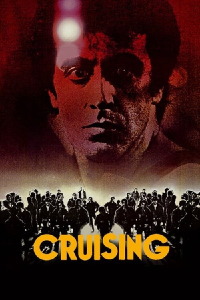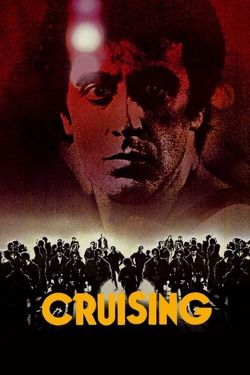
Review of Cruising (1980) by Todd J — 24 Feb 2008
The controversy over this film is really quite baffling to me. It's not that the film deserves no controversy. After all, the portrayal of a very specific subculture of gay America and sadomasochistic sex in general is quite demonized.
The slow descent into the leather gay scene in New York in the late 70's early 80's is depicted as a horror film. The psychological confusion that Pacino feels over participating in this environment is supplicated by the threat of being murdered, which, combined with Friedkin's no nonsense depiction of the environment, gives the whole scene a very threatening feel, which is fine for the film's crime elements, but as far as depicting such an often misunderstood culture accurately, Friedkin goes for it but ends up imbuing the whole thing with a reactionist phobia (that isn't necessarily homophobia) that ignores the fact that S&M has a feature of safety about it.
Of course, the ironic part about all this is that the participants and proponents of this scene weren't the ones protesting the film. The fact that Friedkin was allowed to shoot in their locations and with them as extras with vehement protests everywhere around the production carries that as fact.
The protestors' agenda had more to do with the presentation of homosexuality as demonized as a whole, and after seeing the film, this allegation is quite baseless and, well, rather stupid. Granted, the example of "regular" homosexuality in the film is a Reagan-approved stereotype of homosexuality (one that continues to surface in nearly any mainstream treatment of homosexuality), but beyond that, the only people who have a right to be offended by the film are members of the S&M scene, and well, as I've said, they weren't against the film but actually helped the production in rather essential ways.
Now that the above tidy bit of business has been concluded, we can actually talk about the film. What we have here is Friedkin at the top of his game directing a crime thriller with a hell of a cast with a helluva screenplay that's maybe a little too willing to buy into the notion that sadomasochism will inevitably lead to murder but beyond that couldn't be more masterful in the way in which its protagonist skirts around an environment that to nonparticipants does indeed seem quite scary.
Friedkin's direction is untouchable here, blending his usual sense for locations and tense crime narratives with an environment unseen on film shot in a very ambivalent light. Those long slow pans around the Ramrod and other S&M clubs don't just present the world but also lend it a certain amount of sheen that makes the leather and aggressive, testosterone full sexuality surreal, nervy, unpredictable, alluring, and threatening in the same swoop.
That Pacino's straight relationship with his girlfriend is the film's most boring feature only seems to reinforce the fascination that the film has with the scene. That Pacino's relationship with his gay playwright neighbor (which, as I said, is the most available stereotype in the "how to write a screenplay" glossary) has more tenderness and interest than the straight relationship maintains that tightrope walk that Friedkin constantly balances in his presentation of homosexuality as a whole.
It's consistently clear that homosexuality itself might not possess much threat in and of itself (although the thought of my dad watching the more innocuous scenes of dudes dancing and flirting makes me very tempted to trick him into watching the film) but that this specific subculture is wild and quite threatening.
The power with which Friedkin depicts the sadomasochistic facet constantly threatens to make a negative statement about homosexuality in general but never does. Instead, the film sees sadomasochism as a problematic feature of homosexuality that indicts itself rather than homosexuality as a whole.
Of course, this is all the backdrop for the crime narrative. Pacino's arc as a straight undercover cop allows the above dynamic of allurement and repulsion to carry through the entire film, and his ambivalence when it comes to how far he's willing to go into this life to get his gold badge forms the center of the film's tension.
Although this kind of tension might not hit home with audiences other than straight males, I'm not going to sit here and pretend that when Pacino gets drugged out against a backdrop of the somehow infamous fisting scene I didn't feel as though he got in a bit over his head with this assignment.
The affectation that he feels by this life is quite palpable and maybe is the most engaging thing about the film. Then, at the very end (SPOILERS), Friedkin completely twists it when he implicates our protagonist as a new murderer.
Although problematic for the reasons I've been concentration on in this whole review, this twist seems to imply that Burns, unable to accept his attraction/affection for his former neighbor, must murder him in order to continue the straight life that his new detective position and reconciliation with his girlfriend will afford (that she tries of his coat and glasses while he brokenly stares in the mirror reemphasizes the toll that this action takes on him).
With this reading, the film becomes a tome about repressive sexuality that manages to put a limit on the more problematic features. But then I had to go and check out Friedkin's thoroughly awful commentary track.
To him, the threat of murder in the environment is a constant, and the shot of an unidentified man going into the club that comes in conjunction with the scene in which we question Burns' role in the murder of his gay friend becomes a scene of an anonymous man entering the club, suggesting, as he says, that the cycle goes on.
Well, his earlier assertion that the film isn't meant to make comment on the S&M scene and that the scene serves simply as a backdrop for a crime narrative instantly turns into half-baked jelly with his own reading! The pride in the man's voice as Karen Allen puts on the leather gear really reinforces the criticism of the film for me and makes me question the brilliant filmmaker.
I learned a valuable lesson from this experience: the artist sometimes doesn't really know what he/she is talking about. END SPOILER. Even with any reservation I expressed above, Cruising's a great film.
The cast is to die for with not only Pacino and Paul Sorvino in the center but Joe Spinell as a dirty cop and an unending roster of memorable extras. Friedkin's depiction of the scene is legendary and quite authentic just as his depiction of police work.
Despite his comments on the ending, his work here is among the best of his career, and if you can ignore his insightful commentary on the film, I think you'll find it quite a bit more nuanced than the protests would have you believe.
But even if you can't find anything politically permissible about the film, Friedkin's expert handling of the crime narrative material and the brilliant balance in the scenes set in the leather bars is alone grounds for recommendation.
**** out've *****.
This review of Cruising (1980) was written by Todd J on 24 Feb 2008.
Cruising has generally received mixed reviews.
Was this review helpful?