Review of Cries and Whispers (1972) by Leonardo B — 08 Feb 2009
Remember the final half hour of "Terms of Endearment"? When the dying mother says goodbye to her children in perhaps one of the most heart wrenching scenes in the past twenty(ish) years of film history? "Cries and Whispers" is the anti-"Terms of Endearment". We don't see a loving mother, still beautiful, bidding her children farewell. These scenes are replaced with harrowing screams - the kind that, to use the cliche, makes hair stand up on the back of your neck. If you excuse vulgarities and torture porn, a more disturbing picture you're unlikely to find. Rarely do you see families so monstrous and selfish, or death depicted so horrifyingly and bleakly.
It's said that Ingmar Bergman uses film as a method to exorcise his personal demons. For instance, Bergman, an agnostic, releases a film like "The Seventh Seal" which is largely about debating the afterlife. "Religion" is an easy release to cite, however, as Bergman grapples with a numerous amount of troubles and guilts in his body of work. His films, like the films of many other great directors, serve as therapy.
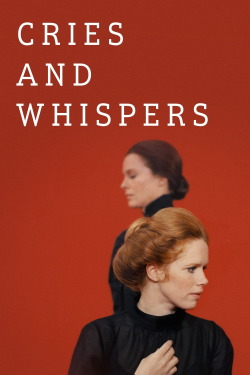
"Cries and Whispers" centers around the death of Agnes (Harriet Andersson). She's sick with some kind of cancer, and now her two sisters, Karin (Ingrid Thulin) and Maria (Liv Ullmann), have come to spend time with her in her final days. This isn't a nostalgic and loving family affair, however, as the sisters are there as if it were a chore. The only woman that legitimately cares and sympathizes with Agnes is Anna (Kari Sylwan), the caring maid. If you look in an art history book, she'll resemble most mothers you'll see - with the Pieta, for example, being cited at the end of the film.
The timeline of the film is challenging and very anecdotal. There are dream sequences, flashbacks, journal entries, etc. In the chilling flashback of Karin, we see her stick a shard of glass inside her to avoid sleeping with her husband. She lays on the bed before him, her crimson legs wide open, smearing blood on her grinning face. In a flashback of Maria, we see her husband drive a sharp object through his stomach in an effort to commit suicide, and Maria could care less. These are divided with close ups of the human face (Roger Ebert stated that no other director has done so much with the human face, which is hard to argue), and the transitions fade to a sharp red rather than the typical black. Red is the primary color of the film, "the inside of the human soul", as Bergman states in the screenplay.
I don't know if i've ever seen more beautiful cinematography in a film. I feel like this entire response to the film is an extended cliche, but to use another, you could hang any frame of the film on your wall and it'd be unmatched art.
"Cries and Whispers" is terribly dark - perhaps, even, one of the most wrenching films you'll ever see. But it's also an enormously effective masterpiece. A must see.
This review of Cries and Whispers (1972) was written by Leonardo B on 08 Feb 2009.
Cries and Whispers has generally received very positive reviews.
Was this review helpful?