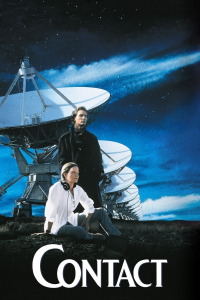
Review of Contact (1997) by Stephen L — 04 Oct 2009
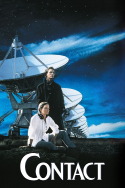
This is a really awesome movie on two levels. On the first level, it's an interesting and inspiring tale of a curious and determined scientist who sets out to search for signs of intelligent extraterrestrial life and, despite all the naysayers and funding difficulties and other obstacles, eventually succeeds and fulfills her scientific dream of first contact. As someone interested in a career in pure scientific research in a field often derided as useless and not lucrative (zoology), this aspect of the film, that openly celebrates pure science and knowledge for knowledge's sake, speaks to and appeals to me. (Plus, I've always been fascinated by ETs.).
On the second level, this movie is an ongoing debate between science and religion, and explores the logic behind what makes people gravitate to each, often at the expense of the other. As an atheist who is often perplexed, ala Bill Maher, as to how people can come to not only accept but devote their lives to religious teachings, I certainly share the perspective of the film's resident atheist-scientist, Ellie Arroway. And the opposite point of view, held by theologian Palmer Joss, is written well enough that I can see many reasoned people of faith seeing themselves in that role. Rounding out the religious spectrum are religious reactionary idiots (all the people inexplicably wringing their hands over whether the aliens believe in God), religious opportunists (David Drumlin, who shamelessly flaunts his not-entirely-sincere piety to secure the position of interstellar ambassador), and religious nutheads (a frighteningly ugly character played by Jake Busey). Interestingly, there are no atheist extremists, if such people even exist.
Contact makes a real effort to show that religion and science need not be in conflict and that they, with the right amount of temperance and level-headedness, can both be enjoyed and celebrated side-by-side, as they fill different roles and answer different kinds of questions and problems in our lives. As someone who has been skeptical to this argument, and of faith in general, in the past, this movie makes this argument well enough to leave even me somewhat convinced, and I imagine it would convince a lot of people on the other side as well.
As someone who often wonders how in the world people can believe all the fairy tales that religion pushes, the movie's biggest blow-me-away moment was the part when Ellie asks Palmer how he can be so certain, without any proof, that God exists. In reply Palmer asks Ellie if she loved her father, and when a surprised Ellie answers yes, Palmer says, "Prove it." I was left stunned at how simple yet elegant Palmer's response was, though I would point out that in this example Palmer was not defending religion per se, but rather the idea and practice of irrational faith.
The central conflict between religion and science isn't confined to just empiricism vs. faith, but more visibly occurs when religion tries to override what science teaches us about the nature of the universe, e.g. on questions of evolution and natural history where the answers are a little easier to prove than for a question of whether Ellie loved her dad. The movie tries to address this conflict when Ellie returns from her trip across the stars (which was very 2001-esque, I noticed) and has to convince a skeptical world and a very belligerent and loud James Woods that she saw what they didn't see. The key here, which I'm thankful that the movie provided, is that Ellie admits that as a scientist she should be skeptical of her own view of events, as it was not shared or verifiable by others.
And that's really the difference between science and faith: skepticism. Science has a set of answers but those answers are found through painstaking and empirical methods, and above all science maintains that there's always room for improvement and no answer it provides is the final word. Faith, on the other hand, provides answers that are often dogmatic or seemingly pulled out of someone's ass, and on top of that pushes these answers as the absolute, unquestionable truth. That's why science is good for answering some questions, like those regarding the nature of the universe, while faith is good for answering others, like whether Ellie loved her dad or moral questions that are beyond the realm of science and empiricism. I think that's the ultimate point that the movie is trying to make and I think the movie does it well.
This review of Contact (1997) was written by Stephen L on 04 Oct 2009.
Contact has generally received positive reviews.
Was this review helpful?