Review of Coco (2017) by Trevorsview — 01 Dec 2017
How do you feel after a relative passes on? Sad? Afraid? Regretful? Doubtful? Relieved? Maybe you’ll remember your exact emotions after seeing Pixar’s newest celebration of family.
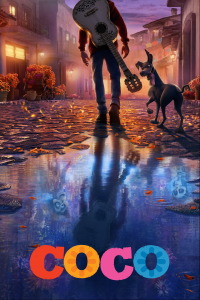
A young Mexican boy named Miguel lives with his mamá Luisa and papá Enrique, his little sister Socorro, his aunts Carmen and Gloria, his uncle Berto, his cousins Abel, Rosa, Benny and Manny, his grandparents Franco and Abuelita, and his great grandmother, Coco, together, they’re the Rivera family. The ancestors remain dear to the Riveras’ memories—well, except the father of Mamá Coco who left his family to pursue music. Today, all the Riveras, Grandma Abuelita in particular, took it to discipline anyone for touching an instrument.
On the other side, a dense city houses Mexico’s deceased souls alongside numerous other colorful spirit animals. When one of the inhabitants’ photographs is set out by the live family members in the local cemetery on Día de los Muertos, a gate designed to resemble an immigration system gives them the okay to cross the amber leaf bridge to see their loved ones. Miguel knew them for years only through stories and photographs, and now he finally meets them in person after stealing a famous musician’s guitar leaves him cursed. Miguel’s ancestors include great-great grandmother Imelda, Mamá Coco’s mother, the short Papá Julio, the plump Rosita, the horn-eyed Victoria, and the twins Felipe and Óscar; he must receive one of their blessings before sunrise, or else he will be stuck there forever.
But Miguel thinks he found another way home through his musical idol, Ernesto De La Cruz, his great-great uncle from the story! He even has a way to find De La Cruz: Héctor, a silly little man desperate to see his family again since they never once set out his photo. Then once a Shyamalan twist reveals why he wants to see his family again so bad, the true heartache comes full circle.
This production proves Pixar’s continually committed research, including the steps outlined in the Día de los Muertos ceremony. Especially amongst the world of the incarnate, beautiful leaves create relaxed candlelight glows, like the long celebrated fun creativity shined by the immortal hopping lamp! I’m sure it keeps accurate to Mexico’s family values, since audiences in Mexico were supposedly thrilled at the premiere, taking in $28 million since its October 27th release! The same level of effort goes to the voice actors: Anthony Gonzalez gives a true, soulful performance for Miguel, his musical voice as pure as child actors come, and the right cast surrounds him with further compassionate voices, whether dead or alive.
Yet once Miguel enters the afterlife, coincidences lead him to wherever the narrative takes him. Similar to what the revolutionary animation studio continues failing at, the details of the world prioritize comedy over realism. For instance, the undead skeletons drink liquor, but at the same time, say they need no bathrooms. Some other elements appear to contradict the hard research, such as English being the primary language spoken in a Mexican location. Pixar long succeeded in its widely-loved shorts without dialogue, so couldn’t they expand that format to a feature length? I mean, imagine if Coco was entirely in Spanish, except speech kept to a minimum? I think it would have made the experience a lot more authentic.
Looking deeper into the script’s issues, the title character, Mamá Coco, gets too little screen time to serve her plot importance justice; she just sits in her wheelchair, eyes half open, less prominent than her highest potential. The writers should have implemented the family theme further by giving each boy and girl (and dog) in the Rivera family a purpose.
In full honesty, the script’s issues stem from the protagonist, Miguel; he starts off whiny and selfish, in turn making his growth throughout less earned than its capacity. In fact, quite a few offensive moments seem tossed in for humor’s sake, specifically a brief unnecessary scene where Miguel notices a nude portrait model (a skeleton). The depiction of Mexico’s afterlife as truth rather than myth may also concern some more religious viewers. And finally, the gate used to allow Mexicans to pass through on Día de los Muertos almost parallels Trump’s future vision of his wall, which could offend some more conservative viewers.
Although Coco can overall still please anyone looking for a good holiday treat. These months are not always a happy time, considering the number of deaths around this time, so this special celebration of both life and death just might satisfy our hurt.
This review of Coco (2017) was written by Trevorsview on 01 Dec 2017.
Coco has generally received very positive reviews.
Was this review helpful?