Review of Cloud Atlas (2012) by Clarisesamuels — 08 Jun 2013
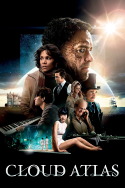
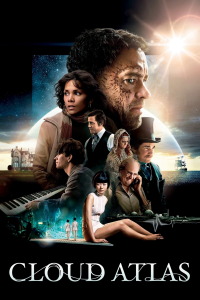
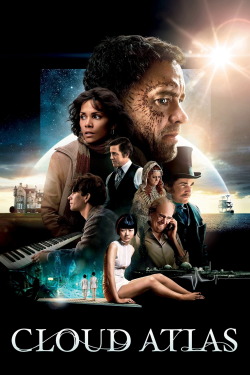
A confusing morass of six story lines and a seventh that serves as epilogue and prologue--this film gives new meaning to the question, “What just happened?” A cast of eloquent and well-known actors plays multiple roles where in some cases they are virtually unrecognizable. The most outrageous include Hugh Grant as a tribal chieftain who is a confirmed cannibal, and Tom Hanks as a murderous physician from 1849 as well as a frustrated and equally murderous 2012 book author who kills his harshest critic at a party by throwing the arrogant and presumptuous cad over the balcony. Hanks is also a father figure in a primitive clan in 2346 Hawaii, although there he is highly recognizable, even though he is speaking a barely comprehensible pigeon English that can only be described as Hillbilly Jive. (To say “that's the truth” is “that's the true-true.”) Strangely enough, Hanks lapses into standard English in a few instances where he has to explain an important plot point. Subtitles would have been beneficial.
The film changes geographical locations and time periods, as it ricochets between 1) 1849 South Pacific; 2) 1936 Scotland; 3) 1973 San Francisco; 4) 2012 Great Britain where actor Jim Broadbent is kept prisoner in a nursing home; 5) 2144 Neo Seoul (somewhere around old Seoul); 6) 2346 Hawaii; and 7) the frame story provided by the prologue and epilogue taking place about 30-40 years after 2346 Hawaii on a planet colonized by humans.
Presumably the movie is about people finding their true inner selves, setting off on the path of that which is good, true and beautiful, and establishing a humanistic, worldwide faith where a divinity does not figure into it, except in the primitive society in 2346 Hawaii, where they falsely worship the little Korean girl from 2144 Neo Seoul, a clone who fought bravely against corporate consumer predators, and who was part of a workforce consisting of an army of clones, robotlike employees who worked 19-hour days for a certain amount of time, and were then murdered, recycled and fed back to the other clones as a protein drink, the only nourishment they were allowed. The resistance army for which the clone was a kind of Joan of Arc was called The Union. The clone, played by Korean actress Doona Bae, is the connective thread, while Halle Berry and Tom Hanks also provide secondary connective threads, to the extent that anything really connects in this movie.
The philosophy of the film seems to be about incarnation and reincarnation, and how we are all a part of something much larger than ourselves, somehow reaching out to ancestors and descendents, on some subliminal level of consciousness that connects everyone and everything to everything else, and that has to do with the stars and outer space, with no mention of God, apparently because there are too many atheists who go to movie theaters.
A noble effort that somehow went awry with too much sophomoric philosophy and too much amateurish make-up.
This review of Cloud Atlas (2012) was written by Clarisesamuels on 08 Jun 2013.
Cloud Atlas has generally received positive reviews.
Was this review helpful?