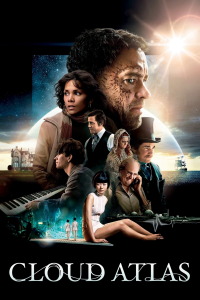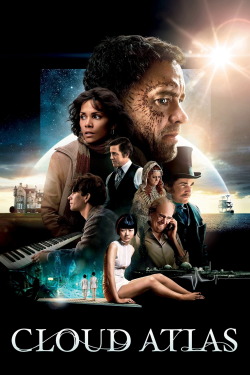
Review of Cloud Atlas (2012) by Ddrussianinja — 29 Oct 2012
It's somewhat difficult for me to pinpoint why exactly I love "Cloud Atlas" as much as I do, but I think if I were to find one thing above all else (and this is something that has been true of the Wachowskis throughout their entire career) it is that the movie is not afraid to expect a lot from its audience without trying to come of as exclusive.
Far too often, big blockbuster films are sanded down to be as palatable as humanly possible. They can't be too complex or challenging or else they might scare off potential audience members. Similarly, movies that do expect a lot from their audiences generally proceed as though they are more interested in being ~artistic~ than actually engaging their audience.
"Cloud Atlas" is a very rare mixture between the two. It is a very demanding film. It tries your patience, it doesn't try to simplify itself, and for some it will possibly offend. If some aspect of the film repulses you or you simply have a tendency to cynically disengage from films that actively try to be different or have a message, I imagine you will not enjoy this movie.
And if you do wish to engage with the film on the level that it expects you to, then I can guarantee that you will feel exhausted by the end of it. But I also believe that if you do fully engage with the film, you will have a very powerful and deeply moving film-going experience.
The film bounces between six different stories as a sort of stream of consciousness. The film is still somewhat chronological in that all of the simultaneous stories move along at roughly the same pace (you don't have situations where one film is climaxing while the other is still building) but the cuts between the stories ask you to multitask.
Put one story on hold while you jump into another. As someone with ADHD, I would say this movie is the best way I could explain what it is like. Something in a scene sort of triggers a scene from a different story to pop out, leaving the previous story on hold until something brings it back.
The movie is basically a stream of tangents that all end up moving together in the same general arc. Not only that, but all of the stories, while sharing the same basic themes, are vastly different in tone and genre.
On TOP of that, the film makes use of makeup techniques that are inarguably racist in order to both maintain a sense of continuity and also to perhaps provoke that sense of racism so that we as an audience can carry that with us and connect it with our lives.
This is a lot to ask of an audience, and while I acknowledge that not everyone wants to play along, the film is not taking these risks for the sake of self-indulgence. At least, that's not what I believe that it is doing.
These decisions don't feel like they were made in order to be ~unique~ or whatever, but because they directors believed that they made the film better. I felt like the same conversation came up whenever they discussed how they should approach something within the film, if anyone involved expressed doubt that the audience would go for it, they insisted that they give the audience more credit than that.
The film asks a lot of its audience, yes, but it's not shouting from a mountain of superiority, arrogantly proclaiming that if you don't get it than you are a simpleton. It humbly places itself into the viewers hands, respectfully asks for your patience, and then unfolds.
It's true that I'm probably more inclined to be patient with this film than others might be. I've always been fond of the Wachowskis' work and pretty much all of the genres involved within the film are genres that I have some degree of affection for.
Additionally, the film's unusual method of movement really clicked with me, perhaps because that tangential stream of consciousness is how my mind tends to work. But I'm not giving this film a 10/10 simply because I truly loved it, but because the movie was willing to be different in order to achieve that level of connection with the audience, even if it meant risking losing a part of that audience.
And it wasn't just different for the sake of being different. Every time it did something that would probably make an executive nervous, it was for a very specific reason, and that reason was almost always "To improve the film".
It wasn't breaking the mold for the sake of it. It was breaking the mold because there was no mold that could properly convey what this film was trying to do. The biggest problem with film (and other popular visual media) is that the creators are often afraid to say what they want to say exactly how they want to say it because it is generally believed that art should be able to speak to as large an audience as possible.
The problem is that it is often misconstrued to mean that art should be LIKED by as wide an audience as possible. Even though "Cloud Atlas" won't work for a lot of people, it's not for lack of trying.
"Cloud Atlas" knows what it wants to be and is very honest about it. To me, that is most admirable.
This review of Cloud Atlas (2012) was written by Ddrussianinja on 29 Oct 2012.
Cloud Atlas has generally received positive reviews.
Was this review helpful?