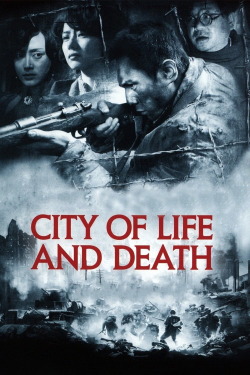
Review of City of Life and Death (2009) by Darrin B — 23 Jun 2009
Probably the most well produced and most importantly, objective, portrayals of the Nanking Massacre yet. What makes it so compelling is that nearly half of the film is from the Japanese perspective and the character of Private Kadokawa essentially becomes our protagonist. Though playing only an auxiliary role or no role at all in most the crimes, he undergoes a spiritual erosion that is stalled only by a romantic interest in a comfort woman he becomes overly attached to. On the other side of the spectrum is German businessman John Rabe and his secretary, Mr. Tang. Along with Tang's wife, these two men do the most in their power to establish and maintain an international asylum for civilians and wounded soldiers, however with all his pull as a member of the Nationalsozialistische Deutsche Arbeiterpartei, there is physically nothing to stop Japanese soldiers from waltzing in and taking whatever they please, shooting whoever they please and generally terrorizing the inhabitants within.
The two threads overlap often as Kadokawa eventually becomes a Kempei and plays a larger role in suppressing resistance and seeking out Chinese soldiers in hiding. Learning a small amount of English in his church's school, he is able to have rudimentary conversations with the similarly religiously taught women of the International Zone. All of this comes to an emotional head when the women are taken to become army prostitutes and as Kadokawa knows, eventually executed. His character is concretely defined when he was is asked in English by a passing captive to "shoot [her]." and he obliges, much to the confusion of the two men taking her off to amuse themselves with her.
Surrounded by absolute hopelessness and destruction, the great crisis transforms from escape to acceptance and many a character are forced to come to terms with the deaths that closely await them - until in the films final and most poignant sequence, Kadokawa and a comrade escort two Chinese prisoners out in the fields on the outskirts of the city and release them. Awestruck, the Chinese slowly walk with no destination towards some other later fate, while the two Japanese men are left alone. When Kadokawa salutes to excuse the other, he does not salute back but rather bows. As he returns to the city and leaves our "hero" alone, he suddenly stops and calls his name, then bows again, this time a full, deep and lingering bow of the utmost reverence. After so much wanton rape and murder, Kadokawa has become the very personification of the humanist spirit unextinguished.
Beautifully shot and acted by a multilingual cast, the only hiccups I found grating were with the foreign volunteers. John Rabe almost never speaks German and when he does he's being dubbed by someone else, and some unnamed American doctor seems to possess a thick Swedish accent. The rightfully American Minnie Vautrin is too obnoxious to be sympathetic and there is even one puzzling scene when Rabe replies to a Japanese officer before the present interpreter can even relay what was said to him. Despite these minor flaws, and the volatile subject matter, this is an especially powerful film and one that can be received by broader audiences than earlier Chinese films about Nanjing. The violence is primarily execution by rifle and pistol. The most infamous tales of bayonet practice and beheadings are not shown, although there is a brief shot of severed heads nearly a quarter into the film. Rape is shown mostly off camera save for one establishing shot where a group of men holding a woman down on a table tear open her blouse - but actual sexual content is more implied than shown, which is more emotionally effective anyway. The massacre is portrayed not as a ludicrously inhuman orgy of depravity, nor is it an industrious mechanism for complete and unwavering ethnic cleansing - it occupies some bizarre whimsical middle ground wherein life is spared when it is too much trouble to extinguish, and it is taken when it is too much bother to accommodate. At any rate, the film is banned in Japan, as to be expected.
I've left out a lot, such as the early combat sequences that will distract enough to think you're watching a conventional war film until things...turn sour. These are expertly choreographed and acted - weapons and uniforms are authentic, sound design is professional and visceral and all the kills "feel" right. The post-Saving Private Ryan motifs are present, but subtle and the stark black and white thankfully sidesteps the genre's new favorite faded-colour effects. Speaking of choreography, the film also features prominently the victory celebration for the capture of Nanjing, which comprises of a rather complex and ordered formation dance with a pair of taiko drums lifted on shoulders behind them. Marching down a main thoroughfare before a solemn audience, the men painstakingly repeat their routine for the entire length. While I don't know the specific ins and outs of this Shinto rite, it was definitely fascinating. There's not much else to say, except that this is a film that needs to get out there and be seen.
This review of City of Life and Death (2009) was written by Darrin B on 23 Jun 2009.
City of Life and Death has generally received very positive reviews.
Was this review helpful?