Review of City Lights (1931) by Jake R — 07 Oct 2008
In 1927 Warner Brothers released a sentimental melodrama about a Jewish performer who finds fame by performing in blackface. The basic premise seemed like a 'Birth of a Nation' for the Jazz Age, where black people were mocked and ridiculed in more socially acceptable ways. 'The Jazz Singer' went on to become the biggest box office hit of 1927, and afterwards Hollywood hit a creative low that took almost ten years to recover from. The reason for this massive change? One word: Sound. With 'The Jazz Singer' being the first film to feature synchronised dialogue (and songs!) 1927 was officially the final year of the silent film and the artform died out almost overnight, so eager were the general public to hear people talk to each other instead of having to be informed one sentence at a time via subtitles. Hundreds of silent stars were ruined because of their unwieldly voices or date styles. All except one, the most famous and successful star of them all.
Chaplin never liked sound, remarking 'Who the hell wants to hear actors talk?' when learning of 'Warner Brother's supreme triumph.' He was scared also for his own comic style was perfectly suited for the silent era, but now seemed inappriate and awkward in the new craze for speech. So what did he do for his next project? Produce another silent feature length comedy, four years into the sound era. That took guts no one else had ever had, to risk his entire career in the pursuit of his own idea. And, like always, it worked.
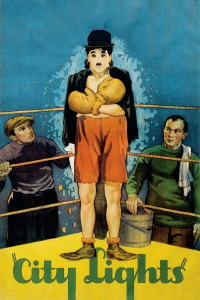
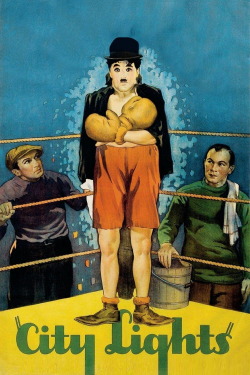
'City Lights' is any typical romance, where the hapless Tramp endeavours for a pretty girl's affections. Really, this is little more than an updating of popular comedy plots from 15 years earlier. What ellevates this particular interpretation is its method of execution. Chaplin, ever the creative genius, comes up with more brilliant and hilarious scenarious worked through on his characteristic pratfalling. He uses the world of the 1930s around him in his style so it appears less dated, and subtly utilises sound effects to catch the audience off guard to his supposed Luddism. Then, with intertitles now an old habit for the movie-going public, he uses smaller phrases to convey greater meaning, well-suited to his uniquely poetic verse. But what Chaplin really excels at is his concentration on the actors and introduces a more cinematic approach to his narrative. Many close ups carefully study character faces, mostly the Tramp's, and we feel like we don't need speech from anywhere to tells us what to think or feel about the story. Nowhere is this more evident than in the final scene, a masterpiece of understatement.
When the Tramp meets the Girl for the first time with her sight back he is visibly disappointed, but slowly something else forms across his face. The Girl is clearly confused, and then it dawns on her own face who he really is. The Tramp reluctantly makes small talk to hide his staggering humiliation, but the Girl can see it and responds to him with warmth and the implication of friendship. But it's the final shot, the last lingering close up of the Tramp as he intently focuses on her, his finger absent-mindedly stuck between his teeth to make his smile ambiguous, that stirs up a welter of emotions, all of them his favourites: pity, sadness, hope and a sense of relief, still raw come the closing title.
Chaplin knew stories like this would never last in the more sophisticated sound era, and consequently made this his final straightforward romance melodrama. Afterwards he used his creativity to inflict scathing social satire on everything he saw 'wrong' with the world. Whether or not the decision to abandon such expertly handled material was both a blessing and a curse, but it was a progression he could'nt escape. He knew perfectly how to remedy that: make 'City Lights' an 80 minute cinematic wonder to remind the world of the simplicity and joy it chose to neglect. That was his ultimate critique of his fickle audience.
This review of City Lights (1931) was written by Jake R on 07 Oct 2008.
City Lights has generally received very positive reviews.
Was this review helpful?