Review of City Lights (1931) by Ryan M — 18 Mar 2010
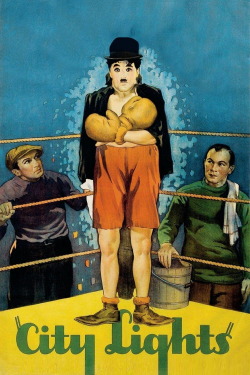
Charlie Chaplin may not have been as skilled behind the camera as Buster Keaton, but he was funnier, and "City Lights" is his best silent film despite being released when talkies were well established (it was shot over the 3 years where talkies were first being introduced). After an opening where everyone else's dialogue in the film has been replaced by some weird quacking noise, everyone's favourite Tramp winds up rescuing a millionaire from suicide who treats him like a real pal when drunk, but when sober he doesn't recognise him. But at the heart of each Chaplin film there's a love interest, and this time it's a blind flower girl who lives with her mother (she senses the Tramp hanging out with the millionaire and thinks he's a millionaire too). After they spend some time together she decides she wants an eye operation to enable her to see again (I'm not sure if that's possible today let alone 80 years ago, but just go with it), but she's a poor lady being threatened with eviction from her landlord, so Chaplin has to take odd jobs to get enough money for his lady.
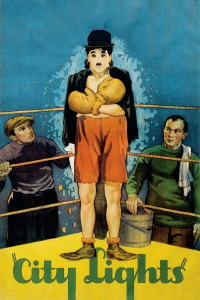
The storyline in Chaplin's films are always second fiddle to his comic routines, and there are some brilliantly memorable ones: A moment where the Tramp swallows a whistle, saving the millionaire's life multiple times, the eating spaghetti moment and the brilliantly choreographed boxing match (which was rated as one of the best boxing scenes ever by Sports Illustrated). But the reason these comic sequences work so well is not just because they're worked into the storyline to add an extra dimension to them (instead of feeling like a filmed comic routine on a stage), it's that some of them happen quite suddenly regardless of how many similar comic bits you've seen in various other films so they're still unexpected after 80 years, some of them are also inventive on an obvious comedic level, but particularly with the boxing scene, they're so expertly timed and choreographed that it's hard not to laugh. Not every single joke works in the film, but nearly all of them work and nearly all of them are very very funny.
If there's one aspect on Chaplin that divides some people, it's his sentimental side that he can let a little too loose on his audience that it can spoil his films, but it would be nigh-on impossible for anyone to dispute how well Chaplin inserted his sentiment into the ending of "City Lights", definitely one of the best endings ever for its beautiful simplicity (Jack Lemmon shed tears while discussing how much that ending meant to him).
"City Lights" may not be the most inventive silent comedy (That'll go to "Sherlock Jr") but it's definitely one of the funniest and most touching, it's arguably Chaplin's greatest achievement.
This review of City Lights (1931) was written by Ryan M on 18 Mar 2010.
City Lights has generally received very positive reviews.
Was this review helpful?