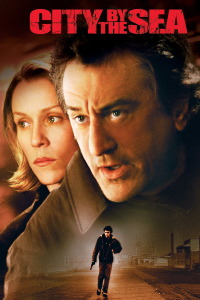
Review of City by the Sea (2002) by Mark B — 20 Mar 2004
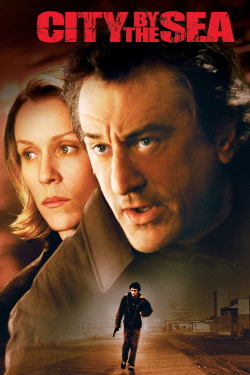
The recent film "City by the Sea" is a multi-generation cop drama set in locations around New York. It's an excellent story about crime, abandonment and the viscious circle it creates.
The plot is straightforward. Vincent LeMarca (Robert DeNiro) is an NY cop who left his family in Long Beach, NY fifteen years ago. His son Joey LeMarca (James Franco) is now a junkie, and as the movie opens, he vows to improve himself. However, that is soon out of reach as he murders someone and now has to run.
The body washes up in NY, and as luck would have it, the investigating cop is DeNiro himself. Now he must deal with his son's deep problems, his abandonment of his son, as well as his own father's leaving him. Complicating matters is his relationship with current girl and neighbor Frances McDormand, as well as the appearance on his doorstep of Joey's girlfriend, Eliza Dushku, with Joey's son. The back story which drives the DeNiro character is a fascinating one: his father had accidentally killed a child in the late 1950's, and was executed, leaving DeNiro alone. And, that cycle of leaving has carried over to DeNiro leaving his own son.
The town of Joey's problems is Long Beach, with all the shooting being done in famously decrepit Asbury Park, NJ. The town is rundown, empty, dirty, and totally abandoned. It also serves as a metaphor for the emotional lives of these men, a complete dump. One thinks of young Dedalus' observation in "Ulysses" of the "snot green scrotum-tightening sea" among other unpleasant images of a wasteland. By the ending scene, the beach is bright, lit up and hopeful, a view of town never before scene: the transformation of character is complete, and with it, the external environment.
Thematically, the film revolves around the bonds of father and son, which inevitably come into conflict with his duty as a cop. At first, and correctly, DeNiro wants to just do his job and bring the messed-up kid in. As it progresses, he realizes that the son is perhaps not entirely responsible, both for his actions, and the crimes of which he is accused. The growing love for his wayward son, the feeling of remorse for how he messed up, and the desire to make things better gradually creep into the character. These feelings take over the hurt, anger and immaturity of running away which had previously come into play. I loved this steady change, brought to a head in the climax where DeNiro's character has recognized the cycle of behavior and wants nothing more than to change it all.
The performances are very good all around. DeNiro and Franco both flesh out their respective roles' conflicted emotions. McDormand and Dushku are both terrific as always. Forsythe has a small role and shines. The technical credits are very good. The only reason to demote this to a 8/10 is that the film in many places feels to be treading previously essayed territory: junkieism, the dead cop partner, the crusty cop who doesn't love, the cliched mullet-wearing biker enemy, etc. But buoying the story is the main theme, rising above the stock elements that here inhabit it.
This is the kind of movie I am almost preternaturally drawn to. Rather than a stark tale of good and evil, it gives us knotty situations. Instead of a clear cut protaganist and antagonist, it offers up conflicts all around. The aforementioned kind of movies (Lord of the Rings comes to mind) are boring. They reduce everything to an inevitable matrix, with a foregone outcome. The solutions are clear cut, and problems never intractable. In other words, it bears little resemblance to real living. As Robert Mckee has said, "a choice between good and evil is no choice at all"; a dilemma is what interests us as people, something between two terrifying opposites.
Films like "City by the Sea", "Dirty Pretty Things", "Bringing out the Dead", "Chinatown" etc. are all about the conduct of a virtuous man in a moral muddle. No clear right or wrong exists. Deep hurts, wounds, and doubts undergird every decision. To navigate this swamp requires the utmost prudence, foresight and right action, and even then a good outcome is not guaranteed. Simple moral philosophies, like Kant, with their insistence on never taking wrong means, or absolute ideas of good and evil, are useless here. We need a view of the world of locking opposites and the conduct of the sage.
Arthur Schopenhauer once reduced ethics to a simple maxim: "Injure no one; on the contrary, help everyone as much as you can." Far more so than the simplistic Kant, this is a maxim to get us through the praftalls and pit traps of living. Watching DeNiro's Vincent LeMarca try to help everyone as much as he can, from his son, to his superiors, his grandson and his girlfriend is to watch the sheer difficulty and tough decisions required. Yet, in seeing how an ordinary troubled man can exercise deep compassion we can see the possibility of ourselves transcending ethical morass to a plane of purer wisdom, insight and feeling. The City by the Sea transformed into the shining Castle in the Air.
Am I reading too much into it? Grafting too much philosophy onto a simple cop drama? Perhaps, but you know what, life and film are about so much more than two hours of fluff, popcorn, and onscreen computer generated eye candy. Hooray to films that dwell on those topics and aspire to something greater.
This review of City by the Sea (2002) was written by Mark B on 20 Mar 2004.
City by the Sea has generally received mixed reviews.
Was this review helpful?