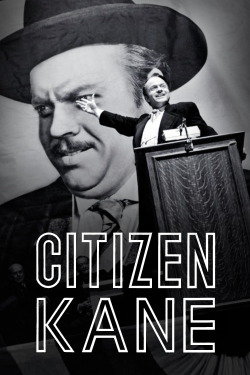
Review of Citizen Kane (1941) by Liam C — 21 May 2015
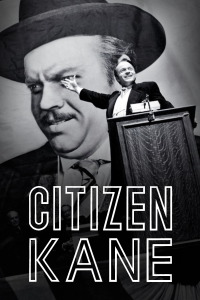
This was the first film that I had ever put on my 'want to see list' and, boy, what a film; 'Citizen Kane' remains a powerful and innovative film. Right from the first second this film is exuding uniqueness as its title just appears on the screen in big bold letters in a very matter of fact way. It then goes on to set a very strong atmosphere, almost that of a classic horror film, with its excellent mood setting with the perfect camera angles, fading, music and sound effects. This is then carried on throughout the film and still remains very beautiful and striking, especially the deep focus shots that add a lot to the film, especially because I've rarely seen it used anywhere else, if at all. I also like the focus on the mirrors and windows and how they are used in filming as; again, it's smart and unique, especially with the deep focus shots keeping them very much part of the scene and this starts from the beginning of the film with the reflection off of the snow globe. However, at the end when Kane walks past the huge mirrors reflecting off one another it does linger and zoom in a bit after he walks off screen, not too sure why. Later on during the film someone keeps looking at the camera when he keeps scrambling around when things keep going wrong and it made sense because he was looking at someone and it was a nice touch.
It also seemed odd that no one saw Kane enter the room later on in the film when everyone is huddled together because surely those facing the door would have seen him, regardless of if he was in shadow. The way that the scene played out with lifting up the newspapers to show the 'fraud at polls' is just an example of how well the film is put together, even if it seems kind of odd to lift it up just to confirm it, although it does make sense. Also at the party near the end, whilst having a theme that sounded like the song at the dance in 'Back to the Future Part I', birds are used in the background and they aren't real but it looks good and is imaginative for its time, considering its budget as well. I also really liked the make-up in the film as well and thought it was really good, looking like Michael Keaton at some very choice shots later in the film as well as Jack Nicholson when he is wearing his picnic clothes. As Welles stated, there is so much more you can do with Black and White.
I thought it was kind of odd to go from the opening scene to what happens next but it is revealed to be a short film showcasing Kane's life, which I did think ended in an odd way. It shows his life being relatively okay, then being alone to being dead and then the words 'The End' just appear on the screen, still, it is a very good way to introduce us to his life and it works well. I questioned who heard him say 'Rosebud' when Kane died but that gets explained as well, I really do like the very subtle alluding to what Rosebud might be as it is in the film quite a bit and it is even mentioned casually as early as a scene during the short film. Even if, looking back, we see something in shot for a while when Kane is taken away that looks all the more different knowing what it is. That scene was odd also because Kane acts like he hasn't seen his father for a while. The film splices between the modern time and the past with such excellent editing and fading in of the scenes, like one character's face fades in and is talking in the present whilst the scene in the past is still playing and fading out, that you don't even notice. You might wonder why so many people care about what one man's dying words are but the film explains very well what a character Mr. Kane was.
The film has an absolutely amazing script filled with excellent, engaging, as well as memorable, dialogue and you really do go on an epic journey throughout the film. The acting is compelling all throughout the film by everyone but the way Orson Welles plays Kane is excellent. The name of Charles Foster Kane is just so powerful and memorable and the amount of emotion Welles puts into it all is excellent, just his eyes speak so much. Welles just has a very powerful presence about him, just the way he comes out with the dialogue is so natural, the part where he says, 'I'm still hungry', for example, is just so nearly put in and it works. It's also filled with many little real life quirks that just add to the experience, like when Kane walks in front of that person when he is at the paper business and then the other person has to swing around the poll and walk behind him, it adds a lot and has meaning too. The speech about losing a million dollars was memorable and he also just comes out with some funny things, when he says that it isn't dirt it's mud and I expected the other person in that scene the express how they weren't his best clothes anymore, or pretty much anything in his speech, especially about not having any promises yet. He talks about the fact that he could have been a good man and I expected him to say he is a brilliant man, he also doesn't want money, I thought it might have been power but it is explained very well at the end what he truly wants. Earlier on when he says to someone he still loves them, I expected them to be facetious and say, 'aww how sweet' and then she would just leave.
I did expect him to shout more though, especially when his wife keeps yelling, I thought he would shout at her to stop or like the time when everyone is shouting in her face right before she's about to go on stage, but then we see that he is very high up in the audience. Or earlier on when he is at the papers and everyone remains standing up, I thought he would end up shouting at them to sit down but it was odd on the other person, he continues to talk to Kane and then finally tells everyone else to sit down. I thought he would have yelled about her getting a bad review and I bet he wished he kept his friend on the paper now as he might have given a positive review; and I didn't really find her singing bad at all, I certainly couldn't do it. Also, her singing teacher reminded me of Peter Sellers. I thought it was funny how the reporter says he was going to look at someone 'private diary', as it isn't very private now, is it? A theme is also portrayed with that as well. I thought the diary would have said, 'I first encountered Rosebud'. I thought it was kind of odd that only one reporter was asked to do any research, though as I thought all of them would have had to do something. Also at the end when he says about the other person being sentimental or not, he says yes and no and he seemed to have missed the point of sarcasm. I thought it was oddly humorous when Kane leaves his award ceremony quickly to go off with someone and one of the people in the building says, 'let's all go to the window'. Also when Leland shouts for the nurse then complains and says, 'I'm coming', in a disgruntled tone, he was the one that called them!
I noticed that Kane kept his arms down when his wife was saying that she was leaving and it really showed him in an odd, new light, like that of a now weakened individual. His scene where he destroys the room seemed oddly casual at first, and he gave up on that bookshelf that didn't want to break, regardless of whether or not Kane said', 'he felt it'. Also, the way he hit the first thing off of the table looks really satisfying. Seeing as how the film loops back to where the film began soon after, it would make sense to see if he died of a heart attack given all of the stress that he was under. The sense of loneliness nearing the film's end is felt with every shot, the sparse rooms with everything widely apart with his wife just doing her uniquely shaped puzzles. The only thing that was odd was that there was a random screech by an animal when we see his wife leave the door that took me off guard, it was odd. The film has a really sad end when our characters just talk about what they believe Rosebud to be and it does have a very classic feel to it and when the film finally reveals what it is, you realise what it represents and it really hits you, especially knowing that no one will never know. I think, given the music and the shot, the film should have ended with just the smoke coming out if the chimney but the way it ends is great.
It was certainly surprising to find out all those years ago, when I first started to get into film that this film hadn't won more than it had. It's constantly referenced even until this day, is pretty much still a household name and its influence changed film is such a bold new way and its impact is still being felt, I'm not implying just because it is a household name that it should have won I'm just saying it is clear how relevant this film still is. However, it was also under a lot of controversy at the time, under-screened and even booed at the Oscar ceremony, which is something I've never even heard of, I thought that kind of thing only happened at Cannes, which still isn't the right way to handle things. Still, looking back, it does seem like the first huge widely regarded mistake made by The Academy as well as one people still talk about today, some say that 'How Green Was My Valley' won just because of its relevance at the time, and having Hearst go around claiming Welles was a communist didn't help the film at all. Still, it is nice to see that at least the script's brilliance was recognised, but even that has a story behind it as well, and even with the technical awards it is hard to believe it lost. It does seem kind of odd to make a script that is a thinly disguised tale on someone else, as it would naturally welcome huge controversy. You would just think with all the groundbreaking techniques Welles put into this film that he would have easily won Best Director! Especially because Ford already had 2 before 'How Green Was My Valley'. Nevertheless, 'Citizen Kane' is a groundbreaking film that is exceptionally well put together and holds up very well; it is a very interesting and engaging film that has an excellent pace; it is unbelievable to think that he was only 25 when he put this together. It'll probably change because there is always that one person that always comes along, but this film still has 100% for a reason and speaks so much. Knowing that there is a show called 'Citizen Khan' exists as well as the fact that this film was very strangely compared to Metroid Prime for whatever reason, is odd. Nevertheless, this film is fantastic, filled with so many iconic moments, did so many new things and changed so much for film, I would talk more about its theme and intricacies but everyone else already has, with much more detail. It is hard to believe that Welles never was nominated again, perhaps the Oscars were bitter, but at least they nominated this film when everyone else, at the time, dismissed it, oh how wrong they were.
This review of Citizen Kane (1941) was written by Liam C on 21 May 2015.
Citizen Kane has generally received very positive reviews.
Was this review helpful?