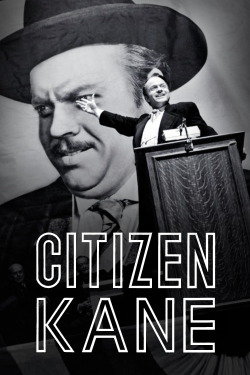
Review of Citizen Kane (1941) by Laura S — 31 Jan 2014
Vertigo has only topped Citizen Kane as the greatest film of all time on Sight and Sound magazine's critics poll just two years ago, but that hasn't stopped this film in radiating it's power to the general public. Some people haven't even seen Citizen Kane and they know it's the greatest film of all time because society for so long has kept that stamp on it, that it's hard to argue so. I have spoken before about reviewing or discussing films that are regarded as classics, and one cannot always share the same opinion as everyone else. Some argue that this film is the best film of all time, while I see how one can praise this film, I felt that the film isn't perfect. Don't take this statement as a matter of fact but rather a form of opinion and one can choose to agree or disagree with it.
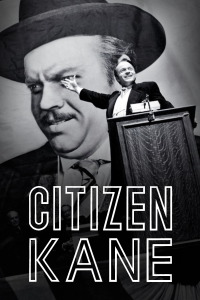
Citizen Kane was written by Herman J. Mankiewicz and Orson Welles. What Welles and Mankiewicz have written here is a character study of Charles Foster Kane. It explores his entire life, touching on his relationships and career while tied together with a search for the meaning of his last spoken word before his passing, "Rosebud". The film begins with a short documentary detailing Kane's life and it takes the point of view of the general public. It doesn't give us the whole picture of the man, so the film allows to explore and understand the character through the stories and opinions of his closest relationships. For most of the film, I was fascinated on what made this man so important and was curious on the reason behind that final word. Rosebud ties everything up together, and answers all of our questions at the end without actually fully explaining itself. I found this approach to be quite satisfying as the writers wanted us to make the connection ourselves and create our own interpretation of it's meaning. Kane is an interesting character, he does what he does because it allows him to try and fill a void that is empty but in doing so, it causes pain to others and have led him to a road of self sabotage. The aspects of the screenplay that I found less exciting was it's detailing of his relationship with the "singer". I understood that her story was also important but I never found it to be that interesting, especially when it is compared to the rising story of his newspaper tycoon or his attempt to be involved in politics. Once it touched on that side of the story, mostly during the second marriage, I never was hooked and hoped that it was better written. The dialogue in the film was quite engaging, as each word being said allows us to get closer and closer with solving the puzzle that is Charles Foster Kane. At times it does feel like, Welles is indulgent in his writing, allowing himself to have the best lines and leaving others feeling like they're just minor supporting players and seem unimportant.
Citizen Kane was Orson Welles' debut film and what a great way to start your career as a director. Welles wanted this film to be truly focused on the protagonist and let everything else just be present to support it. It makes the film feel like a one-man show and it makes it harder for the audience to connect with other characters. When a certain tragedy occured late in the film that didn't physically affect Kane, I simply didn't care because Welles didn't want us to. He simply wanted our eyes to be focusing on Kane and look through his layers, not anybody else's. This may cause the director and the film to come off as pretentious, but sometimes that's the ingredient that makes a film great. Welles sets the film in a non-linear style of storytelling, having the film move through flashbacks from the members of Kane's life. I found this interesting because it allows us to see different perspectives of the man, and give us a better understanding of who he was. But because he has the film be told in the perspective of these separate individuals, we never get to the core of the character, which Welles leaves for us until the end. Welles was so confident in his material, that he didn't need to add any violence or sex to keep the audience interested. The film rarely feels slow, as Welles just allows the material to bloom and indulge itself. This approach wouldn't have worked if the film lacked a great script. As every scene passes, I always look forward to the next clue that would be given to us because I am so eager in finishing the puzzle.
The film's cinematography was handled by Gregg Toland. Aside from Citizen Kane, he has worked on notable films like The Grapes of Wrath and The Best Years Of Our Lives. Toland's work here is definitely a stand out. I was fascinated in his choices of lighting the scene. He uses low key lighting to illuminate the shot and creating wonderful shadows. This style is commonly found on noir films during that time, and Citizen Kane changed the rules of it's use. Welles and Toland has created deep shadows in covering our detective making him look faceless, which I felt was appropriate because the audience didn't truly need to know who he was and why we have to care, all we needed to care about was Kane. The man also was in way a representation of us, asking the questions that we would ask and seeing what he would see. Toland has the camera usually set up behind this character because the man and the audience are always at the same page. The film also consists many instances of low-angle shots giving off a sense of power and importance of this character. It is normal for a film to look down on it's characters, especially on the moments where they are wounded or in a state of shame, but the film never applies that when Kane is on screen. Citizen Kane is also an opportunity for Toland to show off his experimentation with the use of deep focus shots. There were a couple of moments that looked beautiful when employing this technique, but for a few times throughout the film, I felt that it was repetitive and overstayed it's welcome. I completely understand that it was something new and groundbreaking back then and that it was used to make the film look one of a kind. I just personally feel like it could have been reduced a bit, in order for it to not draw too much attention to itself.
The film's score was composed by the legendary Bernard Herrmann. He has written so many of my favorite film scores; Psycho and Taxi Driver. Citizen Kane was his first film and that may have been a factor on why his work here isn't as impressive as it could have been. I personally felt that Citizen Kane's score lacked that sort of gem that makes his best score shine, the slashing strings on Psycho or the sleazy saxophone on Taxi Driver. I guess i'm just being overly critical. Overall it isn't abysmal, just underwhelming.
The acting in this film feels like it's carried solely by Orson Welles. Welles truly feels like he is in touch with the character, with him also being one of the writers, he can tap into the mind and understand the inner workings of Kane. He was able to play multiple stages of the man, from when he was fresh young face in the start of his newspaper tycoon or the fragile old man living in an isolated castle. His perforamnce was also supported by the impressive use of make up effects in making him seem much older than what he was. Welles' most impressive scene is where he is in a room, destroying everything he sees in it. This scene is the closest connection I felt, along with the reveal at the end, to gaining a connection with his "Rosebud". The film contains a average supporting cast that is never at par with Welles' performance. Everett Sloane as Mr. Bernstein and Joseph Cotten as Jedediah Leland were quite fun to watch. I did find Dorothy Comingore to be quite annoying, delivering lines that feel very over the top and cheesy. It does stand out even more when she is conversing back and forth with Welles.
Citizen Kane isn't a perfect film in my eyes but it is a great film. It does so many things right that it's hard to give the film a lower score. The film boasts a strong script, groundbreaking cinematography and a stand out perforamnce from Welles albeit with minor imperfections in all three categories. It may grow on me later on, as I would have grown and understood cinema much better and therefore would change my perspective of the film.
This review of Citizen Kane (1941) was written by Laura S on 31 Jan 2014.
Citizen Kane has generally received very positive reviews.
Was this review helpful?