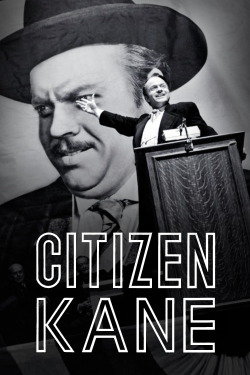
Review of Citizen Kane (1941) by Anthony E — 16 Feb 2014
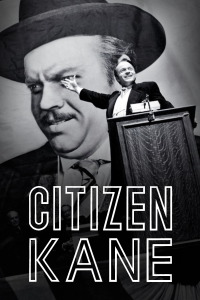
"Rosebud", the diamond forever lost as the sand ground up into smaller particles, is the unforgettable word that comes to mind whilst I present you my opinion on this, Citizen Kane, one of the greatest movies I have ever witnessed thus far in my living existence.
The story revolves around Charles Foster Kane separated from his parents to live a more privileged lifestyle at a young age. Later in life, he, portrayed by Orson Welles, works as a newspaper manager (not to mention being expelled from a handful of top-tier universities). Having been increasingly being introduced to the taste of success and wealth, it would congeal his identity in the two marriages which would befall him. The metaphysical synopsis around this movie revolves around a team of reporters that try to unveil the meaning of the word "Rosebud", the missing part of the puzzle.
In the final moments of the flick, quote Peter Griffin, "It's his sled. It was his sled from when he was a kid." Unquote; the sled was burned with all of the other insufficient artifacts of Kane's life. So, if "Rosebud" was his sled, what did it mean?
Well, in the scene from when the young Kane was playing in the snow with the sled, you may have heard it say "Rosebud"; linking that to many of Americans' youths, we all had this object we would be attached to. Girls would be attached to their Barbie dolls; boys would be attached to Teenage Mutant Ninja Turtles or Power Ranger action figures and video games such as Super Mario, Sonic the Hedgehog, and Crash Bandicoot; well...at least around my time. But of all of this mentioned out, the core of that youth is as kids, we become so attached to those we love dearly, it would be very hard for us to see it all vanish in an instant, yet the longer we grow attached to these artifacts that give us comfort in our youths, the less responsible we would become for ourselves as we grow older. That was probably why Kane's parents sent him away, they wanted what's best for their son; his maximum potential in life.
Now, as Kane's life moves forward, he becomes owner of America's top-leading newspaper chain; a candidate for governor, yet dropped out after being rigged for humiliation of an affair which cost him his first marriage; owner of an opera house for his second wife to follow her dream as an opera singer, yet grew authoritarian in his expectations for his wife, one incident having to fire one of his workers for a negative review on one of the shows; him building this top-notch multi-million dollar mansion of marble and artifacts of the world's top riches, killing his second marriage in the process.
In The Simpsons episode, "Mr. Lisa goes to Washington", the winning candidate (no, it wasn't Lisa Simpson) stated that freedom and success comes at the expense of eternal vigilance. The way that can best relate to this movie as it moves along the Third Act is that Kane has become obsessed with what his second wife wants best in her acting career, he is willing to use whatever is necessary to try to make her happy. Alas, the other newspaper companies say otherwise in regards to her acting, and when she does the math, she demands the right to know why Kane's newspaper company rebels with the mainstream media. As time moves on, she becomes more constrained within what she is allowed to do in her life as long as she's married to Kane; hence she becomes more of an object of Kane in to why he thinks she loves him, leading to the straw that finally broke the camel's back; thus she decides to leave him, inducing Kane to go on a room-wrecking rage, until he finds a snow globe with a house on-par with the one in his youth, stares at it for a moment and murmurs, "Rosebud" (no, he didn't hit the ground).
With all of that said and done, I can now best assume the Kane means "Rosebud" as a reminder of the day his parents sent him away; he was on his sled named "Rosebud" when the man came to pick him up, to be carried off into the apprenticeship of capitalism. While Kane's success did bring him friends, it also created enemies; thus he is willing to drown out their voices by means of his own tools he enhanced out of, and at the end of the day, he would still be full of his egotistic successes. Had he not left home at youth, he would be more of a humble man, one who would be successful; not to show it off every day, per-se.
Overall, "Citizen Kane", with its truth in the certain dangers of the American capitalist workings and the top-notch performance, is really more than worth the watch; it's worth the understanding of a certain aspect life.
This review of Citizen Kane (1941) was written by Anthony E on 16 Feb 2014.
Citizen Kane has generally received very positive reviews.
Was this review helpful?