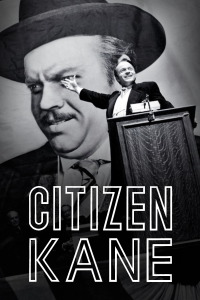
Review of Citizen Kane (1941) by Filius S — 13 Dec 2015
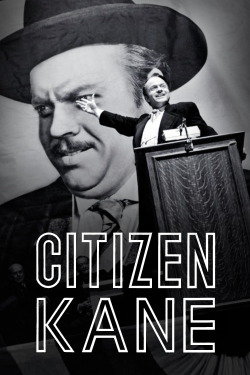
Citizen Kane is the Orson Welles masterpiece that reigned supreme as the greatest film ever made for forty fucking years until it was recently dethroned by Hitchcock's Vertigo. Does it deserve all the high praise and reputation? Well you'll have to watch it to decide for yourself, but I'll try and tell you why it might.
Citizen Kane is the story of Charles Foster Kane, a billionaire magnate who created a newspaper empire from practically nothing, driven by ambition and the need to do good. As the years go on, Kane's do-gooding becomes corrupted by the need to acquire more and more power, leading him to a life similar to that of the current .01% class.
On his deathbed, Kane drops a snowglobe and utters the words "rosebud" hurling the viewer back in time to Kane's early life and telling the story through a series of flashbacks, facilitated by a reporter named Jerry Thompson who is tasked with finding the meaning of the final words. As the story proceeds we meet people from Kane's life, as Thompson interviews them one by one, attempting to piece together the puzzle of the reclusive Kane's life; and how and why his life was as it was.
Sounds like a pretty boring story huh? Yeah, well it sort of is. But a good story is all about how it's being told, and the claim to fame of Citizen Kane is that Welles is one motherfucker of a storyteller. Rather than using the traditional narrative format of the day, Welles used a non-linear structure, in effect being a storyteller telling the story of a storyteller finding a story told by multiple narrators. You with me? The genius of this is that you learn about each character describing Kane through their perception of how Kane was, never really learning the true story, but only how each person thinks it went based on their scope of events.
Another thing that Welles had going for him was the attention to detail he paid to how films looked. While film makers relied on the studio standard for composition, Welles tossed all that shit out the window and made films the way he wanted them to look. And the way he wanted them to look was better. Shots with long dining tables had all characters in focus creating a sense of foreboding executives. The camera was made to shoot from a low angle - sometimes so low that they cut the floor out of the room to fit the camera almost at floor level - giving the cast an imposing sense of power. Camera movements were long, drawn out and complex, leaving you thinking "how the fuck did they do that?" if only you're paying attention to them.
Not stopping there, Welles went on to hire audio engineers from radio for the best possible fidelity in the audio tracks. He set microphones farther away from his source so that he could pick up the way a voice sounded in the ambiance of a room. He layered dialogue, creating overlapping tracks years before Altman ever picked up a camera. He hired the best makeup people, managing to change Kanes appearance from that of a young man, to that of an old, withered, dying one. The lighting and set design were carefully planned months in advance - a technique Welles picked up while studying German expressionist films which went so far as to physically paint shadows on the set for effect.
And did I mention that Welles wrote, directed, and acted in the entire film, and that this was his first time stepping on to a film set? Did I also forget to mention he was 24 when the film was released?
TL;DR - 10/10.
True, you may not enjoy the film, and its pace may be considered slow, or it's narrative form considered dated. Nonetheless, Welles' Kane is paramount in the world of film. Its enduring legacy exists for a reason, and it's not just because of the pioneering techniques it employed to tell its story. The film is a rare example of a passion project from a director who sought to create something brilliant, and devoted an entire portion of his life to doing so to the utmost of his ability. The film may not resonate with you as it has with audiences of the past, but it's absolutely essential viewing for anyone who has an interest in film, not only for its own sake, but to acknowledge all the references other films pay in homage to this genuine masterpiece.
This review of Citizen Kane (1941) was written by Filius S on 13 Dec 2015.
Citizen Kane has generally received very positive reviews.
Was this review helpful?