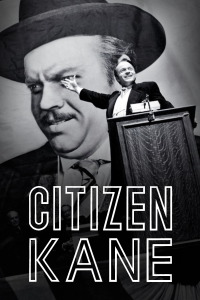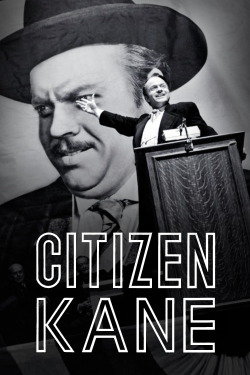
Review of Citizen Kane (1941) by Joe R — 19 Dec 2015
"What good is it for someone to gain the whole world, yet forfeit their soul?" When viewing this film, I immediately paralleled Mark 8:36 to Citizen Kane. Considered one of the greatest, if not the greatest, films of all time, Citizen Kane, which also revolutionized film cinematography, told truth about life that love cannot be gained by money. Assuredly, the film's remarkable excellences in every respect attest the addition of my perfect score to the already sky-high positive reviews of critics and audiences.
Based on the newspaper publishing tycoon William Randolph Hearst, who also is credited for triggering the Spanish-American war, Citizen Kane begins with Kane's final, dying, "Rosebud." Inquisitively, a curious reporter by the name of Thompson hopes to solve the mystery around the word and its meaning by interrogating friends and family of Kane. During these interviews, Kane's life unfolds in flashbacks as we see him possessing, with high hopes, his rich guardian's failing newspaper, which he quickly expands into an empire of thirty-seven nationwide newspapers under his unique techniques. But he wanted more; he wanted to be loved by everyone, adored by everyone, a governor, a household name. He just could not be content with what he was; he had to be bigger.
Without doubt, Orson Welles, the director, producer and screenwriter, also masterfully played this unique Kane, the rajah of the American society. As it was openly frowned upon during the Golden Age of films, little negative content appears Citizen Kane. Even though the plot revolves fairly around adultery, it is only mentioned slightly in newspaper headlines and characters' monologues. Also, young viewers may find the film boring as the message is told in a style that might be above their level.
What if I said that "Rosebud" was his childhood sled? I revealed absolutely nothing about this unique, troubled life, as Thompson mentioned at the near the end, "Maybe Rosebud was something he couldn't get or lost. No, I don't think it explains anything. I don't think any word explains a man's life. No - I guess Rosebud is just a piece in a jigsaw puzzle - a missing piece." Kane, a man who wanted love on his own "terms," failed to understand in his "terms" that in receiving love, love needs to be given. With this deep and powerful message, this piece of art has been ingrained into history as the most influential film ever, and it will easily become a family favorite.
This review of Citizen Kane (1941) was written by Joe R on 19 Dec 2015.
Citizen Kane has generally received very positive reviews.
Was this review helpful?