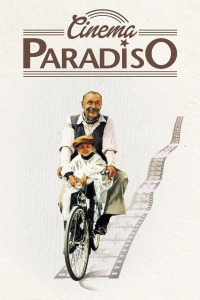
Review of Cinema Paradiso (1988) by Budge B — 13 Apr 2009
Is this the ultimate film about lost love? Guiseppe Tornatore explores the nature of love, its ability to flicker, burn, consume, then slip through your fingers because of a moment missed, a second's inattention ... and she's gone, and you're left with a lifetime of dreams and might-have-beens, and, occasionally, her reflection in your most private tears.
Set in a small town in Sicily, there is an autobiographical element as Tornatore pays homage to his youth. It's a setting anyone brought up in a small town or village will understand - a place of certainties, of warmth, or safety, of claustrophobia. Here we find young Toto (Salvatore Cascio), waiting, still believing his father will return from the Russian Front. He's too sleepy to be an altar boy - he spends his nights at the local cinema, watching the films and pestering Alfredo, the projectionist (Philippe Noiret).
The local priest runs the cinema and censors it, cutting out any pornographic images such as kisses. He notably fails, however, to censor Left-wing messages or to rob the films for their political content. Toto watches Jean Renoir and Charlie Chaplin. It's an evocation of the fascination of the cinema, the whole town packing the theatre each night to laugh, cry, cheer, and share experiences and passion. It's an intimate world where the public and the private overlap and live in harmony.
Toto longs to be a projectionist - Alfredo reluctantly trains him. The boy loves the cinema, loves its romance and power. At one point, Alfredo projects a film outside onto a white wall, so people locked out of the cinema can see it. It is one of the magical moments of cinema: I can watch this again and again and the magic remains fresh!
Toto grows to adolescence as the town's projectionist. The old cinema has burned down, the new one is glitz and glamour, no longer within the control of the Church, but run for profit by a speculative outsider, a man from mainland Italy. Toto knows his father will never return, that he lives only as charred memories. He is taking pictures himself, now, and his attention is captured by a beautiful newcomer, Elena (Agnese Nano). He is confident and adept at everything to do with the cinema, but inept at expressing his love for this girl.
When he is called up to do his national service in the army, Toto loses touch with Elena. It is his baptism into a world beyond his small town, a real world beyond the safety of the cinema screen. But the army cuts him adrift, leaves him alone. He doesn't fit in the way he fitted into his community ... and now he cannot go back. Alfredo tells him to leave town, to follow his talents, his dreams, never to come back. The central irony of the film is Alfredo's insistence that Toto should not be made a slave to nostalgia - memories should be liberating, enlightening, should be the fuel for the mind, not a mawkish prison for it.
And so the film starts with Toto, now a successful, renowned film-maker in his own right, being given the news of Alfredo's death. Can he return? His home is the scene of so much love, of so much loss. He has been prepared to wait for love all these years ... or, at least, to try to escape from it - he has a string of failed relationships. Surely his home will simply rekindle the pain of loss?
Here is nostalgia as a motivating force in life, as cherished memory. Here we have love - and the loss of it. The joy, the pain, the anticipation, the dreams. This is a film which will make you cry, make you laugh, fill you with hope ... and trigger a few memories.
The "Director's Cut" restores the 51 minutes raped from the film during its first US release. Why did they do that? Most of the cuts are at the end, robbing the film of its conclusion, its meaning, its depth of emotion! The cut version is magnificent, the restored version more so. Could the American film industry not understand emotion? Were they determined to impose their definition of a happy, or at least cerebral ending? Was it an ironic take on the priest cutting out the naughty bits?
If you can, try to watch the shorter version first. Then watch the restored version. It will double your enjoyment of a magnificent piece of cinema. "Cinema Paradiso" will stir your emotions. Watch it with hanky in hand ... and be prepared to laugh loud and cry openly.
This review of Cinema Paradiso (1988) was written by Budge B on 13 Apr 2009.
Cinema Paradiso has generally received very positive reviews.
Was this review helpful?