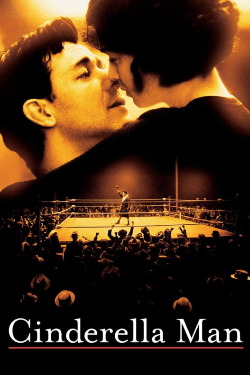
Review of Cinderella Man (2005) by Cameron J — 24 May 2013
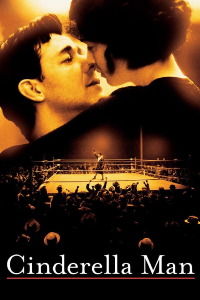
"Cinderella Man, hang on to your plans; try as they might, they cannot steal your dreams! In the betrayal of his love he awakened to face a world of cold reality, and a look in the eyes of the hungry awakened him to what he could do!" Okay, sorry, Rush fans, but I'm gonna stop right now, because I've got to stop for a second a think about how that song about a manic depressive, like John Nash, fighting for the sake of the poor and misfortunate, much like James Braddock, is interestingly fitting for this discussion about the round-off to Ron Howard's and Russell Crowe's all too brief collaboration period. That's kind of cool, so I guess that there is, in fact, something kind of cool about James Braddock's nickname, which makes the quote from a certain other boxing legend, "float like a butterfly and sting like a bee" sound about as manly as, well, boxing. Hey, if I were to meet Braddock during his golden years as I boxer, I wouldn't have said anything, because silly name or not, the guy could sure pack a punch, and one that was backed by committed honor, so you know that he could do some damage. I reckon that means that Crowe, who hardly looks a thing like what Braddock looked like, is actually well-cast in this role, because as "L.A. Confidential" and "Gladiator" will tell you, when the man is committed to a goal, or at least has a phone handy, you might not want to cross him. Well, that makes Crowe seem perfect for this role, and the simple fact that he's Russell blasted Crowe and awesome, as he reminds you in this film, though not so much so that he can completely knock out this film's issues.
There's certainly a lot of meat to comfortably sustain for just under two-and-a-half hours in this story, so the film can't afford to slow down, yet that doesn't stop it from having its limp moments, built on the foundation of overdrawn, maybe even repetitious periods in plotting, and exacerbated by quiet and dry moments in atmosphere that bland things up just enough to disengage. Sure, the film's disengaging moments are rarely, if ever too offputting, but they're still here, and for every one of them, there is a spell in the film that is either comfortably tight enough to give you a firm feel for resonance, or kind of undercooked and somewhat slapdashed, and such pacing unevenness shakes smoothness in story structure, sometimes into wanderings that have no place in something as driven by gradual momentum augmentation as an underdog drama. I wouldn't necessarily say that the film meanders, or at least not all that much, but there are just enough aimless moments for rises and falls in structure to go settled, until the film is rendered unable to fully explore its rich potential, which is still pretty limited, no matter how much the makers of this film want this project to have more kick, or, if you will, seeing as how we're talking about a boxing film, punch. This film is nothing if not ambitious, and such ambition often backs inspiration that carries the final product a long way, yet at the same time, the desperate desires for this film to accel only leave you to meditate upon shortcomings, while shaking the subtlety in more than a few dramatic areas, which sometimes go so far as to come off as rather sentimental. There's enough delicacy put into the handling of this worthy story's dramatic aspects, but those lapses in genuineness, emphasized, if not inspired by overambition telegraph atmosphere to the point of igniting predictability that is made all the worse by conventionalism that emphasizes the familiarity in most every major individual aspect to this story, rather than how they could bond rather uniquely. The film wants to be something truly refreshing, and in a lot of ways, yeah, it genuinely is, or at least inspired enough to compensate for shortcomings and compel as much as one of your more inventive underdog films of this type, but no matter how inspired this project is, its ambition only accentuates the shortcomings that are, in fact, present, shaking momentum smoothness in storytelling with unevenness in pacing and sparking predictability through lapses in subtlety and relative uniqueness, until you end up with a somewhat overlong and certainly flawed drama. That being said, when the film lands a hit, like Jim Braddock himself, it makes it count, boasting enough heart and inspiration to thoroughly compel as genuinely strong, and even enough production value to sell you on this setting.
Now, let me tell you, Jim Braddock's boxing career is, of course, instrumental to the telling of this underdog tale, but really, what the marketers won't tell you is that this film is less about success in the boxing business, and more about just trying to get by during the Great Depression, so, of course, the selling of this film's era is absolutely crucial and cannot be half-baked, and production designer Wynn Thomas and costume designer Daniel Orlandi, realizing this, spare no expense in restoring the look of 1930s New York impeccably, making sure that most every setting throughout this film is distinguished as what you would expect for the time, whether it be the polished up city life and boxing ring, or the hauntingly gritty slums. The production value of this film is strikingly immersive as both neatly intricate and complimentary to this story's heart, whose depth goes further complimented by such relatively little things as Thomas Newman's score, which is too minimalist and formulaic to be all that outstanding, but has enough soul to both entertain and compliment the genuine spells in resonance about as much as it is misused to supplements the sentimentality, while Salvatore Totino, returning for the first of many times as Ron Howard's cinematographer, plays with lighting in a carefully coordinated fashion that handsomely marries grit with rays of liveliness time and again. The film looks good, sounds good and is designed go-I mean, "well" (I'm insulting the efforts of my past English and writing teachers with my run-on sentences, alone), though not entirely in the traditional sense, as there is a kind of grit and heart infused in the artistry behind the crafting of this film that is not only attractive in a rugged way, but a companion to substance, which needs to be done justice, seeing as how this story, while with some minimalist areas, is worthy, and deserves to be executed well. Realizing the value of this film's important story, Cliff Hollingsworth and Akiva Goldsman put together a script that is often too ambitious to pay all that much attention to such things as evenness in structural pacing and originality, but is, on the whole, genuinely strong, with clever and well-timed dialogue that colors entertainment value up, as well as characterization that, while with the occasional thin spell, is generally very thoughtful in its creating believable and relatable humans in the lead regions of the character roster, while meditating upon the individual struggles of certain supporting players in an organically subtle fashion that gives you insight into the immensity of this story's theme of struggling during harsh times that affect many people differently. No, this film isn't always all that subtle, but where it could have devolved into straightforward sentimentality with superficial thematic weight, Hollingsworth's and Goldsmith's writing breathes life into the genuineness of this important story much more often than not, and is itself brought to life by a directorial performance by Ron Howard that is even more problematically overambitious, but still generally just as strong as Hollingsworth's and Goldsmith's script, at least stylistically, as Howard plays with the thrilling snappiness of Daniel P. Hanley's and Mike Hill's exceptional editing, and thumpingly well-structured sound design in an immersive fashion that captures the frantic thrill of the chillingly effective boxing sequences that grip you with every palpable beat, but aren't the only areas in Howard's storytelling that engross, because for every rather sentimental note in the crafting of dramatic resonance, Howard breaks up a consistent degree of compellingness with heights in emotional resonance that range from moving to near-penetrating. From such particularly haunting moments as a memorable sequence in which Braddock deeply analyzes a film showcasing the agonizing style of a terribly dangerous opponent he faces in the climax that is accompanied only by the eerie click of a film projector, to breakthroughs in our leads' journey to a comfortable life again, there are plenty of sequences that Howard crafts exceptionally well, and while the film is, on the whole, not quite as sharp as the occasional high notes, it succeeds as a moving character drama, powered by inspired writing and direction, and anchored by a myriad of strong performances, with Renée Zellweger's dramatically piercing portrayal of a concerned matriarch who fears for the welfare of her family and the life of a beloved husband who is willing to put himself in danger for his family's sake being a particularly outstanding beat, though perhaps not the most outsanding beat, because in the end, our lead, the great Russell Crowe, is the real force behind this dramatic character study, turning in impeccable accent work, electric charisma and sharp line delivery that are practically trademarks of his, as well as a humanly thoughtful and subtly layered capturing of the essence of a good man of family, morals and strength that is relatively unique in this performance by Crowe, who firmly reminds you of his exceeding talent by bypassing acting material limitations in order to absorb the full depths of his role, time and again, and goes above and beyond the call of duty. Crowe is certainly a distinguished figure, and one who doesn't entirely look the part of the late, great James J. Braddock, but through a deep commitement in the exploration of this role's essence, Crowe becomes Braddock and, by extension, an engrossing force of a lead whose subtlest dramatic moments can move mountains, and certainly do a lot in carrying the film, which is too flawed and, in a few areas, naturally undercooked to be excellent, but comes close, powered by a heart off and on the screen that makes the final product a strong one.
When the bell sounds and the brawl concludes, unevenenss in pacing drives storytelling into aimless spells that join overambition and formulaic areas in emphasizing natural shortcomings that render the final product incapable of fully achieving the excellence that it still comes close to reaching, thanks to fine production value, decent score work, handsome cinematography, strong writing and direction, and fine acting - especially by Renée Zellweger and Russell Crowe - that compose a well-structured machine of a production whose entertainment value and heart make "Cinderella Man" an inspired and inspiring tale of doing what's best for your loved ones during harsh times.
3.25/5 - Strong.
This review of Cinderella Man (2005) was written by Cameron J on 24 May 2013.
Cinderella Man has generally received very positive reviews.
Was this review helpful?