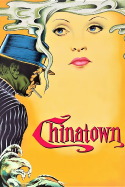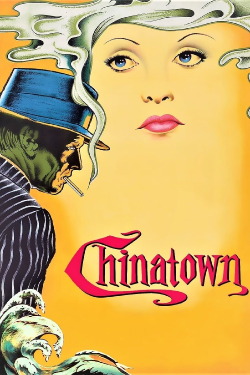
Review of Chinatown (1974) by Cameron J — 28 Aug 2014
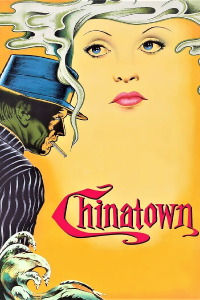
"Well, we're sitting here in Chinatown, and they're closing all the factories down!" There are, like, a million songs about, if not named after Chinatown, and I ended up going with Billy Joel's "Allentown", because not too many people remember The Move's "Chinatown". Maybe I should have referenced that song after all, because no one at all would remember The Move if they didn't lead into Electric Light Orchestra, and this film probably wouldn't be remembered if it wasn't Roman Polanski's last film made in the United States... and if it didn't get a lot of nods as the Oscars, a lot of wins at the Globes, and recognition from numerous people as one of the greatest noir films of all time. Some people might wonder why I would figure that this film would be forgotten, but Roman Polanski has made so many films that if the pedophilia accusations didn't come in, he would have fled from the States just for a vacation. It's a good thing he did bail out, because there's no way he could have defended against accusations of his being a sexual deviant after a film this sexually creepy (A sexually-charged detective noir? That's new!), and I stress the adjective "sexually" because it's just not a Roman Polanski film if it isn't a little creepy... or a little too long. Even "Macbeth" got rather excessive and dull, and it had real warfare instead of these here California "Water Wars". Sorry if I'm offending anyone, but the name of a situation that serious always sounded kind of silly to me, as did the basic concept of a war over water, but make no mistake, this film, while plenty creepy, is not silly, although it, as good as it is, does have other things going against it.
As a neo-noir, this film broke a little ground, or at least impacted the formula for dramas of its type, but when it falls into convention, it falls hard, whether it be following Roman Polanski's usual storytelling structure and themes, or hitting noir tropes that range from a plot carrying themes of adultery, politically-charged murder, sexuality, etc., to an enigmatic lead who might be a little too enigmatic. Well-drawn and, of course, very well-portrayed by Jack Nicholson, the J.J. "Jake" Gittes character is a compelling lead, but not quite a distinguished one, for there is no immediate background on him, and only so many expository layers to a characterization that you'd think would be more fleshed out throughout the course of this lengthy, character-driven drama. As a matter of fact, while I understand that this film can't commit the noir sin of straying too far away from the point of view of its main character, this film also stands to flesh out its focal layers, as it gets to be a bit uneven in its progression, partly because it covers too much material, and takes it time to cover it. Running well over two hours and, of course, being directed by Roman Polanski, this film is way too long, with plenty of fat around the edges which, before too long, gets to be repetitious, having some limitations in storytelling dynamicity that could have been more easily overlooked if there was more dynamicity to Polanski's directorial storytelling. As it often is, Polanski's thoughtfulness is realized enough to be adequately compelling, with considerable effectiveness upon the incorporation of heights in material, but the director has always had a tendency to very often get carried away with his subdued atmospherics, and he does just that here, with a steadiness that makes a lot of the plotting material run together, stiffens pacing, and rounds it all out with a blandness that all too often slips into all-out dullness. Again, there is something inspired about Polanski's storytelling, leading to sound engagement value that, before completely wearing off, really kicks up with the thickening of plot, but when this film limps out, it crawls, down a formulaic, undercooked, uneven and altogether overdrawn path, until it finds itself running the risk of collapse into underwhelmingness. This film isn't quite what it could have been, but it is rewarding, with graceful subtlety, biting edge, and even taste.
Taste can be found within Jerry Goldsmith's score, when it is, in fact, used in this largely deeply quiet and atmospheric drama, being rather formulaic in its noirish jazzy sensibilities, but lovely and effective in its tenderness, and carrying an artistic value which is even more subtle in John A. Alonzo's often flat, but reasonably handsome, shadowy cinematography. The stylistic trappings of a film noir are certainly there, and Roman Polanski at least works with those well, but as a director, he delivers on more than just aesthetic value, for although his trademark overt thoughtfulness gets to be seriously dull, and is ultimately too recurrent, it could have resulted in a flat film, if it didn't carry a certain atmospheric realization that immerses, and is biting once dramatic material comes into play. This is a steady and lengthy film that is heavy on mystery over action, so there isn't much material for Polanski to draw upon, but there is plenty of tension to spare, partly because of Polanski's directorial highlights, and largely because the story has plenty of meat to begin with. The dramatic material is a little lacking, and the human factor is further diluted by thin characterization, but as an extensive dramatization of a case to unravel the murder of a powerful and somewhat scorned man, driven by a charismatic lead, this story has potential. A lot of that potential is obscured by the Robert Towne's draggy, uneven and somewhat thin script, which mostly does a great deal of justice to the narrative, through sharp dialogue and sophisticatedly crafted set pieces, in addition to enough rich character drawing to make up just fine for developmental shortcomings. If nothing else makes up for characterization issues, it's the performers, with the lovely and emotionally solid Faye Dunaway stealing the show from time to time as a widow who wants to know about the affairs and fate of her husband, yet is concealing her own dark secrets, while Jack Nicholson, despite playing himself, carries the film with his trademark sparkling charisma, which fits the classic noir lead role like a glove and adds the hint of entertainment value this film needs to reward. The film is so slow and so cold so often that it comes very close to losing its reward value, but its sophistication is respectable, and the inspiration behind its thoughtful storytelling and endearing performances secure the final product as plenty compelling.
When the case is closed, conventional aspects as a Roman Polanski film and noir thriller include an underdeveloped lead, while unevenness to a draggy story structure that is made all the more aimless by often dully cold direction most shake your investment, and threaten reward value that is secured by the solid score work and cinematography, generally effective direction, smart writing and charismatic acting that manage to make Roman Polanski's "Chinatown" an overly steady, but reasonably engrossing noir classic.
3/5 - Good.
This review of Chinatown (1974) was written by Cameron J on 28 Aug 2014.
Chinatown has generally received very positive reviews.
Was this review helpful?