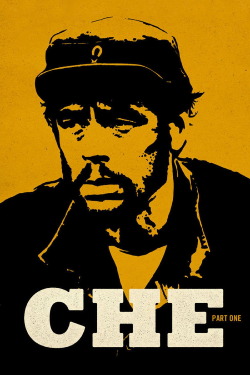
Review of Che: Part One (2008) by Sean C — 31 May 2009
Part One: The Argentine.
Written by Peter Buchman.
Directed by Steven Soderbergh.
If it wasn't so ironic, it would be funny, but the fact that Che's face is now used to sell more t-shirts than Nike is in fact one of the saddest reflections of American consumer society at large. How exactly does a guerrilla fighter from Argentina, that led the Cuban Revolution, end up becoming a pop culture brand? I suppose the same way his life story becomes a meandering, unfocused film starring one of the most important actors of our generation, and a largely unknown supporting cast. Throw into the mix the high budget (for an art film) and the stuttered, buried art house theatrical release, and you have a real mess of a movie. So how did this happen? Simple. Revisionist history.
We live in a time where history is written by those in power, and it is written how they choose to remember it. Ernesto "Che" Guevara (Benicio Del Toro) is an Argentinian doctor, Marxist, humanitarian, free thinker, artist, and most famously, a revolutionary. His actions, works that were solely motivated by his truest beliefs, speak louder than any of his words, and his words were some that have changed the world over the past 53 years since Che met Fidel Castro (Demien Bichir, TV's Weeds). On that night, the two men met, and began to seriously discuss what would entail a complete revolution in Cuba.
Fidel, a great leader of men, proud Cuban, and strategic genius, comes to Mexico to explain to Che how he sees the revolution happening. They make preliminary plans of how they would go about such a daunting task, but before you know it, they are on a boat from Mexico headed toward Cuba, with 82 fighters ready to take on the entire army and regime of American-supported dictator Fulgencio Batista.
In a story that is as harrowing as it is heroic and amazing, these men slowly made their way across the entire island of Cuba, traveling hundreds of miles on foot, over the course of two years, fighting and winning along the way, building the support of the populace.
However, even though this film is about Che and the Cuban revolution, really, it's not about either of those things. It's about man's nature, his will to overcome anything given the proper circumstances, and on what occasions men will rise to these challenges. Much of the film is spent watching Che and other fighters wearily meeting new recruits and citizens who pledge support. The only trouble is, Che is unsure of who to trust, therefore the viewer has no clue who he is actually trusting, and since there is no attempt to individualize anyone but a handful of main characters, the viewer spends a lot of time living day to day life with Che and the guerrillas.
I understand this was the point Soderbergh was making, it's a film about the ideas of the men, the accomplishment of these ideas, and all the circumstances that, added up, equaled the Cuban revolution. However, the structure of the narrative, the style of camerawork, the editing choices, and the plot points leave any fan of history wondering why he chose to make this film. He's the director, so ultimately it is his choice, but personally, this is not the film about Che I would like to see. I would like to see why he steadfastly believes what he believes, not how readily he is to fight for those beliefs. In fact, pieces of each would have worked better than one or the other, but I suppose that would have made this a mainstream biopic, and I just keep getting the feeling that very genre is what Soderbergh (for some reason) was purposely dodging.
Well, we all know our history. In 1958 Castro finally took Havana, Batista was overthrown, and in one of the few underdog military victories in the history of humanity, (remember, the Spartans were slaughtered at Thermopylae) they took the country of Cuba back from an imposed regime. What is unique about this story is the fact that they didn't start with full support, they built it along the way, traveling across the country, showing the peasants they felt their plight, they were living it, and if only the peasants could help them, they were fighting to make their lives better.
With ingenuous attack points, strong organization, the populist support, and unique guerrilla tactics, Castro, Guevara, and their communist supporters were able to take the country back. However, this film does not expound these points, they seem to be a smaller part of a big picture. The problem is, the big picture is never quite clear. I believe this theme was intentionally left open-ended for the viewer just to explore the lives and times at hand, but realistically, there are so many disjointed scenes that a viewer uninitiated with the story will be lost when confronted with the realism of such a revolution because of the nature of the narrative.
The cinematography is excellent, but the lackadaisical approach to direction of each scene is so wide open that often the viewer can't tell who is talking, where the scene is going, or what important piece of the revolution is being explained. The editing adds to the separation of the scenes, we follow Che as he meets his new recruits, making it a point to pass his commitment to the cause on to them realistically. However, without seeing the actual hardships of many of these characters, or any of the people of Cuba really, the revolution itself comes off looking self-serving, which, given the circumstances, was not really the case. The music is low key and well used, the costumes and locations are all authentic in nature, but without a single line connecting all the dots, the viewer is often left in the dark.
These points are all disappointing in the end, because I felt that the narrative was never connected to the spirit of the film. We come to like Che, his general nature, and his humanitarian spirit, but as a person, I couldn't connect with the characters, although I strongly believe in their ideology.
7.9/10.
This review of Che: Part One (2008) was written by Sean C on 31 May 2009.
Che: Part One has generally received positive reviews.
Was this review helpful?