Review of Che: Part One (2008) by Josh S — 15 Jun 2009
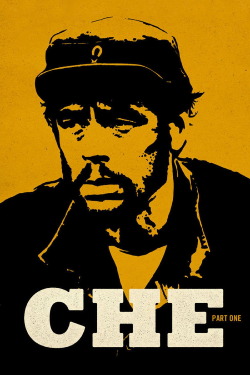
On occasion, this first instalment of Steven Soderbergh's biopic of renowned Argentine revolutionary Eneresto Che Guevara can easily equal the likes of Oliver Stone for its epic portrayals of revolutionary conflict in late 1950s Cuba.
Benicio Del Toro seems insistent on portraying the legend of Che as much as he does the man: a sort of chivalrous Robin Hood revolutionary who threatens one minute and shows compassion the next. Del Toro certainly always looked the part for the role (what he calimed, unsurprisingly, to be the hardest role of his career) and clearly savors it to its full potential. Indeed, Soderbergh seeks to present Che as an idealised, heroic figure who when not trying to scrip rations out of peasants or executing his own soldiers for mis-conduct is busy helping the wounded and protesting his rationale on Capital Hill. Denying many of Che's more negative characteristics (his extreme intolerance of homosexuality for example). In Soderbergh's Cuban Revoluition, Fidel Castro - every bit the charasmatic historical figure as Ernesto Guevara - has been kicked to the curb in an attempt to almost remove him from any involvement in the Revolution. Whilst dramaticly this may be a good choice of thinking by the screen writers, as a histroical chronicle the film seems as inadequate as Braveheart, though Soderbergh ensures that the Cuban leader's brief presence in the film is a memorable one.
In this respect, historical spectacle seems to be the primary goal and Soderbergh has done much to show his revision of political epics, particularly JFK. Che: Part One's use of narrative chronology acts as a vivid example of the way colour can be used as a symbolic of time and space in that it exhibits a versatility for switching betweem real-time naturalism and the sort of grainy monotone film reel footage which dominated Soderbergh's previous, less impressive, nostalgia piece: The Good German.
However, the seems to be too much information for just two hours. Like Citizen Kane before it, Che suffers the problem of most great epics in that the meagre 120 minute duration forces the pace to go too quickly, disallowing the audience to process the information they have been given, eventhough much of it is high school history being re-hashed to fit a different perspective. Soderbergh has never been too subtle when it comes to dealing with heavy-handed plots and as such his occasional cluminess is evident amongst the sheen and spectacle, although admittedly there are far fewer plot holes than in The Good German. The ending also seems a little rushed as well, with the action which engulfs much of the third act grinding to a halt just as the tension reaches its peek. Perhaps this was an attempt by the screenwiters to prove that they could stay true to the source material but compared to the build up of the first two acts, it feels underwhelminig regardless.
Che is far from a perfect film. However, it remains a stand alone performance from Benicio Del Toro and a shining example of his ever-growing dramatic experience. One cannot escape the truth when watching Che that this is nothing along the lines of JFK, but then, it doesn't try to be. As a pure biopic, the film works extremely well matching Michael Mann's Ali for dramatic gravitas and casts a large shadow over Che: Part Two.
This review of Che: Part One (2008) was written by Josh S on 15 Jun 2009.
Che: Part One has generally received positive reviews.
Was this review helpful?