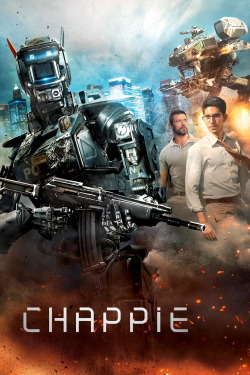
Review of Chappie (2015) by Asjklasjklas — 07 Mar 2015
Chappie isn’t a failed mission more than it is a missed opportunity. Because despite the many, many critics firing at it to its post-apocalyptic hell and back—specifically targeting director Neill Blomkamp’s 2009 commercial and critical breakthrough District 9, calling his success a “fluke” after 2013’s disappointing Elysium and considering him a “one-hit wonder” among the sci-fi genre—I, however, found Chappie to be both conceptually and visually involving when it wasn’t balancing on a tightrope between Chappie’s Short Circuit’s innocence-meets-Iron Giant’s naivety and the “gangsta” glorification or glamorization of their respective stereotypes. It’s one of the rare occasions where the R rating felt quite restrictive and main protagonist Chappie’s awe-inspiring lightheartedness and the supporting characters’ vulgarity and ugliness and the film’s gritty nature crossover in what appears to be Blomkamp’s identity crisis of whether he wants his ‘80s sci-fi influences to tug audiences at the heartstrings or the attention span.
As you can tell from the “awe-inspiring” comment, maybe I’m of the minority that found Chappie’s childlike nature both charming and, dare I say, cute as a former police bot could be. It’s a bit frustrating when I hear film critics call adolescent characters in any film “annoying” based on, let’s say in Chappie’s case, their immature, inquisitive, or at certain scenes, whiny qualities. Because aren’t all children annoying because of their wondrous behavior? I could’ve understood these criticisms if I didn’t let out so many damn ‘awe’s at Chappie’s dialogue; from Chappie’s use of “mommy” and “daddy”—both [spoiler] referring to the South African rave-rap duo Die Antwoord, ok—to the take-it-or-leave-it “f***-mother!” to the questions that even bask in the back of our minds from time to time regarding our own existence (“Why did you make me so I would die?”). The supporting characters—Chappie’s good-natured AI creator and the oppositely-natured Die Antwoord respectively—are all there, ready to adopt the bot for their own selfish moral desires, which is engaging entertainment in its own right once you see Chappie’s rapid character growth due to their influences all-in-one. But it’s as if the human characters themselves experience frequent and unusual personality malfunctions throughout Chappie’s two-hour duration, where DA’s Yo-Landi even becomes more nurturing than the creator.
Besides the narrative shortcomings, philosophical and political undertones also make their way into Chappie in typical Blomkamp style, where we are not once explicitly aware of what he’s actually trying to say outside of obvious topics—such as the state of consciousness and how far it may or may not expand beyond that of current common knowledge, not that 2013’s Her didn’t already quite commendably confront that—and AI—already. Because let’s face it, Blomkamp just can’t take a breather when it comes to the film’s overabundance of action sequences. The $50 million budget definitely results in some visually striking imagery and the South African setting feels original in an era where everything in cinema is happening in either America or Europe nowadays. But couldn’t we get at least a hint that the storyline can progress itself without the need of guns, explosions, ultraviolence toward the third act, and more and more explosions. As if its identity crisis couldn’t have been distracting enough regarding its moral stance and aforementioned change in tone.
But as much as I could nitpick Chappie for simply not being District 9’s much, much more successful storytelling, I’d be a damned liar if I said I didn’t feel enchanted or engulfed at least once throughout its desperation of wondering what Short Circuit would be like if it existed in the RoboCop universe. If I was ambivalent at certain moments, I began to see the inspiration start to sneak through the tiniest bits of dialogue or visual sequences, particularly those involving Chappie himself. It’s an excellent concept that merely needed a longer lifespan during the developmental process, perhaps if Blomkamp wasn’t so anxious to direct the next Alien sequel—but, I mean, who wouldn’t be? After reading online into many professional’s reportedly slim expectations regarding its fulfillment of its half-of-a-hundred million dollar budget, I’ll be even more disappointed if Chappie doesn’t at least garner a cult following just so I can hope for the slightest chance that Blomkamp—or another director, if so many others don’t find him fit enough—to reintroduce us into this universe, whether it’s in the form of a sequel or perhaps even a reboot in the distant, distance future. Please!
Overall rating: 7.1.
P.S., without revealing any major SPOILERS, one of the scenes has Chappie in his childlike form receiving quite a bit of physical and emotional abuse and has received negative reactions from former victims of child abuse, saying it triggered painful memories. A warning, I suppose.
This review of Chappie (2015) was written by Asjklasjklas on 07 Mar 2015.
Chappie has generally received mixed reviews.
Was this review helpful?