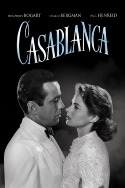
Review of Casablanca (1943) by Alex G — 11 Nov 2012
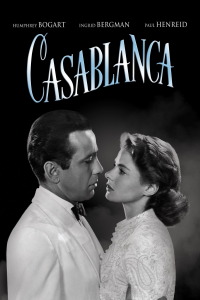
Casablanca - Hollywood's finest moment, a film that succeeds on such a vast scale not because of anything experimental or deliberately earthshaking in its design, but for the way it cohered to and reaffirmed the movie-making conventions of its day. This is the film that played by the rules while elevating the form, and remains the touchstone for those who talk about Hollywood's greatness.
Ultimately Casablanca is a story about painful sacrifice for the greater good, softened by the assertion that the problems of three little people don't amount to a hill of beans in this crazy world. It's fascinating to consider the reality of that statement as we hurtle through the cosmos suffering the slings and arrows of outrageous fortune. But as we try to find all the answers, it's nice to be able to look back to one of the most tumultuous times in modern history and see three people who know they have to suffer but know the reason why. So often we aren't afforded that luxury in real life.
There are so many classic scenes and lines from Casablanca you can write a comment just by listing them. But my favorite has been when the Germans have taken over Rick's place and are singing some of their songs, Paul Henreid goes to orchestra leader and asks him to lead La Marsellaise. With a nod from Bogey, the orchestra plays, Henreid leads them and the rest of the non-Germans in the cafe join in. Over 60 years later, one still gets a thrill from that act of defiance.
Humphrey Bogart is Rick and Ingrid Bergman is Ilsa, in roles that are archetypes in film lore. Theirs is a relationship of almost perfect cynicism, one-liners and professions of neutrality that provide much humor, as well as give a necessary display of Rick's darker side before and after Ilsa's arrival. They are great parts besides, very multilayered and resistant to stereotype, and both actors give career performances in what were great careers. He's mad at her for walking out on him, while she wants him to understand her cause, but there's a lot going on underneath with both, and it all spills out in a scene in Rick's apartment that is one of many legendary moments.
But there's so much to grab onto with a film like this. You can talk about the music, or the way the setting becomes a living character with its floodlights and Moorish traceries. Paul Henreid is often looked at as a bit of a third wheel playing the role of Ilsa's husband, but he manages to create a moral center around which the rest of the film operates, and his enigmatic relationship with Rick and especially Ilsa, a woman who obviously admires her husband but can't somehow ever bring herself to say she loves him, is something to wonder at.
Bogart and Rains were nominated for Best Actor and Best Supporting Actor. Any of the others could have been as well. As Casablanca is perfectly cast right down to minor roles like Curt Bois as a pickpocket, John Qualen as a fellow resistance leader, and S.Z. Sakall as a waiter at Rick's. If there was an award for ensemble cast, Casablanca would have won it. As it was it did win for Best Picture of 1943 and best director for Michael Curtiz.
I know no other movie that so perfectly balances humor, romance, and drama. The soul of good drama lies in presenting characters with hard choices, and few choices are as hard, or as illuminating of the protagonists' makeup, as the choices in Casablanca. It's hard to imagine the movie-making world in which the movie was made, but equally fascinating to learn that the people making the movie had no idea that they were making what would become one of the most popular movies ever made. It was a big movie, of course, but it was made on a relatively tight budget, which is something that I wish modern filmmakers would remember. Money has never been what makes great movies. Few people know that anymore.
Review Number: 15.
This review of Casablanca (1943) was written by Alex G on 11 Nov 2012.
Casablanca has generally received very positive reviews.
Was this review helpful?