Review of Carrington (1995) by Janet H — 29 Jan 2007
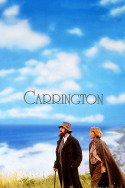
Although writer/director Christopher Hampton has adapted his [i]Carrington[/i] from Michael Holroyd?s biography of Lytton Strachey, he has chosen to focus his story on the complex and fascinating character of Strachey?s longtime platonic life partner, painter Dora Carrington.
This film has a lot of plot, with characters drifting in and out as their lives and loves dictate, but its story is simple: Carrington (Emma Thompson), a talented and tomboyish bluestocking, meets the frail, Wildean Strachey (Jonathan Pryce) and falls in love with him in spite of his avowed preference for young men. They move in together and live happily until his death, after which she commits suicide rather than face life without him.
Hampton has chosen to create a film that offers a lot of questions and not many answers (an admirable alternative to the preponderance of films that portray love, desire and marriage as monolithic and inevitable). It is remarkable, then, that [i]Carrington [/i]succeeds in being deeply, epically moving ? we understand this love story in our hearts even as we struggle with it in our heads.
One of the ambiguities Hampton has chosen not to pursue is the historical Carrington?s bisexuality, perhaps feeling that it would further muddy an already confusing array of friends and lovers. In fact, bisexuality is the elephant in the room in [i]Carrington: [/i]the actual Strachey and Carrington were both functionally bisexual, occasionally sharing both male and female lovers. The 21st-century viewer, steeped in post-identity-politics culture ranging from Judith Butler to [i]Will and Grace, [/i]would perhaps accept the sexual fluidity of Carrington, Strachey and the other Bloomburyites more readily than did audiences in 1995 when the film was released (and almost certainly more readily than they would have in 1976 when it was first written). But as far as this script is concerned, Strachey is 100% gay (he prefers to refer to himself as a ?bugger?), Carrington 100% heterosexual, and the film is weakened by the oversimplification.
Carrington, both the historical artist and the film character, is a complex and contradictory figure: an accomplished artist who paints only for her own and her friends? pleasure; a feminist who is admittedly happiest when subordinating her desires to those of her beloved; androgynous in her affect but nurturing in her affections. At the outset of the film she is still a virgin at twenty-two, to the despair of her friends, most particularly of her suitor Mark Gernsler (Rufus Sewell). She accuses him of desiring, not her, but her body. ?I am my body,? he replies angrily ? but the physical awkwardness with which Thompson imbues Carrington argues that this is not the case for her, that she is most emphatically not her body, and that she would in fact prefer to be free of the damn thing.
When Strachey first sees Carrington, he mistakes her for the boy that she later confesses she wishes she were ? an easy mistake, given her rough bowl haircut and corduroy knickers. When she tells him of her wish to be male, he is plainly moved; he attempts to kiss her. Shocked and furious, she pushes him away and runs off. But in that moment the two of them have entered each other?s hearts, for good or for ill, and the rest of the film follows the accommodations they must make to build a workable life around the central fact of this difficult but undeniable love.
Each takes lovers; Carrington goes so far as to marry Ralph Partridge (Steven Waddington), a stunningly handsome man she doesn?t much like, in part because Strachey enjoys having him around. Very gradually she comes to discover her own physicality ? although even in her mature lusts, notably with Beacus Penrose (Jeremy Northam), she seems emotionally disconnected, discomfited by the yearnings of the body she wears so awkwardly.
In the end, it seems, Carrington loves Strachey because, alone of her lovers, he accepts her as she is. ?If only I weren?t so plural,? she sighs. ?People want me so ? conclusively.? Strachey is the only person in her life who would not have her be more feminine, more sexual, more monogamous, more anything; he is the companion of her soul if not of her body.
History has proven both Strachey and Carrington to be relatively minor artists compared to several of their Bloomsbury Group compatriots ? it is significant that Carrington?s best-known painting is her famous portrait of Strachey (enacted by Price with startling fidelity, down to the long feminine fingers). Carrington painted for love, and painted on whatever surface she found available, covering the walls of hers and Strachey?s home with fanciful murals; in the end, her talent was fundamentally decorative rather than expressive. Strachey?s acid and iconoclastic [i]Eminent Victorians[/i] reflected the mood of his time and made him wealthy, but, as the film makes clear, he loathed writing and was happiest when traveling and spending time with his friends.
Perhaps this couple?s greatest work of art was their relationship itself, created willy-nilly out of the unlikeliest of materials. And in spite of the film?s flaws, the thrill and heartbreak of Carrington is seeing that work of art made immortal.
This review of Carrington (1995) was written by Janet H on 29 Jan 2007.
Carrington has generally received positive reviews.
Was this review helpful?