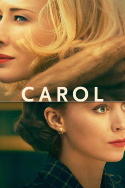
Review of Carol (2015) by Glenn G — 25 Nov 2015
FAR FROM HEAVIN' - My Review of CAROL (4 Stars).
Somewhat of a sister project to his 2002 film, FAR FROM HEAVEN, Todd Haynes' CAROL, written by Phyllis Nagy, looks at repression in the 1950's through a decidedly queer lens. It's a quiet, deliberately stilted look at the developing love between Carol, a New York suburban divorcee (Cate Blanchett) and Therese (Rooney Mara), a young department store clerk. Still in the throws of a divorce and custody battle with her husband Harge (Kyle Chandler), which has got to be the WASP-iest character name I've heard in ages, Carol meets Therese while Christmas shopping.
The film opens, however, later on in the story, when Carol and Therese sit in a fancy restaurant and are interrupted by one of Therese's friends. The remainder of the film flashes back to their meeting and eventually fills us in on the importance of their dinner scene. It's a strange bookend device due to the fact that it's based on an emotional epiphany rather than a plot point. The great mystery of this film is whether or not these characters will ever be truly able to express themselves.
Haynes is swimming in very familiar waters again, making another twisted variation of a Douglas Sirk melodrama. Mara is icy, interesting, and otherworldly, giving Therese a wide-eyed vacant stare that deftly hides her true feelings. She's like an eerily quiet Zooey Deschanel. It's a tricky, fill-in-the-blanks role, and Mara, resisting the tough bravado at which she typically excels, stretches herself with this minimalist approach. Chandler gives a galvanizing performance as the jilted, typically patriarchal husband who still manages to sympathetically show the hurt of losing his wife. Jake Lacy plays Mara's boyfriend, and like Chandler, he evokes sympathy due to the fact that society expected alpha male behavior from its men, even if the men weren't fully on board. Sarah Paulson plays Blanchett's ex-girlfriend, and in her very few scenes, she paints a vivid picture of a woman not afraid to be her own person, much like the actress herself.
Blanchett, however, has the toughest part, and she's grand and theatrical in a way we haven't seen since the great female stars of the 30s and 40s. The performance factor necessary to conform to 50s society reads loud and clear with every formal gesture and tight smile Blanchett gives. Carol often comes off as a predator in trying to ensnare Therese, lacing her polite conversation with subtle innuendos and not-so-subtle glances. Blanchett and Mara don't so much have chemistry together as they do an odd performance friction and a cohesive dedication to the subject matter. Neither character has the tools for self-expression, and at a time where one could go to jail on morals charges, it's easy to understand why their love story is so clandestine. When Therese requests Carol's address and subsequently mails gloves she left behind, it feels like a suspenseful, sexually charged endeavor. It's a risk that still could lead to jail time, torture and even execution in many parts of the world today.
It takes most of the film's running time for these women to even so much as kiss. They circle each other, speak in code, until they finally, FINALLY feel safe. Late in the film, there's a surprising turn of events that drives home the necessity for gay people to be quiet even behind closed doors. CAROL keeps things pretty chaste and at arm's length throughout. It's long been a signature of Haynes' work to play with these formalities and expose what's hidden just under the surface. If you love that style, you'll love it again in CAROL. If not, it's easy to see how some could find this to be a lifeless bore. Quite the opposite, I found the film to be achingly beautiful, sad, and swooningly powerful. The novel was the first of its kind to depict a same sex relationship that didn't end in suicide or some such tragedy. I won't spoil the ending to the film, however, but suffice it to say, Haynes and Nagy seem to delight in bringing all of the subtext usually buried in romantic storylines, and gradually laying it out on the table. This film remains true to its time and is a reminder of how far we've come as an American society, yet how far we need to go as a world community still.
Adding greatly to the mood of the film is Edward Lachman's gorgeously windswept, snowy cinematography and Carter Burwell's swirling, quiet yet memorable score. It's highly reminiscent of Philip Glass' work, yet Burwell maintains his own distinct voice. Sandy Powell's costume design adds to the beautiful color palette of this film, giving both Blanchett and Mara vivid, memorable looks. Mara's hat alone feels just right for her curious, observant character. It tells us she's an artist trapped in the social mores of her time. Like its source material, Patricia Highsmith's novel, THE PRICE OF SALT, CAROL is a romance that feels like a mystery thriller. If you don't mind its formal style, stilted chastity and the feeling that Todd Haynes has already made this film before, you're likely to fall for the lushness of the furs, the restaurant smoking, the poached eggs and creamed spinach dishes and the "love that dare not speak its name" nature of this little gem.
This review of Carol (2015) was written by Glenn G on 25 Nov 2015.
Carol has generally received very positive reviews.
Was this review helpful?