Review of Carnage (2011) by Spangle — 12 Jan 2017
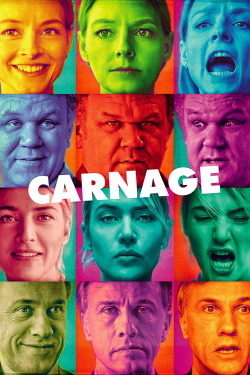
Adapted from a play, Carnage is set in a single room and is a dramatic and uproariously comical black comedy-drama from director Roman Polanski. Bringing together two couples who have to discuss an incident between their respective sons, the civilized encounter quickly turns nasty and shows the carnage of the situation between their sons. Opening wounds regarding their marriages, lives, and characters, the encounter soon descends into chaos with in-fighting and larger revelations about the world around us with the carnage extending far beyond expectations. Set in just the living room of one of the couple's homes with some scenes in the bathroom and hallway, the film is easily identified as a play, but is one hell of a play translated to film. One of the greatest accomplishments of the film, however, is how it characterizes each person. While the acting is exemplary, the characters are feasts for the eyes and have a lot of meat on their bones. This is largely examined when each is put on the hot seat and attacked by the other three people in the room, with the person on the hot seat constantly changing. What is crucial, however, is how fake each person is, which becomes apparent quite quickly.
The person who wants the meeting the most is undeniably Penelope Longstreet (Jodie Foster). Married to Michael (John C. Reilly), her self-righteous, savior of the world persona becomes readily apparent in her interactions with Alan Cowan (Christoph Waltz). Constantly dramatizing his words and editorializing them, the attack on her child by the Cowan's boy is clearly seen as a personal affront because she sees the world in a particular way. As she describes, she is a believer in a civilized world with a set rule of law where violence has no place. Everybody else, however, has there point of difference on this stance and Penelope's superiority complex is constantly derided. Foster does a great job capturing both the defensiveness and perplexed nature of the character. Clearly an educated white liberal (I am independent, so this is not an attack on politics), Penelope seems to have operated in an echo chamber all her life with a husband who just gives up rather than fight her. As such, she is shocked to see anybody dare to trivialize the turmoil in Africa - which she has never seen first hand - in favor of issues that impact their immediate lives instead. She is prim, proper, and to the point, unafraid to express her opinion. The way in which the character is written feels incredibly authentic. The script by Yasmina Reza and Polanski really highlight what is important to this character when Nancy Cowan (Kate Winslet) pukes on her coffee table. Though she later apologized, Penelope freaks out that Nancy puked on her one-of-a-kind art magazine or something. Valuing culture above all else - family included - Penelope pretends to be conscientious of the world around her, but is just as materialistic and vapid as the rest of us.
As for her husband Michael, he is a shockingly cruel man. Killing his daughter's pet hamster Nibbles because he does not like rodents, Michael casually criticizes those who have kids and describes newlyweds as "poor **** who will wake up to the truth soon enough. Clearly unhappy in his marriage, nihilistic, and cynical about the world around him, Michael is a man whose values may be less clear than the others. Buying tulips to keep up appearances in front of the Cowans even though he does not want to meet with them, he is a guy who values money and displays of wealth. The tulips are a small part of this, but his emphasis on illegal acquired and expensive cigars, the 18-year old malt liquor, and his belief that kids are a drain on the lives of the parents, it is clear he values material wealth. While his wife is more concerned with what the money buys and the culture she lives in, Michael just likes to buy items that show off how much money he has acquired in his life.
On the other side of the table are the Cowans. Alan, a successful lawyer in the midst of a legal issue with a pharmaceutical company's unsuccessful drug, is clearly distracted. Constantly on the phone, he is like Michael in that he does not want to be there. He does not value his children and could care less about his son. As the ending shows, his son apologized on his own to the child he hurt. Yet, he casually casts him aside a maniac incapable of emotion and sympathy. He, according to his wife Nancy, delegates all matters of the kids and the home to his wife as that is his role. In this way, he is incredibly paternalistic. The man works and the woman raises the kids. He cannot process other methods of doing things, hence his need to constantly work in order to feel busy and accomplished. Since he barely has the wife and the kids are long gone from him, Alan focuses in on the only element he is good at: providing. As such, he is constantly on the phone and is obsessed with the thing.
This review of Carnage (2011) was written by Spangle on 12 Jan 2017.
Carnage has generally received positive reviews.
Was this review helpful?