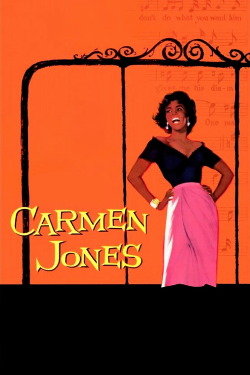
Review of Carmen Jones (1954) by Rodolfo R — 25 Sep 2004
In 1927 Oscar Hammerstein II wrote the Broadway musical [i]Show Boat[/i] with Jerome Kern. At this point, you should be thankful I'm not starting with the history of the opera [i]Carmen[/i]. [i]Show Boat[/i], as you may or may not know, revolutionized the world of musical theater and the world has been a more glorious place ever since. Sixteen years later, Oscar* did it again, this time with Richard Rodgers and Agnes de Mille in [i]Oklamoma![/i] Now, [i]Show Boat[/i] was a hit. [i]Oklahoma![/i] was a smash. The kind of smash that allows one to take chances.
Oscar could have started an unsuccessful cabaret career like Stephen Schwartz did after [i]Godspell, Pippin[/i] and [i]The Magic Show[/i]. He could have written highly questionable sequels to his earlier successes like Charles Strouse did with [i]Bring Back Birdie[/i] and [i]Annie 2: Miss Hannigan's Revenge[/i] [u]and[/u] [i]Annie Warbucks[/i]. He could even continue to write musicals of diminishing quality and financial success like, ummm...what was his name again?
Instead, Oscar took a risk. With the enormous success of [i]Oklahoma![/i] behind him, Oscar was able to get Billy Rose to produce his version of Bizet's 1875 opera C[i]armen.[/i] Oscar rewrote the lyrics and libretto and reset the story in the American South during WWII, with a cast made up entirely of African Americans. Unlike a great many operas (and to be fair, I don't know a lot of them) that rely on recititive for story exposition and comedy, [i]Carmen[/i] was originally written with scenes of dialogue between the arias, duets and choruses. (The recititive heard in the score was added after Bizet's death.) Therefore, [i]Carmen[/i] was structured like the musical dramas Hammerstein had become so good at writing. And what better way for a lyricist/librettist to work than with a dead collaborator?
The risk payed off (artistically and financially) and the result of his efforts worked beautifully. [i]Carmen Jones[/i] opened on December 2, 1943 (my Dad's first birthday), ran for 502 performances and left behind a terrific cast album with Muriel Smith in the title role. [i]Carmen Jones[/i] to this day has been my only exposure to [i]Carmen[/i] - what can I say? opera's expensive - and I find it utterly satisfying as a musical drama, albeit one with and operatic score. Oscar's contributions as a lyricist are particularly affecting, especially in "Dat's Love," "Beat Out Dat Ryhthm on a Drum," and "Stand Up and Fight.".
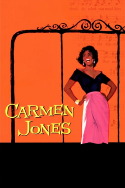
Like most successful Broadway shows at the time, [i]Carmen [/i]Jones found its way to Hollywood. In 1954, somewhat toward the end of the movie muscial's heyday, Otto Preminger produced and directed [i]Carmen Jones[/i], the film. Today, the movie is primarily remembered for its star turn from Dorothy Dandridge, who became the first African-American to be nominated in the Best Actress category. Of course, that little tidbit tells you nothing about the quality of the film itself, and that's why you have Rodolfo.
Dandridge stars as Carmen, offering a performance of pure fire and music. True, her singing was dubbed (beautifully) by Marilyn Horne, but Dandridge is the one on screen and without her glamour and sheer sex appeal, the whole picture would fall flt. Harry Belafonte (dubbed by LeVerne Hutcherson) plays Joe, the man Carmen makes a play for and ultimately destroys. He's good and I enjoyed his performance, but I never really saw what drew Carmen to him so lustily. Grand support was provided by Joe Adams (dubbed by Marvin Hayes) as the boxer who won't let Carmen go, Olga James (dubbed by Olga James) as the virgin engaged to Joe and Broadway Babies Pearl Bailey and Diahann Carroll, who did their own singing, thank you very much. What's with all the dubbing? That's just how they did things back then. Especially when they wanted popular actors in an operatic film.
I'm becoming quite a fan of Preminger's work. I still haven't [i]Laura[/i], but [i]Bunny Lake Is Missing[/i] absolutely floored me, as did [i]Anatomy of a Murder[/i] and I quite enjoyed [i]Angel Face[/i]. At first I thought it a little odd that he would attempt a musical - and a non-tradition one at that - but at its heart, [i]Carmen Jones[/i] is a tragedy. And that's how he directed the film. The songs don't seem ridiculous because he treats the story as grand tragedy - the fact that the chacters break out into arias makes sense when you're telling a story of human emotions on such a grand scale. The only real disappointment in the film is that it ended very suddenly. One quick final aria and we're out. Not that I wanted a finale of [i]Carmen's[/i] hit songs a la Jerry Herman, but I thought he could have milked it more.
Well, it's taken me a week, but I finally finshed it. God damn, that's a long review.
Fun Fact: 1954 also brought about the Broadway musical H[i]ouse of Flowers,[/i] starring Pearl Bailey and Diahann Carroll. The show didn't last, but it left behind a stunning cast recording.
*His work has become so ingrained into the very fabric of my existense that I call him Oscar. He doesn't seem to mind. Neither do Steve, Arthur, Lenny, Betty & Adolph, Yip or Mr. Abbott.
This review of Carmen Jones (1954) was written by Rodolfo R on 25 Sep 2004.
Carmen Jones has generally received positive reviews.
Was this review helpful?