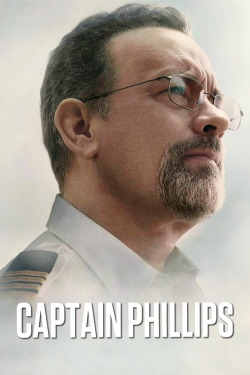
Review of Captain Phillips (2013) by Shiira — 02 Jun 2014
Not for nothing are Americans accused of being "isolationists", men and women who willfully choose to live out of context with a world they deem insignificant and beside the point. Even in this post-9/11 era, stubbornly, Americans still believe they can live in a bubble, despite the pop heard around the world.
Captain Phillips, however, serves as a sort of reorientation to the lessons we learned, albeit briefly, and then forgot, in regard to our blow-by-blow synchronous apposition with other nations as always having been a persistent reality, independent of public cognizance or lack thereof.
Days after Islamic fundamentalists irrevocably transformed the Manhattan landscape, we asked ourselves aloud, "Why do they hate us?" The short answer: colonialism. And our collective forgetting.
A film such as The Life Aquatic with Steve Zissou makes no apologies, or even, mention, about our bloody past. In the 2003 Wes Anderson film, the pirates who attack the Belafonte are Filipino, marauders with a century-old grievance, but because the narrative is ideologically naive, the specificity of their ethnicity is treated as a post-colonial joke.
The fact that the American occupation set the Philippine Islands on a path towards catastrophic poverty, in which over 200,000 natives died(mostly from cholera) is not important. Nobody mourns the murdered southeastern pirate that Zissou guns down.
The captain's revenge against the jaguar shark takes precedence over the more justifiable revenge. Interestingly enough, genre differences aside, the Danish import, A Hijacking, like the Anderson film, also sees the pirates purely as villains.
We either laugh at them, or hate them, but we never understand these Third World ruffians.That's not fair. That's not telling the whole story. Captain Phillips, on the other hand, to its credit, shows both sides.
At the outset, the filmmaker juxtaposes Muse's struggle for survival in arid Somalia with the captain's whiny middle-class Boston angst. The pirates, for some, become less villains than anti-heroes. According to Muse, the hijacking is just business, differentiating his organization's agenda from Al-Qaeda, when he first threatens Phillips at gunpoint.
Muslim or no Muslim, it makes no difference. He doesn't understand that many Americans, even a decent man such as Richard Phillips, see dark-skinned foreigners as one monolithic race, especially to the navy that kills them all.
Muse is simply the "other", not Somalian. Because thirteen years after the World Trade Center came crumbling down, reduced to rubble by Taliban anti-pilots, many people still live in a vacuum, still possess a blind faith towards our government, who propagandizes the very nature of its tyrannical foreign policy with doublespeak sugarcoating, using catchwords such as "liberation" and "freedom".
Very subtly, the filmmaker evokes the history of Africa's colonization, in which Captain Phillips, presides over a map of the "dark continent"; his hands draped over the shipping route, connoting a sense of entitlement, as the co-captain plots their course from Salalah to the Somali Basin.
Unilateral to the main narrative, through its subtext, the film concedes that Muse's people, as well as the whole world, have a case to express their anger with militant force against the United States.
Ironically, like the Filipino restaurant workers gathered around the kitchen television, learning about the international currency that Zissou stores away on-board his ship, the Somalian pirates too are only thinking about the money, not the historical circumstances that landed them in the third world ghetto.
But in the lifeboat, Muse's cohort, Bilal, despite his limited grasp of the English language, senses the captain's arrogance, as America's colonial past rolls off Phillips' tongue, when he tells Muse how Somalian waters are "international waters", which is analogous to saying that Liberia, albeit populated with Liberians, once belonged to the United States, who colonized the West African country in the 19th century.
Phillips is silent, indifferent to the pirate's remonstrative explanation that "the big ships" leave nothing left for them to fish. Whereas the filmmaker understands that the pirate attack on a cargo vessel like the Maersk serves as a last resort to stave off poverty, the captain, as well as the audience, disregards the underlying causes of the conflict at hand.
"You're not a fisherman," hisses Phillips, when Muse points a gun at his temple. He, alas, forgets that his country plays a hand in hurting the local economy. Once again, the U.S. plays the innocent victim.
As if 9/11 never happened, the captain, with appalling ignorance, ask Muse, "There's got to be something other than being a fisherman and kidnapping people?" Maybe, in the final scene, the captain recognizes that the collateral blood on him isn't merely literal.
After all, there are no heroes in Captain Phillips.
This review of Captain Phillips (2013) was written by Shiira on 02 Jun 2014.
Captain Phillips has generally received very positive reviews.
Was this review helpful?