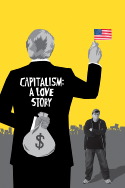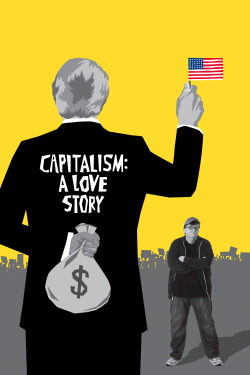
Review of Capitalism: A Love Story (2009) by Jesse W — 10 Aug 2010
Is it a balanced representation of the United States? economic system? No. Does it make a few good points throughout its two hour runtime? Yes. Will it make you change your mind about anything important? Maybe, but probably not. In a sense, Capitalism: A Love Story is the culmination of every documentary Michael Moore has directed thus far. Whether he?s talking about healthcare, terrorism, or gun control most of our country?s problems eventually end up getting pinned on the greed of corporate America and the too-close-for-comfort relationship it shares with Washington. It only makes sense that Moore would make a film that forgoes picking a topical social issue and flat out attacks corporations themselves. Unfortunately, Capitalism ends up feeling more like a retread than it does a magnum opus.
That isn?t to say the documentary as a whole is bad. Moore does a fantastic job of finding stories that show capitalism?s bad side and tells them in a way that is both focused and heart wrenching. Like many of his previous efforts, a good chunk of this film is a pastiche of masterfully documented underdog tales that are terrifying and uplifting at the same time. This aspect is what makes the film worth watching, and I have a feeling that it?s what fills the seats for Moore?s films time and time again.
Where the documentary begins to run into problems is in its overall message. While the film does an adept job of skewering capitalism, it spends shockingly little time proposing an alternative. Other than a bit about how fiscal conservatives are afraid of communism, and a few polls that demonstrate favorability toward socialism in the US is rising, hardly a single moment is spent discussing the logical alternative to the economic system that bleeding heart liberals love to hate. The reason Sicko resonated so well with critics and audiences was because it took the time to present successful healthcare systems in other countries, so the audience never felt like a solution was out of reach. In Capitalism the volley of complaints is never balanced by any proactive discussion about a solution.
The issues with Capitalism, however, run much deeper than an overall negative tone. Like most political discourse in the mass media seems to be these days Capitalism: A Love Story is not only apathetic but downright belligerent toward those with dissenting opinions. The entire film is peppered with cruel jokes about conservatives that never rise above the level of rejected Daily Show bits. The most egregious instance involves a dubbed over scene from Jesus of Nazareth where Christ?s dialogue is replaced with caricatured conservative talking points. Even the film?s facetious title has a snarky ring to it that would deter anyone from the opposite side of the fence from giving it a fair shot. I got a chuckle from a few of the jokes, but by inserting them Moore seems to be shooting himself in the foot and alienating the audience who he needs his arguments to reach the most.
Film can be a powerful medium to enact social change, and Moore is incredibly fortunate that his documentaries receive widespread theatrical release. While Capitalism does a decent job of motivating like-minded movie goers to political involvement, I can?t help but mourn how much potential it wastes by presenting a single polarized viewpoint rather than a well constructed argument for reform.
This review of Capitalism: A Love Story (2009) was written by Jesse W on 10 Aug 2010.
Capitalism: A Love Story has generally received positive reviews.
Was this review helpful?